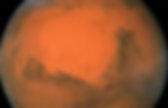
Atmosphere of Mars. The Martian atmosphere consists of approximately 96% carbon dioxide, 1.9% argon, 1.9% nitrogen, and traces of free oxygen, carbon monoxide, water and methane, among other gases,[1] for a mean molar mass of 43.34 g/mol.[5][6] The atmosphere is quite dusty, giving the Martian sky a light brown or orange-red color when seen from the surface; data from the Mars Exploration Rovers indicate that suspended dust particles within the atmosphere are roughly 1.5 micrometres across.[7] On 18 March 2015, NASA reported the detection of an aurora that is not fully understood and an unexplained dust cloud in the atmosphere of Mars.[11] Structure[edit] Mars's atmosphere is composed of the following layers: Lower atmosphere: A warm region affected by heat from airborne dust and from the ground.Middle atmosphere: The region in which Mars's jetstream flowsUpper atmosphere, or thermosphere: A region with very high temperatures, caused by heating from the Sun.

Observations and measurement from Earth[edit] Atmosphere of Mars; structure. Atmosphere of Mars; measurement and observation from Earth.
Atmosphere of Mars; potential for use by Humans. History of Mars; history. Here's why everybody is freaking out about methane on Mars. Climate of Mars. The climate of Mars has been an issue of scientific curiosity for centuries, not least because Mars is the only terrestrial planet whose surface can be directly observed in detail from the Earth with help from a telescope.

Mars has been studied by Earth-based instruments since as early as the 17th century but it is only since the exploration of Mars began in the mid-1960s that close-range observation has been possible. Flyby and orbital spacecraft have provided data from above, while direct measurements of atmospheric conditions have been provided by a number of landers and rovers. Advanced Earth orbital instruments today continue to provide some useful "big picture" observations of relatively large weather phenomena. The first Martian flyby mission was Mariner 4 which arrived in 1965. That quick two day pass (July 14–15, 1965) was limited and crude in terms of its contribution to the state of knowledge of Martian climate.
Historical climate observations[edit] Weather[edit] Clouds[edit]