
Niceness is in Your DNA, Scientists Find. Many times, two siblings raised by the same parents, and subject to similar environmental influences, can turn out to be polar opposites: one kind and generous, the other mean-spirited.

A new study reveals that the latter might simply have been dealt the wrong hormone receptor genes. Oxytocin and vasopressin, two hormones that inspire feelings of love and generosity when they flood our brains, bind to neurons by attaching to molecules called receptors, which can come in different forms. The new research, led by psychologist Michel Poulin of the University of Buffalo, suggests that if you have the genes that give you certain versions of those hormone receptors, you're more likely to be a nice person than if you have the genes for one of the other versions. However, the researchers found that the genes work in concert with a person's upbringing and life experiences to determine how sociable — or anti-social — he or she becomes.
"We aren't saying we've found the niceness gene," he said. Explaining Déjà Vu. Cancer and Egyptian mummies: are tumours a 'man-made' illness? Do ancient Egyptian mummies show that cancer is a modern disease?

Einstein's theory of relativity works on a human scale: the higher you are, the faster you age. If one of the clocks was moved just a foot higher, then it ran a little bit faster – albeit by a tiny fraction of a second.

So, taking just a couple of steps upwards will remove 90 billionths of a second to a 79-year lifetime. By moving about 10 feet to the top of the stairs, you would age quicker by 900 billionths of a second. And if you were to spend your life at the top of the 102-storey Empire State Building (1250 feet) you would lose 104 millionths of a second, said one of the researchers, James Chin-Wen Chou. The experiments used "quantum logic" atomic clocks which can keep time to within one second over 3.7 billion years. They prove the theory that clocks at higher elevations run faster because they are subject to less gravitational force. A NIST spokesman admitted the phenomenon, called "gravitational time dilation", would not impact on people's lives.
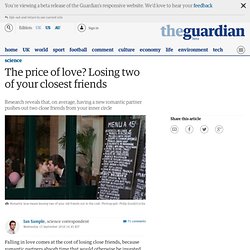
The team's calculations will be used to improve technology used to measure the Earth and the gravitational field. UK News, World News and Opinion. The price of love? Losing two of your closest friends. Falling in love comes at the cost of losing close friends, because romantic partners absorb time that would otherwise be invested in platonic relationships, researchers say.
Why Overheard Cell Phone Conversations Annoy. A new study reveals a twist that helps explain why nearby cell phone conversations can be so annoying.

Overhearing half of a verbal exchange, it turns out, is much more distracting than having to listen to a full conversation going on in the background. Researchers found that in a simple attention game, study participants did three times worse when hearing a cell phone conversation – a "halfalogue" – compared to a face-to-face dialogue, a monologue or silence. When researchers muddled the cell phone conversations' words, however, this performance gap in the attention task and in a reaction time test vanished. The results suggest that it is the unpredictable informational content – the randomness of what is being said, essentially – in a half-heard exchange that makes cell phone banter exquisitely irritating.
Study: Body shape affects memory in older women. By the CNN Wire Staff July 15, 2010 7:16 a.m.

EDT Memory loss in later life is more pronounced in women who carry excess weight around their hips, a study says. It's better to be an apple than a pear, study saysExtra weight affects memory in everyone, but where fat is located is importantStudy includes more than 8,000 women ages 65 to 79 (CNN) -- A woman's body shape may play a role in how good her memory is, according to a new study. The more an older woman weighs, the worse her memory, according to research released this week from Northwestern Medicine at Northwestern University in Evanston, Illinois. The effect is more pronounced in women who carry excess weight around their hips, known as pear shapes, than women who carry it around their waists, called apple shapes.
The reason pear-shaped women experienced more memory and brain function deterioration than apple-shaped women is likely related to the type of fat deposited around the hips versus the waist. It's good to think - but not too much, scientists say. 17 September 2010Last updated at 10:52 By Katie Alcock Science reporter, BBC News People who think more about their decisions have more brain cells in their frontal lobes People who think more about whether they are right have more cells in an area of the brain known as the frontal lobes.

UK scientists, writing in Science, looked at how brain size varied depending on how much people thought about decisions. Do men and women really think alike? Light Diet: Eating Food without Seeing It May Impede Ability to Judge Hunger. As psychologist Benjamin Scheibehenne and his wife left the restaurant where they had just finished dinner, they discussed whether to stop somewhere else for dessert.

It was an everyday decision, one they had made countless times before, but this particular evening they could not make up their minds. "When we came out of the restaurant, we didn't really know whether we were still hungry or not," Scheibehenne recalls. "We realized we were completely clueless about how much we actually consumed. " The couple's appetite for dessert owed its ambivalence to the unusual nature of their dining experience: The Scheibehennes had visited a "dark restaurant," where sight-impaired waiters serve customers their meals in a total blackout—a trend that claims to enhance the sensory experience of eating, and which has gained popularity in Europe and Asia, with some inroads into the U.S.