
The Incredible Human Eye. Dec 23 '07 photography, art The iris, the most visible part of the vertebrate eye, is composed of pigmented bundles of fibrous tissue.
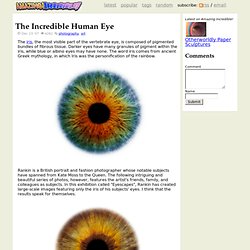
Darker eyes have many granules of pigment within the iris, while blue or albino eyes may have none. What We Eat Affects Everything - James Hamblin. How men and women digest differently, diet changes our skin, and gluten remains mysterious: A forward-thinking gastroenterologist on eating one's way to "gutbliss" Robynne Chutkan, MD, is an integrative gastroenterologist and founder of the Digestive Center for Women, just outside of Washington, D.C.

She trained at Columbia University and is on faculty at Georgetown, but her approach to practicing medicine and understanding disease is more holistic than many specialists with academic backgrounds. She has also appeared on The Dr. Oz Show (of which I’ve been openly skeptical in the past, because of Oz’s tendency to divorce his recommendations from evidence). Chutkan’s first book comes out today. Dr. The title of your book is catchy and uses this evocative term "gutbliss. " I did come up with it. Bioethics. Bioethics established itself in the late 1960s as a field concerned with the ethical and philosophical implications of certain biological and medical procedures, technologies, and treatments.

Early issues included end-of-life decision-making, organ donation, and human experimentation. Human biotechnology became a concern when the first bioethics institutes were established in the early 1970s. This attention skyrocketed in 1990 when the U.S.
Human Brain. Human Healing. Human Ideals. What Does the Average American Man Look Like Compared to Other Countries? — The Feed. Posted by Nickolay Lamm in Lifestyle on 25th September 2013 What if you took the average American man and made him stand next to the average man from other countries?
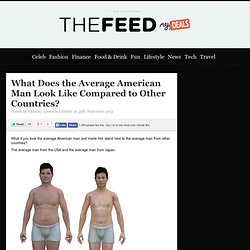
The average man from the USA and the average man from Japan. Japanese women and men live longer and healthier than everyone else thanks to a healthy diet and lifestyle. The average man from the USA and the average man from France. France has a culture that respects food from the farm, and teaches its children to value a well-balanced diet and proper meal times. America Loses Its Stature as Tallest Country. Pundits often opine that America's stature is declining on the global stage.
It turns out that Americans -- literally -- are not standing as tall, compared with the rest of the world, as they used to. U.S. adults lost their position as the tallest people on Earth to the Dutch, who average about two inches taller than the typical American. In fact, American men now rank ninth and women 15th in average height, having fallen short of many other European nations. Women's Body Image and BMI: 100 Years in the US. 1900s-1910s: The Gibson Girl The Gibson Girl, a creation of illustrator Charles Dana Gibson, was a synthesis of prevailing beauty ideals at the turn of the century.

Rarely is a beauty standard so explicit and clearly defined, yet Gibson based the iconic illustrations on “thousands of American girls.” This ideal of femininity was depicted as slender and tall, albeit with a “voluptuous” bust and wide hips. Adult Eating Disorders: Anorexia, Bulimia, Compulsive Eating, and More. Kenji Toma Usually she just had a cup or two of plain pasta.

Your Very Weird, Very Personal Sense of Smell. We’re used to the idea that some among us are colorblind, perceiving the world differently because of a quirk in their genetics.

And it’s well-known that teenagers and young adults can hear high-pitched sounds that their elders cannot, an ability that’s been exploited by manufacturers of The Mosquito, an anti-loitering device that annoys youth into leaving. But perhaps because the effects are harder to compare easily, or perhaps because we have such a hard time talking about them, we tend to overlook some rather peculiar differences in our senses of smell.
When people get a whiff of a molecule called androstenone, they may say it smells like sandalwood, or vanilla—or they might say it has a sickening, urine-like tang. Or they might think it entirely odorless. There are around a dozen known chemicals that provoke this kind of disagreement, scientists think. There’s a large body of research surrounding androstenone.
Humans Theorize. Cosmos, Moby’s Song ‘We Are All Made of Stars’, Universe & Solar System. The theory that everyone and everything on Earth contains minuscule star particles dates back further than Moby's popular 2002 song "We Are All Made of Stars.
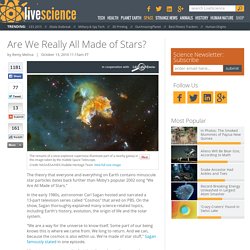
" In the early 1980s, astronomer Carl Sagan hosted and narrated a 13-part television series called "Cosmos" that aired on PBS. On the show, Sagan thoroughly explained many science-related topics, including Earth's history, evolution, the origin of life and the solar system. "We are a way for the universe to know itself. Some part of our being knows this is where we came from. We long to return. His statement sums up the fact that the carbon, nitrogen and oxygen atoms in our bodies, as well as atoms of all other heavy elements, were created in previous generations of stars over 4.5 billion years ago. "All organic matter containing carbon was produced originally in stars," Impey told Life's Little Mysteries. How star stuff got to Earth. Into the Unknown - Short Film. Scientist photographed soul leaving the body in death 1st part. Scientist photographed soul leaving the body in death 2nd part. Scientifically induced Out of body.
Walk This Way: The Amazing Complexity of Getting Around. Walking goes way back.
Could Humans Walk on Water? For centuries, humans have floated the idea that we might, one day, walk on water. In the 15th century, Leonardo da Vinci invented a pair of pontoon-like shoes intended for this purpose, and in 1988, French entertainer Remy Bricka walked across the Atlantic on a pair of floating skis. Perhaps we were inspired by nature more than 1,200 species of animals can walk on water . Odd Gender Differences Found in Walking.
If we see a shadowy figure walking down a dark street, our sense of whether it is coming at us or walking away depends on whether we see it as a he or a she, new research finds. This new result sheds light on the subtle judgments the brain makes when it notices motion. In the past, research has shown that people are extraordinarily good at deducing the gender, age, mood and even personality of others based on just a few of their moves. "Humans are acute observers of each other.