
Monte Albán. The partially excavated civic-ceremonial center of the Monte Albán site is situated atop an artificially-leveled ridge, which with an elevation of about 1,940 m (6,400 ft) above mean sea level rises some 400 m (1,300 ft) from the valley floor, in an easily defensible location.
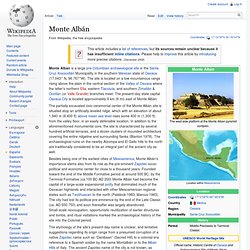
In addition to the aforementioned monumental core, the site is characterized by several hundred artificial terraces, and a dozen clusters of mounded architecture covering the entire ridgeline and surrounding flanks (Blanton 1978). The archaeological ruins on the nearby Atzompa and El Gallo hills to the north are traditionally considered to be an integral part of the ancient city as well.
Besides being one of the earliest cities of Mesoamerica, Monte Albán's importance stems also from its role as the pre-eminent Zapotec socio-political and economic center for close to a thousand years. Research history[edit] Site plan for Monte Albán. Ballgame court Site history[edit] Aerial view of Monte Albán Monuments[edit] Monte Alban Archaeological Ruins Near Oaxaca, Oaxaca, Mexico Travel And Tour Pictures, Photos, Information, Images, & Reviews.
Monte Alban is built at the junction of three broad valleys, across from the Atoyac stream, lays a series of large hills.

The largest of these hills is nearly 400 meters above sea level. It was on the top of this mountain, which the Zapotecs leveled off and built into a great ceremonial city in about the year 500 ad. This center once ruled the entire region and collected tribute from the surrounding cities. The city is now known as Monte Alban. Monte Alban, or "White Mountains" in Spanish, was formerly called Danibaan (Sacred Mountain). Monte Alban was first occupied in about 500 B.C. and it was inhabited until about 850 A.D. when it bacame slowly abandoned.
The entire city of Monte Alban is laid out on a NS and EW Alignment except for Building J which is an arrow shaped structure probably laid out with astronomical alignments. We have written the word ENTER on the site map where most people actually enter the ruins. A word about the restrictions. Monte Alban - Archaeological Zones of Oaxaca, Mexico. Monte Alban was the ancient capital of the Zapotecs and one of the first cities in Mesoamerica.
During it's epoch, it was one of the most populated. It was founded approximately 500 years BC and flourished until 750 AD. Located in the central valley of Oaxaca, Monte Alban exercised political, economic, and ideological control over the other communities and surrounding mountains. Its principal constructions include the Great Plaza, the Ball Court, System II, The Danzantes (Dancers), Building J, Central Building G.H., the Palace, the southern platform, System 7 Deer and Tomb Number 7 of the Great Plaza. The Ball Court is located to the left of the entrance to the Great Plaza, and has the defining characteristics of ball courts in this region. System II is a structure consisting of two bodies with a staircase, flanked by two alfardas, ending in talud with two panels of double escapulario. Los Danzantes, constructed in three sections, belongs to Epoch IIB. Location Additional Information.