
Www.altor-industrie.com/ml/images/content/actus/le_polyester_est_recyclable.pdf. Www.ce-pip.com/docs/Polyester-Recycling-Forum 2006.pdf. La Solution Polyester, spécialiste Polyester armé fibre de verre : Armoires, Coffrets, Cabines, armoire, cabine, coffret, équipement... La co-incinération est une technique qui permet, en produisant du ciment, de traiter des déchets même si l’objectif essentiel du secteur cimentier est bien de produire du ciment.
Dans ce processus, les déchets sont utilisés comme combustibles habituels ou d’appoint et/ou sont soumis au traitement thermique en vue de leur élimination. Ils servent parfois aussi comme matière de remplacement des produits carriers utiles à la fabrication du ciment. La co-incinération est donc considérée comme une opération de valorisation des déchets (au contraire de l’incinération qui reste une opération d’élimination de déchets).
Le procédé de fabrication du ciment consiste à « cuire », à haute température (1450 °C dans la matière, 2000°C dans la flamme), un mélange de calcaire et d’argile, convenablement dosé et broyé sous la forme d’une « farine crue », pour le transformer en « clinker ». New system created for recycling composite boats. Scientists have devised a chemical method for recycling composite parts from discarded recreational boats (Photo: Oxyman) We've all heard about old metal car bodies being melted down for recycling, but what happens to the composite hulls and superstructures of past-their-prime recreational boats?
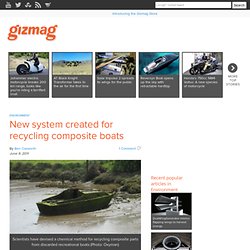
Well, not much. Generally, they just end being sunk, burned, or put in a scrapyard. Sometimes, the composites are ground up and added as filler to virgin material. An alternative may be on the way, however, as researchers have discovered a new method for separating the composite components for future reuse. Many composite boat parts are made from cross-linked polyester and fiberglass, as the combination results in a light yet strong material.
Three years ago, Norwegian recycling company Veolia joined forces with SINTEF Materials and Chemistry, the Norwegian Composite Association, the Reichhold composite company, and Nordboat, in a project aimed at finding a way around that challenge. Recycling old boats. This article was written for Gemini by Åse Dragland.
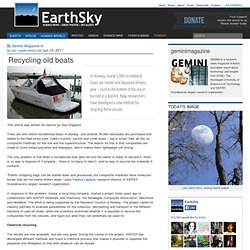
Shipwrecks no more: Recycling old boats. Nearly 5,000 recreational boats are retired and disposed of every year in Norway- either sunk to the bottom of the sea or burned in a bonfire.
Now, researchers have developed a new method for recycling these vessels. There are one million recreational boats in Norway, and another 35,000 new boats are purchased and added to the fleet every year. Cabin cruisers, yachts and small boats -- big or small, they all rely on composite materials for the hull and the superstructure. The reason for this is that composites are made of cross-linked polyester and fibreglass, which makes them lightweight yet strong. The only problem is that when a recreational boat gets old and the owner is ready to discard it, there is no way to dispose of it properly -- there is no place to take it, and no way to recycle the materials it contains.
11/21 > BE Norvège 103 > Un procédé optimisé pour le recyclage des coques de bateaux. EnvironnementUn procédé optimisé pour le recyclage des coques de bateaux Pays largement côtier, la Norvège compte plus d'un million d'embarcations de plaisance.
Chaque année, environ 35.000 (3.5%) sont renouvelées par du neuf, ce qui engendre un volume considérable de rebut. La plupart des coques de bateau sont fabriqués dans des matériaux composites (polyester et fibres de verre) qui réunissent les qualités de solidité et de légèreté, mais qui ne sont pas faciles à recycler. "Les sacs plastiques peuvent être fondus puis transformés, mais ces matériaux composites ont des liaisons moléculaires qui ne se décomposent pas facilement. Veolia Environnement a mis en place ces 3 dernières années un conseil de recherche en partenariat avec SINTEF Materials & Chemistry [2], la Norwegian Composite Association [3] et les sociétés Reichhold et Nordboat. Dans ce domaine, les chercheurs ont obtenu des résultats meilleurs que prévu. Fabrice Lapique - SINTEF. Les vieux bateaux en composite partiront en fumée avec Les Recycleurs bretons.
Les Recycleurs bretons, sont présents au Salon nautique de Paris.
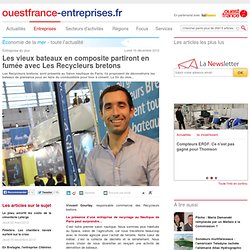
Ils proposent de déconstruire les bateaux de plaisance pour en faire du combustible pour four à ciment. La fin du rêve… Les articles sur le sujet Mercredi 25 septembre 2013 Vincent Gourtay, responsable commercial des Recycleurs bretons. La présence d’une entreprise de recyclage au Nautique de Paris peut surprendre… Www.hisse-et-oh.com/system/assets/000/064/388/original/CT_EcoNav_FinDeVie.pdf?1354959488.
Www.nordic-composite.com/admin/common/getimg.asp?FileID=1131. Les vieux bateaux en composite partiront en fumée avec Les Recycleurs bretons. Les Recycleurs bretons, sont présents au Salon nautique de Paris.
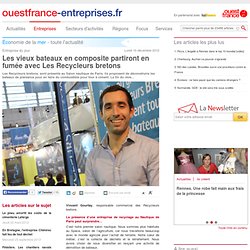
Ils proposent de déconstruire les bateaux de plaisance pour en faire du combustible pour four à ciment. La fin du rêve… Les articles sur le sujet Mercredi 25 septembre 2013. Jit/Articles/wilson020703.pdf. RECYCLAGE_COMPOSITES_CETIM_CERMAT. Ma visite chez SCORI Frontignan. CompoCycle – a new concept in recycling. 12/01 > BE Allemagne 550 > Des éoliennes et après ? EnergieDes éoliennes et après ?
En Allemagne, on parle beaucoup de "repowering" pour l'éolien terrestre. Il s'agit de remplacer plusieurs éoliennes anciennes par un nombre inférieur de nouvelles dans le but d'augmenter les rendements. En Saxe-Anhalt, des modèles des années 90 de type "WW750/52", de 74m de haut, sont actuellement remplacés par des "E-82" de 138m, pouvant produire jusqu'à quatre fois plus de courant électrique que les premières. Cette opération de repowering est soutenue par l'Etat allemand pour les éoliennes de plus de dix ans, ce qui a permis d'ouvrir un marché pour lequel certaines entreprises, comme "Deutschen Wind Technik AG" ou "psm Wind Service", se sont désormais spécialisées.
Il reste qu'en 2020 ces "anciennes éoliennes" représenteront 20.000 tonnes de déchets (matériaux du rotor et des pâles). Breakthrough: Recycling of fibreglass is now a reality. What to do with fibreglass waste?
The industry has been searching for a valid answer to this question for many years. The answer has now been found and will shortly be demonstrated in practice. Fibreglass is widely acknowledged as a material that has major advantages over more conventional rivals, such as wood, steel and aluminium. Ec.europa.eu/enterprise/policies/sustainable-business/files/environment/hlg/doc_06/ah_group_7/jp_degre_1_en.pdf. Ecorev Recyclage - Spécialiste du recyclage des matériaux composites. ECOREV Recyclage vous propose une offre complète qui comprend : la collecte des matériaux composites en fin de vie . le traitement sélectif de ces matières sous forme de broyat grossier (de l’ordre de 15 mm) ou sous forme de poudre (100 à 200 µm). la réintégration de ces nouvelles matières dans des applications sélectionnées avec l’aide de partenaires privilégiés. ECOREV Recyclage accompagne ses clients pour développer des solutions de valorisation des matières composites broyées et trouver de nouveaux débouchés.
Service de broyage sur site ECOREV Recyclage possède une unité mobile de broyage pour limiter les coûts de transport et optimiser la sélection des matières premières. Cet outil permet une valorisation rapide des rebuts de production pour des applications très ciblées, sans mélange des différentes sources. Le broyat grossier La poudre micronisée.
Ecorev Recyclage - Service de broyage sur site.