
Which version of python runs on ibm linux 1. The Hitchhikers Guide to Python! — pythonguide 0.0.1 documentation. Greetings, Earthling!
Welcome to The Hitchhiker’s Guide to Python. This is a living, breathing guide. If you’d like to contribute, fork us on GitHub! Python for dummies by Denis Gavrilov. Ecologie. Programming & web. Hitchhiker's Guide to Python « late.am. I first heard about The Hitchhiker’s Guide to Python at PyCodeConf a few months ago. It’s a fantastic idea: open source, community-driven documentation on how to do Python right: everything from how to learn Python, to how to write idiomatic code, to how to distribute your projects, to surveys of best-of-breed open source projects and libraries you can build projects and applications on top of. Many many thanks to Kenneth Reitz for creating and maintaining the project, which is hosted at GitHub. At this time, the Hitchhiker’s guide is a little rough around the edges: many sections are only outlined, and need content written; other sections may not even exist yet. We can safely consider it a first draft, or, if you prefer, an alpha.
This sort of undertaking is effectively impossible for one person to maintain—one person can’t possibly know of every project, library, and idiom. Python Tutorials, more than 300, updated March 2, 2009 and carefully sorted by topic and category. Boa Constructor home.
Planet Python. Python beginner's mistakes. Every Python programmer had to learn the language at one time, and started out as a beginner.
Beginners make mistakes. This article highlights a few common mistakes, including some I made myself. Beginner's mistakes are not Python's fault, nor the beginner's. They're merely a result of misunderstanding the language. However, there is a difference between misunderstanding (often subtle) language features, vs misunderstanding the language as a whole, and what can (and cannot) be done with it. To put it another way, the mistakes in this article are often cases of "the wrong tool for the job", rather than coding errors or sneaky language traps. Mistake 1: trying to do low-level operations. Dive Into Python. The Mouse Vs. The Python - Nightly (Build 20110507043313) Python Programming Language – Official Website. BeginnersGuide/Programmers. Please Note This is a Wiki page.
Users with edit rights can edit it. Style Guide for Python Code. Code should be written in a way that does not disadvantage other implementations of Python (PyPy, Jython, IronPython, Cython, Psyco, and such).For example, do not rely on CPython's efficient implementation of in-place string concatenation for statements in the form a += b or a = a + b.
This optimization is fragile even in CPython (it only works for some types) and isn't present at all in implementations that don't use refcounting. In performance sensitive parts of the library, the ''.join() form should be used instead. This will ensure that concatenation occurs in linear time across various implementations.Comparisons to singletons like None should always be done with is or is not, never the equality operators.Also, beware of writing if x when you really mean if x is not None -- e.g. when testing whether a variable or argument that defaults to None was set to some other value. The Python Tutorial — Python v2.7.1 documentation. Python is an easy to learn, powerful programming language. It has efficient high-level data structures and a simple but effective approach to object-oriented programming.
Python’s elegant syntax and dynamic typing, together with its interpreted nature, make it an ideal language for scripting and rapid application development in many areas on most platforms. The Python interpreter and the extensive standard library are freely available in source or binary form for all major platforms from the Python web site, and may be freely distributed. The same site also contains distributions of and pointers to many free third party Python modules, programs and tools, and additional documentation. The Python interpreter is easily extended with new functions and data types implemented in C or C++ (or other languages callable from C). This tutorial introduces the reader informally to the basic concepts and features of the Python language and system. The Glossary is also worth going through. Overview — Python v2.7.1 documentation.
Documentation Index. Notice: While Javascript is not essential for this website, your interaction with the content will be limited.
Please turn Javascript on for the full experience. Beginner Moderate Advanced General. The Python Standard Library — Python v2.7.1 documentation. While The Python Language Reference describes the exact syntax and semantics of the Python language, this library reference manual describes the standard library that is distributed with Python.
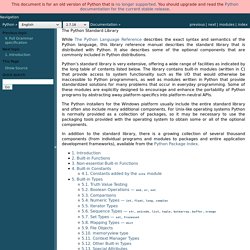
It also describes some of the optional components that are commonly included in Python distributions. Python’s standard library is very extensive, offering a wide range of facilities as indicated by the long table of contents listed below. The library contains built-in modules (written in C) that provide access to system functionality such as file I/O that would otherwise be inaccessible to Python programmers, as well as modules written in Python that provide standardized solutions for many problems that occur in everyday programming. Some of these modules are explicitly designed to encourage and enhance the portability of Python programs by abstracting away platform-specifics into platform-neutral APIs.
Package Index : PyPI. Planet Python. BeginnersGuide. Open Book Project. By Peter Wentworth, Jeffrey Elkner, Allen B.
Downey, and Chris Meyers 3rd Edition (last updated 10/6/12)2nd Edition (last updated 4/21/12) What's the difference among these versions? Which one should I use? In brief, the 2nd Edition uses Python 2, and will be gradually abandoned. Our longer term goal is to faciliate your ability to derive your own custom version to best meet your local needs.
The Python Challenge. Python. Unofficial tutorials. Python Course: Modular Programming and Modules. Modular Programming If you want to develop programs which are readable, reliable and maintainable without too much effort, you have use some kind of modular software design.
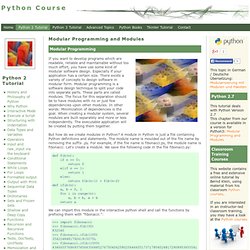
Especially if your application has a certain size. There exists a variety of concepts to design software in modular form. Modular programming is a software design technique to split your code into separate parts. These parts are called modules. But how do we create modules in Python? Def fib(n): if n == 0: return 0 elif n == 1: return 1 else: return fib(n-1) + fib(n-2) def ifib(n): a, b = 0, 1 for i in range(n): a, b = b, a + b return a We can import this module in the interactive python shell and call the functions by prefixing them with "fibonacci A local name can be assigned to a module function to get shorter names: >>> fib = fibonacci.ifib >>> fib(10) 55 >>> More on Modules Usually, modules contain functions, but there can be statements in them as well. Importing Names from a Module Directly. Popular Python recipes.
Python.