
The Perks of Being a Wallflower. The Perks of Being a Wallflower is a coming-of-age epistolary novel by American writer Stephen Chbosky which was first published on February 1, 1999 by Pocket Books.
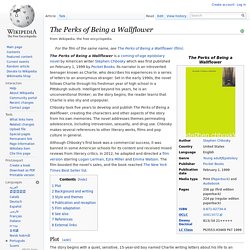
Its narrator is an introverted teenager known as Charlie, who describes his experiences in a series of letters to an anonymous stranger. Set in the early 1990s, the novel follows Charlie through his freshman year of high school in a Pittsburgh suburb. Intelligent beyond his years, he is an unconventional thinker; as the story begins, the reader learns that Charlie is also shy and unpopular. The Perks of Being a Wallflower (2012. Natural Born Killers.
Natural Born Killers is a 1994 American crime-action film directed by Oliver Stone about two victims of traumatic childhoods who became lovers and mass murderers, and are irresponsibly glorified by the mass media.

It stars Woody Harrelson and Juliette Lewis, along with Rodney Dangerfield, Robert Downey, Jr., Tom Sizemore, and Tommy Lee Jones. The film is based on a screenplay by Quentin Tarantino that was heavily revised by Stone with writer Dave Veloz and associate producer Richard Rutowski. Notorious for its violent content, the film was named the eighth most controversial film of all time by Entertainment Weekly in 2006.[2] Natural Born Killers was promoted with such taglines as: "A bold new film that takes a look at a country seduced by fame, obsessed by crime and consumed by the media" and "In the media circus of life, they were the main attraction.
" It was released theatrically in the United States on August 26, 1994. Plot[edit] Introduction Part I Part II Part III Cast[edit] Natural Born Killers (1994. If.... If.... won the Palme d'Or at the 1969 Cannes Film Festival.[3] In 2004, the magazine Total Film named it the sixteenth greatest British film of all time.
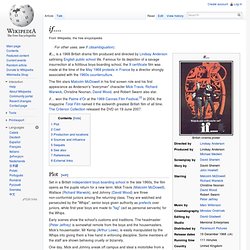
The Criterion Collection released the DVD on 19 June 2007. Plot[edit] If.... (1968. The legacy of Lindsay Anderson's If... The other day I was leafing through 1001 Movies You Must See Before You Die (an embarrassing title but an excellent loo book) and almost had apoplexy when I read that Lindsay Anderson's If... was one of the featured films. When I was at Charterhouse (1968-72), this violent and satirical portrait of rebellion in a British boarding school was regarded as the devil's work by the beaks; more crucially, we boys thought it was pretty infantile anti-establishment propaganda, too.
Which just goes to show that those who have been brainwashed don't always realise it. I decided to give the picture a second chance, 40 years on, and bought the DVD. If... now strikes me as one of the most powerful and daringly inventive British films I have seen. At Charterhouse we used to huff and puff about how unlikely it all was. The other scene we thought absurd was when the prefects administered savage beatings on the rebels. I wonder what this sanctimonious creep did later in life. We Need to Talk About Kevin. Plot[edit] Eva's narration takes the form of letters written after the massacre to her presumably estranged husband, Franklin Plaskett.
In these letters, she details her relationship with her husband well before and leading up to their son's conception, followed by the events of Kevin's life up to the school massacre, and her thoughts concerning their relationship. She also admits to a number of events that she tried to keep secret, such as when she lashed out and broke Kevin's arm in a sudden fit of rage. The novel also shows Eva visiting Kevin in prison. These scenes portray their cold, adversarial relationship. Kevin's behavior throughout the book closely resembles that of a sociopath, although reference to this condition is sparse and left mostly up to the reader's imagination.
As Kevin's behavior worsens, Franklin becomes more defensive of him, convinced that his son is a healthy, normal boy and that there is a reasonable explanation for everything he does. Major themes[edit] It’s perfectly true, We Need to Talk About Kevin is “not an issue-based movie” By David Walsh 21 March 2012. We Need to Talk About Kevin (2011. 'Columbine,' 'We Need to Talk About Kevin," Jared Lee Loughner's Competency Report, and the Value of Studying Mass Killers.
By Alyssa Rosenberg "‘Columbine,’ ‘We Need to Talk About Kevin,” Jared Lee Loughner’s Competency Report, and the Value of Studying Mass Killers" After the shooting at a midnight screening of The Dark Knight Rises in Aurora, Colorado in July, I finally started reading Dave Cullen’s Columbine, which I finished just as word broke that a white supremacist had killed six people and wounded three at a Sikh temple in Wisconsin before committing suicide.
Elephant (2003 film) Elephant was generally acclaimed by critics and received the Palme d'Or at the 2003 Cannes Film Festival,[1] in which Patrice Chéreau was the head of the jury. As the first high-profile movie to depict a high school shooting since Columbine, the film was controversial for its subject matter and possible influence on teenage copy-cats. After arriving at school, Alex and Eric encounter John outside and tell him to leave, as some "heavy shit's about to go down". Realizing what is about to happen, John attempts to warn others not to enter the school, to little effect. The two gunmen then enter the school, and after their plans to blow up parts of the school with propane bombs fail, begin shooting indiscriminately. Elias (Elias McConnell) photographs them entering the library where they open fire, shooting several students, including Michelle and presumably Elias. Realizing that the gunfire is real, students now begin to panic, while teachers attempt to quickly evacuate everyone.
Elephant (2003.