
The language of illness - MIWatch. 12.08.2010 - Our brains are wired so we can better hear ourselves speak, new study shows. Like the mute button on the TV remote control, our brains filter out unwanted noise so we can focus on what we’re listening to.
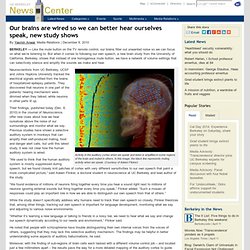
But when it comes to following our own speech, a new brain study from the University of California, Berkeley, shows that instead of one homogenous mute button, we have a network of volume settings that can selectively silence and amplify the sounds we make and hear. Activity in the auditory cortex when we speak and listen is amplified in some regions of the brain and muted in others. In this image, the black line represents muting activity when we speak. Psychology studies relevant to everyday life from PsyBlog. Brain and Physiological Psychology. Body Language. Psychological ("personality") Types. Psychological ("personality") Types According to Jung's theory of Psychological Types we are all different in fundamental ways.

One's ability to process different information is limited by their particular type. These types are sixteen. People can be either Extroverts or Introverts, depending on the direction of their activity ; Thinking, Feeling, Sensing, Intuitive, according to their own information pathways; Judging or Perceiving, depending on the method in which they process received information. Extroverts vs. Extroverts are directed towards the objective world whereas Introverts are directed towards the subjective world. Sensing vs. Defense Mechanisms. Good sleep, good learning, good life. Foreword It is everyone's dream to wake up fresh, happy, and ready for action on a daily basis.

Sadly, in the modern world, only a small minority lives that dream. Yet the dream is within reach for most healthy people given: a bit of knowledge, and a readiness to make some lifestyle sacrifice. Behavioral Medicine Research & Training Foundation. Contents Program Overview and Objectives page 1 List of Courses page 4 Course Descriptions page 5 Basic Clinical Skills Courses page 14 Program Costs page 14 Individual Course Costs page 15 Entrance Criteria page 15 Transfer Credits page 15 Faculty page 16 Library and Internet Utilization page 16 Dissertation Requirements page 17 Comprehensive Exam page 18 U Natural Medicine Description page 19 Contact for Further Information page 19 Sample Syllabus page 19 Grading page 21 Brief Faculty Vitas page 21 Program Credibility page 25 Program Overview and Objectives.
Alternate Sleep Cycles. Most people only think that there is one way to sleep: Go to sleep at night for 6-8 hours, wake up in the morning, stay awake for 16-18 hours and then repeat.
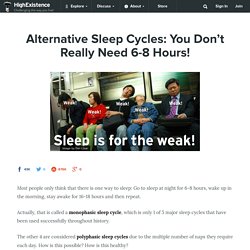
Actually, that is called a monophasic sleep cycle, which is only 1 of 5 major sleep cycles that have been used successfully throughout history. The other 4 are considered polyphasic sleep cycles due to the multiple number of naps they require each day. How is this possible? TheBrain.com - Welcome to TheBrain. 20 Ways To Simplify Your Life in 15 Minutes. “In character, in manner, in style, in all things, the supreme excellence is simplicity.”
~Henry Wadsworth We spend too much, own too much, and want too much — it’s the human condition — and as long as we aren’t aware of it we’ll be a slave to the cycle. Being the ingenious little critters that we are, we’re able to learn, and adapt pretty well. In other words, all hope is not lost, we still have a chance. Serotonin-and-dopamine.gif (Imagem GIF, 620x368 pixéis) Why don’t women just leave abusers?
Psychology Research Database - GenerallyThinking Psychology Research Database. APA DSM-5. Polyphasic Sleep: Facts and Myths. Contents The law of accelerating returns.
How to Sleep More Effectively, Starting Tonight at Personal Development with Ririan Project. “There is a time for many words, and there is also a time for sleep.” - Homer Tired after getting a full nine hours and still feeling exhausted?
The Art of Insight and Action. One Night Of Sleep Not Enough To Make Up Deficit. One Night Of Sleep Not Enough To Make Up Deficit 10 hours of sleep isn't enough to recharge your brain after 5 days of sleep deficit.
DARIEN, Ill. – A study in the Aug. 1 issue of the journal Sleep suggests that a dose of extra sleep on the weekend may be good medicine for adults who repeatedly stay up too late or wake up too early during the workweek. However, even a night of 10 hours in bed may not be enough to cure the negative effects of chronic sleep restriction. How to nap. Top 10 Thinking Traps Exposed. Our minds set up many traps for us. Unless we’re aware of them, these traps can seriously hinder our ability to think rationally, leading us to bad reasoning and making stupid decisions. Features of our minds that are meant to help us may, eventually, get us into trouble. Here are the first 5 of the most harmful of these traps and how to avoid each one of them. 1. The Anchoring Trap: Over-Relying on First Thoughts “Is the population of Turkey greater than 35 million?
Lesson: Your starting point can heavily bias your thinking: initial impressions, ideas, estimates or data “anchor” subsequent thoughts. Body Language. Personality. Personality has to do with individual differences among people in behaviour patterns, cognition and emotion.[1] Different personality theorists present their own definitions of the word based on their theoretical positions.[2] The term "personality trait" refers to enduring personal characteristics that are revealed in a particular pattern of behaviour in a variety of situations.
Individual differences in personality have many real life consequences.[3][4] Measuring[edit] Personality can be determined through a variety of tests, such as the Minnesota Multiphasic Personality Inventory (MMPI-2), Rorschach Inkblot test, Neurotic Personality Questionnaire KON-2006 [5] or the Thematic Apperception Test (TAT).[6] The most popular technique is the self-report inventory — a series of answers to a questionnaire that asks participants to indicate the extent to which sets of statements or adjectives accurately describe their own behavior or mental state.[6] Beginning of study[edit] Biology[edit]
Brain Games & Brain Training. 10 Instant Emotional Fitness Tools. When things get out of control and you momentarily lose your emotional balance, there are any number of little things you can do to regain it. Here are ten tools to help get you started. 1. Wash your hands and face and brush your teeth. It cools and cleans the parts of your body that you use most frequently, which is relaxing, and gives you that "fresh start" feeling. 2. 3. 4.
50 Life Secrets and Tips. Memorize something everyday.Not only will this leave your brain sharp and your memory functioning, you will also have a huge library of quotes to bust out at any moment. The 21 Day Challenge Everyone Should Take. I'm on day 14 of a 21-day challenge that I semi-invented and so far I have to admit the results have been nothing short of amazing.
Now, when I say that I semi-invented it, that is purely because I took the idea from the excellent book 'Psycho Cybernetics' and put it in a format that everyone can follow, myself included. I'm not exaggerating when I say this challenge can literally help with any aspect of your life that you would like to improve.
Before I go into more detail on how you can follow along, I need to talk a little about our 'self image' and why it is very important. Understanding the Self Image. How to Read Body Language. Key Points. Cultural Studies. The Art of Complex Problem Solving. Targeting nicotine receptors to treat cognitive impairments in schizophrenia. Smoking is a common problem for patients with schizophrenia. How Alcohol Affects the Brain. General Effects of Alcohol on the Brain Alcohol can affect several parts of the brain, but in general, alcohol contracts brain tissue and depresses the central nervous system.
Also, alcohol destroys brain cells and unlike many other types of cells in the body, brain cells do not regenerate. Excessive drinking over a prolonged period of time can cause serious problems with cognition and memory. When alcohol reaches the brain, it interferes with communication between nerve cells, by interacting with the receptors on some cells. The alcohol suppresses excitatory nerve pathway activity and increases inhibitory nerve pathway activity.