
Apps Developer Challenge 2012 – Google Apps Developer Challenge 2012. We're pleased to announce the semi finalists in the Google Apps Developer Challenge 2012.

These semi-finalists were selected by our official panel of judges. Education / Not for Profit / Water / Food & Hunger / Health BadgeIt, India BadgeIt is a HTML5 web application that helps event or conference organizers generate badges for their attendees Standard Assessment, India Standard Assessment is a unique tool that pulls in data from multiple data sources and allows for educators to analyze tends in the data at a variety of levels Localizer, India Localizer helps inter-state Indian migrants to settle in a new place Social / Personal Productivity / Games / Fun Doc MineSweeper, India Implementation of the Minesweeper game for Google Spreadsheets CloudPosta, India CloudPosta acts as a discussion and information site by letting the users share their knowledge easily FaceShow, India Face-Show is an application which is used to tell the moods of the persons from your Gmail emails GA!
New Text-to-Speech API for Chrome extensions. By Dominic Mazzoni, Software Engineer Interested in making your Chrome Extension (or packaged app) talk using synthesized speech?
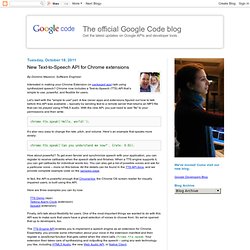
Chrome now includes a Text-to-Speech (TTS) API that’s simple to use, powerful, and flexible for users. Let’s start with the "simple to use" part. A few clever apps and extensions figured out how to talk before this API was available – typically by sending text to a remote server that returns an MP3 file that can be played using HTML5 audio. With the new API, you just need to add "tts" to your permissions and then write: chrome.tts.speak('Hello, world!
') It’s also very easy to change the rate, pitch, and volume. How about powerful? In fact, the API is powerful enough that ChromeVox, the Chrome OS screen reader for visually impaired users, is built using this API. Here are three examples you can try now: TTS Demo (app) Talking Alarm Clock (extension) SpeakIt (extension) Finally, let's talk about flexibility for users. 20+ Essential Resources for Improving Your SEO Skills.
Mollie Vandor is a product manager at BetterWorks, and the former associate product manager at Cooking.com.

Prior to that, she helped launch Ranker.com, where she served as the product manager, amongst many other roles. You can reach her @mollierosev, on her blog, or on her latest addiction – Words With Friends, where she plays under the username “Mollierosev. " Search engine optimization isn’t exactly something you can major in — at least, not yet. In fact, many professional search engine optimizers are self-taught. They’ve supplemented backgrounds in marketing, computer science and the like with self-education via online courses, videos and blog posts.
Whether you're looking to build your knowledge of the basics, master more intermediate material or get to the head of the advanced class, a wealth of online resources can help you graduate your SEO skills to the next level. The Basics Intermediate Congratulations, you’ve passed freshman SEO. Advanced Placement Graduation. #.Tks8-kjWKhs. As more and more journalists are finding, APIs are a great way to get data for your Web applications and projects.

An API, or application programming interface, enables software programs to communicate with one another. (Chrys Wu wrote a helpful intro here.) To give you a better understanding of how they can help you, I’ve outlined some of the best APIs for finding content and explained how you can use open-source programming tools to glean information from them. Twitter API Twitter’s API is very well documented and has a lot of useful functionality. Here is some simple example code that searches Twitter for the term “earthquake” and then creates a bulleted list for the tweets that are found. If your development team uses open-source tools, there are some great libraries for parsing the Twitter API with much more advanced functionality than the snippet above.
Here are a few good examples from the documentation: Other noteworthy APIs Tags: API, Hacks/Hackers.