
Social Media Privacy: 3 Questions to Ask Before Authorizing Third-Party Apps. Carrier IQ tries to spin its way out of trouble. Is that a spy in your smartphone?
Carrier IQ, the mobile phone network analysis company at the heart of the smartphone spyware scandal, isn't talking to me, but it is talking to AllThingsD.
Phone 'Rootkit' Maker Carrier IQ May Have Violated Wiretap Law In Millions Of Cases. LinkedIn founder dead wrong about privacy being just for ‘old people’ « IT Business Blogs Canada - Privacy and Security. Privacy relates to freedom of choice and control over one’s own personal information – that hasn’t changed, despite the explosion of online social media.
In fact, the need for privacy has grown in the face of deceptive practices online, such as identity theft and cyber bullying. Privacy has evolved, with context playing a key role. The onus is now on social media platforms to provide users with clear and simple privacy tools to enable user control. Privacy Links and Blogs. One tweet takes a journalist on a voyage of discovery. Here's a fascinating post by Joanna Geary, the web development editor of The Times, How I tracked down an entire family from one tweet.

During a presentation to the Young Journalists' Academy, she illustrated just how easy it is to trace supposedly private information about people online. Facebook's Big Privacy Changes: An Overview [PICS] Facebook unveiled a massive wave of privacy changes on Tuesday.
![Facebook's Big Privacy Changes: An Overview [PICS]](http://cdn.pearltrees.com/s/pic/th/facebook-privacy-overview-14925009)
It's one of the biggest privacy overhauls in the company's history, one that includes more than a dozen changes to profiles, status updates, locations and tags. In fact, there are so many changes that it's easy to get confused about what changes Facebook is making and what impact they will have on your privacy. The updates are significant enough that Facebook will make every single one of its 750+ million users go through a tutorial about the updated privacy settings. Social networking surveillance: trust no one. A woman uses her BlackBerry at a shopping mall in Dubai, UAE.
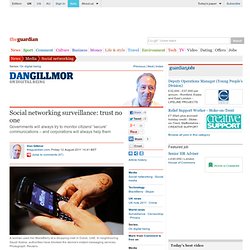
In neighbouring Saudi Arabia, authorities have blocked the device's instant messaging services. Photograph: Reuters Law enforcers in the United Kingdom and elsewhere are coming to grips with a hard reality: modern communications technologies give activists of all kinds an easier way to organise and deploy. But even as governments move to crack down, as Jeff Jarvis notes, activists are also learning a lesson – not just those whom we may support, such as the Egyptian revolutionaries, but also those whose deeds leave us cold or angry, such as many of the rioters and looters who've trashed so many parts of London and other British communities in recent days.
In all cases, they are realising they cannot begin to trust the technology companies whose communications tools they used. The law enforcement dilemma was highlighted by the protesters' use of BlackBerry mobile devices, which encrypt text communications. Old Saybrook High School makes privacy point; Some perturbed when real students shown in social-media slide show- The New Haven Register - Serving New Haven, Connecticut. OLD SAYBROOK -- When Old Saybrook High School freshmen attended a recent assembly on Internet safety, they didn't just hear about privacy settings, cyberbullying and "digital footprints.
" They saw friends' actual photos and status updates from sites like Facebook, Twitter and Tumblr used in the presentation. It prompted outrage from some students, who felt privacy was invaded and that teens should have been notified their photos would be used. Some took to Twitter to express their frustration, writing on the social media site that the school is "corrupt. " Others wrote on Twitter, "I hope old saybrook high school is reading this," and "put me on ur slide show I want you to read my tweets. "
Conversational Commerce Update: End-user Advocates Set FTC Straight on Personal Data Ecosystem. In a tour de force of clear writing and exposition (albeit in 33 typed pages), Kaliya Hamlin and Mary Hodder, executive director and chairman, respectively, of the Personal Data Ecosystem Collaborative Consortium (PDECC) have provided the U.S.
Federal Trade Commission (FTC) with this response to its proposal for "Do Not Track" regulations (similar to the "Do Not Call" List for phone-based telemarketers). Hamlin and Hodder start by pointing out that the "Do Not Track" mandate does a double disservice to the quality of commerce. Advertisers, on the one hand, already "target" product development, customer acquisition, promotional and advertising strategies based on old and often inaccurate information from credit bureaus, data aggregators or even Facebook archives. Courts Disagree on Expectation of Privacy Regarding Social Media. ACLU Settles Privacy Lawsuit Regarding Amazon Customer Data With NC Department Of Revenue. Raleigh, NC -- A federal court fight between North Carolina tax collectors and Amazon.com is over, with the online retailer's customers satisfied that details of their purchases won't be disclosed.
The American Civil Liberties Union said Wednesday the seven North Carolina residents it represents have dropped their fight over keeping private the names of the books and other items. A federal judge in Amazon's hometown of Seattle closed the case last month, ruling in October tax collectors aren't entitled to know specifically what individual customers bought.
North Carolina's Revenue Department was auditing taxes collected by Amazon and wanted names of North Carolina customers. Netizens Gain Some Privacy. Regulating Google’s Results? Law Prof Calls ‘Search Neutrality’ Incoherent. “Neutrality” — if it’s good enough for the core of the internet, isn’t it good enough for the edge?
The biggest internet providers say it is, and they would love to have the government slap a few neutrality rules on Google, just to see how the advertising giant likes the taste of the regulatory bridle. In 2010, while the FCC was debating net neutrality rules, ISPs like Time Warner Cable settled on a “they’re gatekeepers, too!” Strategy. “Google has led the charge to adopt regulation to ensure internet openness, yet it has the ability and incentive to engage in a range of decidedly non-neutral conduct due to its control over so many aspects of the internet experience,” said one representative filing. “Google’s core search application relies on a pay-for-priority scheme that is squarely at odds with its proposed neutrality requirements for broadband-internet-access service providers.” Privacy Law Is Outrun by Speed of Web’s Progress. Should E-Mail and Letters Have Equal Legal Protection?
William P.
O’Donnell/The New York Times Over the weekend, we reported that the government had ordered Twitter to turn over private information about users associated with WikiLeaks. Privacy vs. Security vs. Anonymity. When I first began my PhD, I was keen to properly sort and define any new terms and reconcile them with my own education and experience. Three terms that always seemed to be intermingled were: Privacy, Security and Anonymity. Certainly they are related, but I wanted to be a little more specific and understand exactly when and how they overlapped. First, let’s establish some basic definitions. For the purpose of this blog post, the following definitions will suffice (I’ll address alternative definitions later): • Privacy: having control over one’s personal information or actions • Security: freedom from risk or danger • Anonymity: being unidentifiable in one’s actions.
McSweeney's Internet Tendency: Santa's Privacy Policy. [Originally published December 23, 2010.] Do Not Track isn't just about Behavioral Advertising.
Opinion: Time to double team on Internet privacy - Christopher Wolf and Jules Polonetsky. For years, consumer advocates have urged policymakers to get serious about a privacy agenda. Industry groups opposed this, arguing that the Federal Trade Commission is already authorized to bring enforcement actions against businesses. In addition, these industry groups insist, the White House and Congress should avoid any new steps that could limit innovation. Countering this, privacy advocates complain that the FTC wasn’t aggressive enough, and often took no action on the privacy complaints they filed against businesses.
Continue Reading.
Will a ‘Privacy Bill of Rights’ Include the Right to Class Action Lawsuits? - Kashmir Hill - The Not-So Private Parts. Do Not Track. How Facebook’s New Profiles Impact Your Privacy. An update to Facebook Profiles unveiled over the weekend puts an emphasis on the personal: displaying photos and revealing users’ relationship, hometown and work status right at the top. As users adapt to the new look this Monday, we take a look at how the new design impacts users’ privacy concerns.
Where the current profile lists personal information to the left side of the user’s news feed, the new design puts that information front-and-center, above the news feed, including relationship status, hometown, work status and birthday. The change does not affect users’ pre-existing privacy settings. Microsoft to Add 'Tracking Protection' to Web Browser.
Blog of Rights: Official Blog of the American Civil Liberties Union » Don't Let Schools Chip Your Kids.
FTC. Oversharing is the New Nicotine. Online Privacy: What If Your Valuable, Personal Online Data Got. Online privacy is a hot potato. Finding common ground on an open Inte.