
Waterhouse, Listening to His Sweet Pipings 1911.jpg (JPEG Image, 1600x878 pixels) Waterhouse_echo_and_narcissus.jpg (JPEG Image, 1251x700 pixels) Leighton_Lord_Frederic-The_Fisherman_and_the_Syren.jpg (JPEG Image, 1400x2180 pixels) 9.jpg (JPEG Image, 899x1000 pixels)
Pictures-012.jpg (JPEG Image, 1296x986 pixels) Mourning-for-icarus.JPG (JPEG Image, 811x990 pixels) - Scaled (77%) Hylas-717603.jpg (JPEG Image, 1600x992 pixels) - Scaled (77%) Ophelia.jpg (JPEG Image, 1131x850 pixels) Pre raphielites. Pre-Raphaelite Brotherhood. The Pre-Raphaelite Brotherhood (also known as the Pre-Raphaelites) was a group of English painters, poets, and critics, founded in 1848 by William Holman Hunt, John Everett Millais and Dante Gabriel Rossetti.
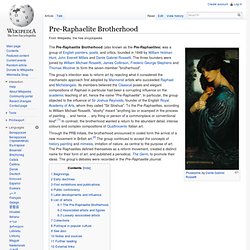
The three founders were joined by William Michael Rossetti, James Collinson, Frederic George Stephens and Thomas Woolner to form the seven-member "brotherhood". The group's intention was to reform art by rejecting what it considered the mechanistic approach first adopted by Mannerist artists who succeeded Raphael and Michelangelo. Its members believed the Classical poses and elegant compositions of Raphael in particular had been a corrupting influence on the academic teaching of art, hence the name "Pre-Raphaelite". In particular, the group objected to the influence of Sir Joshua Reynolds, founder of the English Royal Academy of Arts, whom they called "Sir Sloshua". Beginnings[edit] Illustration by Holman Hunt of Thomas Woolner's poem "My Beautiful Lady", published in The Germ, 1850.