
A Guch-a-riffic chemistry tutorial! Mr.
Guch Explains I have good news and bad news. The bad news is that I'm not going to add to the list below anymore because it's a pain to get everything formatted for the Interwebs. The good news is that I'm going to start adding new questions in blog format over at . Check it out, and email me any questions you've got at misterguch@chemfiesta.com .
Bonus: Questions I've Answered – Answers to some of the random questions people have asked me. Click HERE to go back to the Helpdesk page. . © 1998-2009 Cavalcade Publishing, All Rights Reserved. Physics and Cosmology. Physics/Space. @dannynic #science #iwb. #science #iwb #resources @
Physics Magazines. Great Physicians. Quantum Physics. Physics Pearlers. Electromagnetism. Nanotechnology. Physics on Time. Systems Theories. Nuclear Physics. Why Nikola Tesla was the greatest geek who ever lived. Additional notes from the author: If you want to learn more about Tesla, I highly recommend reading Tesla: Man Out of Time Also, this Badass of the week by Ben Thompson is what originally inspired me to write a comic about Tesla.
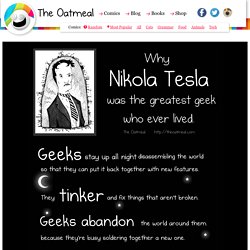
Ben's also got a book out which is packed full of awesome. There's an old movie from the 80s on Netflix Instant Queue right now about Tesla: The Secret of Nikola Tesla. It's corny and full of bad acting, but it paints a fairly accurate depiction of his life. The drunk history of Tesla is quite awesome, too. Physics Flash Animations. We have been increasingly using Flash animations for illustrating Physics content. This page provides access to those animations which may be of general interest. The animations will appear in a separate window. The animations are sorted by category, and the file size of each animation is included in the listing.
Also included is the minimum version of the Flash player that is required; the player is available free from The categories are: Scientists discover snowflake identical to one which fell in 1963. Scientists were today able to dispel the age-old belief that no two snowflakes are the same, using state of the art microscopy and by catching flakes as they fell in specially designed equipment while sitting at a table outside a pub in Norwich.
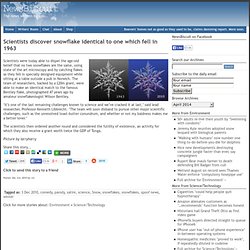
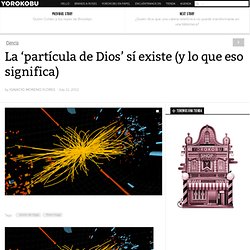
The team of researchers, backed by a £20m grant, were able to make an identical match to the famous Bentley flake, photographed 47 years ago by amateur snowflakeologist Wilson Bentley. ‘It’s one of the last remaining challenges known to science and we’ve cracked it at last,’ said lead researcher, Professor Kenneth Libbrecht. ‘The team will soon disband to pursue other major scientific challenges, such as the unresolved toast-butter conundrum, and whether or not my baldness makes me a better lover.’ El bosón de Higgs: La “partícula de Dios” sí existe (y lo que eso significa) Tags: bosón de HiggsPeter Higgs.
Rocks and Weathering. Tres minutos para entender el bosón de Higgs. Coriolis-like effect found 184 years before Coriolis - physics-math - 14 January 2011. By Macgregor Campbell The cosmos loves irony.

While trying to prove that the Earth is fixed in space, an Italian priest described something similar to the Coriolis effect – the slight deflection experienced by objects moving in a rotating frame of reference – nearly 200 years before mathematician Gustave Coriolis worked it out in 1835. In 1651, Giovanni Riccioli published 77 arguments against the idea that the apparent motions of the heavens were due to the Earth’s rotation and orbit around the sun. These included claims that Hell would be in the wrong place, aesthetic concerns over proportion and harmony, and more scientific approaches. Now, Christopher Graney at Jefferson Community and Technical College in Louisville, Kentucky, has translated them from Latin, and discovered that Riccioli conjectured phenomena resembling the Coriolis effect (arxiv.org/abs/1012.3642).
Laser Crosswalk Saves Pedestrians From a Painful Death. When the light turns red, a huge laser wall projecting apparitions of crossing pedestrians spans across the crosswalk.
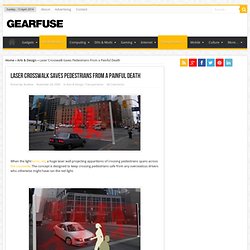
The concept is designed to keep crossing pedestrians safe from any overzealous drivers who otherwise might have ran the red light. Link [via] CERN: Light Speed May Have Been Exceeded By Subatomic Particle. GENEVA — One of the very pillars of physics and Einstein's theory of relativity – that nothing can go faster than the speed of light – was rocked Thursday by new findings from one of the world's foremost laboratories.
European researchers said they clocked an oddball type of subatomic particle called a neutrino going faster than the 186,282 miles per second that has long been considered the cosmic speed limit. The claim was met with skepticism, with one outside physicist calling it the equivalent of saying you have a flying carpet. In fact, the researchers themselves are not ready to proclaim a discovery and are asking other physicists to independently try to verify their findings.
"The feeling that most people have is this can't be right, this can't be real," said James Gillies, a spokesman for the European Organization for Nuclear Research, or CERN, which provided the particle accelerator that sent neutrinos on their breakneck 454-mile trip underground from Geneva to Italy. Demonic device converts information to energy.
Experiment inspired by a paradox tempts a bead uphill.

<div class="c-nature-box c-nature-box--side " data-component="entitlement-box"><p class="c-nature-box__text js-text">You have full access to this article via your institution. </p><div class="c-pdf-download u-clear-both"><a href="/articles/news.2010.606.pdf" class="c-pdf-download__link" data-article-pdf="true" data-readcube-pdf-url="true" data-test="download-pdf" data-draft-ignore="true" data-track="click" data-track-action="download pdf" data-track-label="link" data-track-external><span>Download PDF</span><svg aria-hidden="true" focusable="false" width="16" height="16" class="u-icon"><use xlink:href="#global-icon-download"/></svg></a></div></div> Knowledge is power.
Credit: iStockphoto. La historia del Bosón de Higgs. Una nueva partícula, quizás el bosón de Higgs, se filtra antes de tiempo. "Hemos observado una nueva partícula...
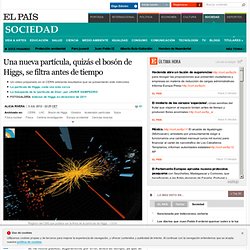
Tenemos fuerte evidencia de que hay algo ahí", dice Joe Incandela, el portavoz de CMS, uno de los grandes detectores del acelerador de partículas LHC, en un vídeo que se ha hecho público, seguramente por error, antes de tiempo, ya que se ha retirado inmediatamente del acceso público, según ha informado Science News. HyperPhysics. Michio Kaku - Smashing Atoms. Sunshine. World’s Most Precise Clocks Could Reveal Universe Is a Hologram. Our existence could be coded in a finite bandwidth, like a live ultra-high-definition 3-D video.
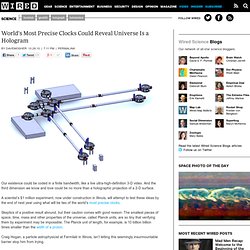
And the third dimension we know and love could be no more than a holographic projection of a 2-D surface. A scientist’s $1 million experiment, now under construction in Illinois, will attempt to test these ideas by the end of next year using what will be two of the world’s most precise clocks. Skeptics of a positive result abound, but their caution comes with good reason: The smallest pieces of space, time, mass and other properties of the universe, called Planck units, are so tiny that verifying them by experiment may be impossible. The Planck unit of length, for example, is 10 billion billion times smaller than the width of a proton. Craig Hogan, a particle astrophysicist at Fermilab in Illinois, isn’t letting this seemingly insurmountable barrier stop him from trying.
Lasers illuminate quantum security loophole. Demonic device converts information to energy. Quantum Computing: Will It Be a Leap in Human Evolution? Quantum computers have the potential to solve problems that would take a classical computer longer than the age of the universe. Oxford Professor David Deutsch, quantum-computing pioneer, who wrote in his controversial masterpiece, Fabric of Reality says: "quantum computers can efficiently render every physically possible quantum environment, even when vast numbers of universes are interacting. Quantum computers can also efficiently solve certain mathematical problems, such as factorization, which are classically intractable, and can implement types of cryptography which are classically impossible.
Quantum computation is a qualitatively new way of harnessing nature. " Quantum computing sounds like science fiction -as satellites, moon shots, and the original microprocessor once were. But the age of computing in not even at the end of the beginning. The Higgs Boson explained by PhD Comics. Higgs Found. Finally, physics’s zoo of subatomic particles is full. Scientists have almost certainly snared the Higgs boson, the last particle waiting to be roped into the fold.
Decades after it was proposed, the Higgs emerged in the shards of particle collisions at the world’s most powerful accelerator, the Large Hadron Collider at the CERN laboratory near Geneva. Higgs boson: What's it for? I have no idea, says Prof. Laws of physics vary throughout the universe, new study suggests. A team of astrophysicists based in Australia and England has uncovered evidence that the laws of physics are different in different parts of the universe. The team -- from the University of New South Wales, Swinburne University of Technology and the University of Cambridge -- has submitted a report of the discovery for publication in the journal Physical Review Letters. A preliminary version of the paper is currently under peer review. The report describes how one of the supposed fundamental constants of Nature appears not to be constant after all. Instead, this 'magic number' known as the fine-structure constant -- 'alpha' for short -- appears to vary throughout the universe.
Electricity. Stuff under an electron microscope. Science Normal things become surreal when put under an electron microscope. Used dental floss Mascara brush. Arranca la búsqueda de la 'partícula Dios' La sala de reuniones del partido tory está llena de militantes que charlan tranquilamente cuando, de pronto, la señora Thatcher entra por la puerta. A medida que Thatcher camina por la habitación, los militantes más cercanos forman corrillos a su alrededor y, en consecuencia, dificultan el movimiento de su líder.
Los militantes representan el campo de Higgs, una forma de energía que impregna todo el espacio y confiere masa a las partículas (como Thatcher). Un protón, por ejemplo, no tendría masa si no fuera por el campo de Higgs. Guide to Snowflakes. The Official String Theory Web Site. Mind blowing physics engine demonstration. Serious Flaw Emerges In Quantum Cryptography. The problem of sending messages securely has troubled humankind since the dawn of civilisation and probably before. In recent years, however, physicists have raised expectations that this problem has been solved by the invention of quantum key distribution. This exploits the strange quantum property of entanglement to guarantee the secrecy of a message.
Entanglement is so fragile that any eavesdropper cannot help but break it, revealing the ruse. So cryptographers can use it to send a secure key called a one time pad that can then be used to encrypt a message. If the key is intercepted, the sender simply sends another and repeats this until one gets through. New kind of light created in physics breakthrough. Physicists have created a new kind of light by chilling photons into a blob state. Just like solids, liquids and gases, this recently discovered condition represents a state of matter. Called a Bose-Einstein condensate, it was created in 1995 with super-cold atoms of a gas, but scientists had thought it could not be done with photons, which are basic units of light.
However, physicists Jan Klärs, Julian Schmitt, Frank Vewinger and Martin Weitz of the University of Bonn in Germany reported accomplishing it. Titanium foam could make your bones as strong as Wolverine's. 9 Things You Didn't Know About Benjamin Franklin. It's Fun Friday -- time for some fun for the weekend. Enjoy today's post and I'll see you back here on Monday with more philatelic news and notes. United States, 1938Scott #803 In 1938, the United States issued a set of definitive postage stamps featuring images of the nation's first 29 presidents. This issue has affectionately become known as the Prexies issue. In addition to the 29 presidents featured on the stamps, fractional postage stamps were issued with images of non-presidents, such as Benjamin Franklin and Martha Washington, and the White House.