
The Skeptics Society & Skeptic magazine. Possibilianism. Not to be confused with Possibilism.
Possibilianism is a philosophy which rejects both the diverse claims of traditional theism and the positions of certainty in strong atheism in favor of a middle, exploratory ground.[1][2][3][4][5] The term was first defined by neuroscientist David Eagleman in relation to his book of fiction Sum: Forty Tales from the Afterlives.[6] Asked whether he was an atheist or a religious person on a National Public Radio interview in February 2009, he replied "I call myself a Possibilian: I'm open to...ideas that we don't have any way of testing right now. Three Passions of Bertrand Russell (and a Collection of Free Texts) Carlos Fraenkel: Citizen Philosophers. Getting out of the cave and seeing things as they really are: that’s what philosophy is about, according to Almira Ribeiro.
Ribeiro teaches the subject in a high school in Itapuã, a beautiful, poor, violent neighborhood on the periphery of Salvador, capital of the state of Bahia in Brazil’s northeast. She is the most philosophically passionate person I’ve ever met. Most of the four million slaves shipped from Africa to Brazil were sold in Salvador, the first residence of Portugal’s colonial rulers. It’s still Brazil’s blackest city. In Ribeiro’s neighborhood, children play football or do capoeira, pray in Pentecostal Churches or worship African gods. “But seeing things as they really are isn’t enough,” Ribeiro insists. To foster that discussion, Ribeiro must take on a deeply rooted political defeatism. Augustine on the Illusion and Reality of Time. Quid est enim tempus?
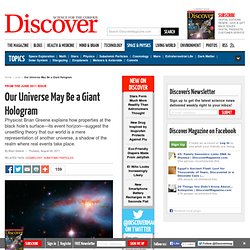
Julian Baggini: Is there a real you? Julian Baggini: Is there a real you? Ken Robinson on Passion. Our Universe May Be a Giant Hologram. Two monster black holes may lie within the double bright area at the center of galaxy NGC 6240.
If, when I was growing up, my room had been adorned with only a single mirror, my childhood daydreams might have been very different. But it had two. And each morning when I opened the closet to get my clothes, the one built into its door aligned with the one on the wall, creating a seemingly endless series of reflections of anything situated between them. It was mesmerizing. What Is It Like to Be a Baby: The Development of Thought. Homosexual behavior in animals. Homosexual behavior in animals is sexual behavior among non-human species that may be interpreted as homosexual or bisexual.
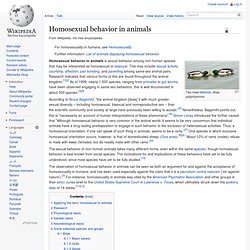
This may include sexual activity, courtship, affection, pair bonding, and parenting among same-sex animal pairs. Research indicates that various forms of this are found throughout the animal kingdom.[1][2] As of 1999, nearly 1,500 species, ranging from primates to gut worms, have been observed engaging in same-sex behaviors; this is well documented in about 500 species.[3][4] According to Bruce Bagemihl, "the animal kingdom [does] it with much greater sexual diversity – including homosexual, bisexual and nonreproductive sex – than the scientific community and society at large have previously been willing to accept.
What Happened Before the Big Bang? The New Philosophy of Cosmology - Ross Andersen - Technology. What existed before the big bang?
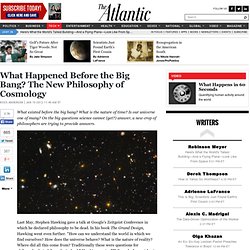
What is the nature of time? Is our universe one of many? On the big questions science cannot (yet?) Answer, a new crop of philosophers are trying to provide answers. Facing the Singularity. Sometime this century, machines will surpass human levels of intelligence and ability.
This event — the “Singularity” — will be the most important event in our history, and navigating it wisely will be the most important thing we can ever do. Luminaries from Alan Turing and Jack Good to Bill Joy and Stephen Hawking have warned us about this, and it doesn’t depend on the occurrence of Ray Kurzweil’s particular vision of an “accelerating change” Singularity. Why do I think Hawking and company are right, and what can we do about it?
Facing the Singularity is my attempt to answer these questions. Personal background I’ll begin with my personal background. When my religious beliefs finally succumbed to reality, I deconverted and started a blog to explain atheism and naturalism to others. Intelligence explosion. Online papers on consciousness. Search tips There are three kinds of search you can perform: All fields This mode searches for entries containing all the entered words in their title, author, date, comment field, or in any of many other fields showing on OPC pages.
Surname This mode searches for entries containing the text string you entered in their author field. Advanced This mode differs from the all fields mode in two respects. Note that short and / or common words are ignored by the search engine. Curiosity with Stephen Hawking, Did God Create the Universe? The Magic of Consciousness. Dangerous Knowledge (Philosophy, Physics, Mathematics) -BBC. Darwinism Must Die So That Evolution May Live. Antonio Damasio: The quest to understand consciousness. The Future: Where Sexual Orientations Get Kind of Confusing. 2011 - A Philosophical Review. HUMAN Identity.mov. What is Consciousness? Philographics on the Behance Network.
Why make New Year resolutions if genes and environment decide our behaviour rather than free will? - The Irish Times - Thu, Dec 29, 2011.