
University Inc. - corporate corruption of Research & Higher Education. Gospel Contradictions Kameron Schulz (Reply) (9-00) Gospel Contradictions Kameron Schulz This is now part of On Quoting The Bible Out Of Context with Matthew Rupert From: "Kameron Schulz" To: "Positive Atheism" <editor@positiveatheism.org> Subject: gospel contradictions Date: Friday, September 08, 2000 10:15 PM A friend and I were having a discussion about how the four Gospels contradicted each other, but in the end I actually found myself woefully short of examples.

Thecyberesq. Internet Archive Library, Complete Index of Writers. Marxists Internet Archive. Deep Ecology, Ecofeminism, Pantheism, Taoism, Agnosticism. Why is philosophy important?
It is the primary underpinning of the behavior of individuals and societies, because what you believe determines how you act. You may not have thought much about philosophy, but you still have one. You may be just so used to it that it has become invisible to you. Common Sense Science. - Anthropological Theories - Department of Anthropology - The University of Alabama. Dictionary of the History of Ideas. Anthropological Theories - Department of Anthropology - The University of Alabama. Incredible! Car Photographed 100 Years Before Produced & Other Cases of 'Time Slip'! According to great scientists such as Albert Einstein, time is not as stable as most of us think.
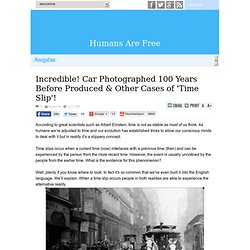
A... According to great scientists such as Albert Einstein, time is not as stable as most of us think. As humans we’re adjusted to time and our evolution has established tricks to allow our conscious minds to deal with it but in reality it’s a slippery concept. Time slips occur when a current time (now) interlaces with a previous time (then) and can be experienced by the person from the more recent time. Quantum Consciousness . Stuart Hameroff. Overview: Could Life And Consciousness Be Related To The Fundamental Quantum Nature Of The Universe?
Consciousness defines our existence and reality. But how does the brain generate thoughts and feelings? Most explanations portray the brain as a computer, with nerve cells ("neurons") and their synaptic connections acting as simple switches, or "bits" which interact in complex ways. In this view consciousness is said to "emerge" as a novel property of complex interactions among neurons, as hurricanes and candle flames emerge from complex interactions among gas and dust molecules. Belief in Belief. Followup to: Making Beliefs Pay Rent (in Anticipated Experiences) Carl Sagan once told a parable of a man who comes to us and claims: "There is a dragon in my garage.
" Fascinating! We reply that we wish to see this dragon—let us set out at once for the garage! "But wait," the claimant says to us, "it is an invisible dragon. " Now as Sagan points out, this doesn't make the hypothesis unfalsifiable. But now suppose that we say to the claimant, "Okay, we'll visit the garage and see if we can hear heavy breathing," and the claimant quickly says no, it's an inaudible dragon. Carl Sagan used this parable to illustrate the classic moral that poor hypotheses need to do fast footwork to avoid falsification. Information Philosopher - Introduction. Introduction The Information Philosopher has established that quantum mechanics and thermodynamics play a central role in the creation of all things.
This finding has enormous implications for philosophy and metaphysics. Instead of a closed universe that is winding down deterministically from an initial state of high information, we find the universe is open and increasing information indeterministically from an initial state of relatively high entropy and low information. Information is being continuously created in the universe, not least by human beings who are just learning that they are part of the cosmic creative process. An open indeterministic universe with increasing information suggests three testable philosophical ideas: a model for free will and creativity that may satisfy determinists and libertarians a value system based on providential processes in the universe an epistemological explanation of knowledge formation and communication. Man is Free. For Teachers For Scholars. Hegel's Philosophy of History. Back to main page The philosophy of history espoused by George Frederick Hegel, philosopher and historian, has often been viewed as largely teleological.

It has often been speculated that this philosophical presumption arose from the historical context of Hegel's life, whether negatively through his fear of the French Terror or positively from his dedication to the Romantic thesis that Reason shapes the universe. Analytic philosophy. Analytic philosophy (sometimes analytical philosophy) is a style of philosophy that came to dominate English-speaking countries in the 20th century.
In the United Kingdom, United States, Canada, Scandinavia, Australia, and New Zealand, the vast majority of university philosophy departments identify themselves as "analytic" departments.[1] The term "analytic philosophy" can refer to: A broad philosophical tradition[2][3] characterized by an emphasis on clarity and argument (often achieved via modern formal logic and analysis of language) and a respect for the natural sciences.[4][5][6]The more specific set of developments of early 20th-century philosophy that were the historical antecedents of the broad sense: e.g., the work of Bertrand Russell, Ludwig Wittgenstein, G.
E. Marx/Engels on Historical Materialism. Broad Overview: The German Ideology "The first premise of all human history is, of course, the existence of living human individuals.
Thus the first fact to be established is the physical organisation of these individuals and their consequent relation to the rest of nature....Men can be distinguished from animals by consciousness, by religion or anything else you like. They themselves begin to distinguish themselves from animals as soon as they begin to produce their means of subsistence, a step which is conditioned by their physical organisation. By producing their means of subsistence men are indirectly producing their actual material life. Study Guide. The Mental and the Physical. Hume and Kant. The 1700s saw many great thinkers who have left a lasting impact on modern philosophy and science -- and psychology.
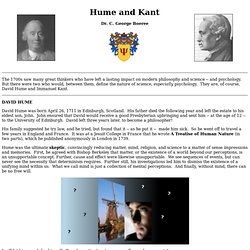
But there were two who would, between them, define the nature of science, especially psychology. They are, of course, David Hume and Immanuel Kant. David Hume was born April 26, 1711 in Edinburgh, Scotland. His father died the following year and left the estate to his eldest son, John. John ensured that David would receive a good Presbyterian upbringing and sent him -- at the age of 12 -- to the University of Edinburgh. His family suggested he try law, and he tried, but found that it -- as he put it -- made him sick. Guide to Philosophy on the Internet (Suber) Welcome to my collection of online philosophy resources. If you are stuck in a frame, click here to escape. If you are a frequent visitor, press reload or refresh on occasion to be sure that you are viewing the most recent version of the page, not the version cached on your hard drive from your last visit.
I've marked recommended sites with a red star . Generally the starred sites are those I've found especially helpful for shortening the search for what one wants, as opposed to outstanding sites in themselves for which one ought to search. When the whole file loads, use the search command on your browser to find items by keyword. To register to receive an email announcement whenever this page is revised, see the bottom of this file.
Squashed Philosophers- Condensed Plato Aristotle Augustine Descartes Hume Marx Freud Copernicus Hobbes Sartre Ayer Sade Wittgenstein Einstein. Philosophy Bro. Existentialism. Kant: Knowledge. Kant: Experience and Reality Analogies of Experience So Kant maintained that we are justified in applying the concepts of the understanding to the world as we know it by making a priori determinations of the nature of any possible experience. Idealist philosophy:What is Real ? Idealist ontology, philosophy of science, cognition, reality, psychological Now, collective conscious experience, egoless experience, philosophy of mind, mind-brain relations, mind-matter relations, collective consciousness, egolessness, spirituality, shamanism, science and religion, God.
Idealist Philosophy: What is Real ? Conscious Experience Seen as Basic to All Ontology. An Overview By Axel Randrup arandrup@mobilixnet.dk International Center for Interdisciplinary Psychiatric Research, CIRIP Written 2000-2003. Leibniz’s Metaphysics The German rationalist philosopher, Gottfried Wilhelm Leibniz (1646-1716), is one of the great renaissance men of Western thought. Enlightenment - The Experience Festival. Philosophicallexicon.com. Open source buddhist research institute. Philosophy Timeline.