
Q&A: Patrice Lamothe of Pearltrees on personal organisation of t. 3 Reasons Curation is Here to Stay. Perhaps you won't believe me since it's my job to spread the gospel of curation as the Chief Evangelist of Pearltrees, but I think curation is here to stay.
These are the reasons why I believe this is the case. This year there has been a tremendous amount of buzz in Silicon Valley about curation. Magnify.net CEO Steven Rosenbaum recently published a book, Curation Nation that has sparked a tremendous amount of conversation on the topic. Likewise a post by Brian Solis has been retweeted thousands of times. My company, Pearltrees has just surpassed 100,000 curators and 10 million page views a month, and in the past two years nearly a dozen companies that incorporate digital curation into their models have launched. Samer Karam: @leweb #lt #pearltrees Cur... Pearltrees. I’ve never been in the same room with so many Internet stars and CEOs.

Even a Queen and French Minister were there! Yep, I’ve been entranced by LeWeb09 for the past two days. This is Europe’s #1 Internet conference hosted by the Le Meur couple. Silicon Alley Insider. TechCrunch. [France] Paris-based Pearltrees has been catching interest around the web the last few days not least because a gaggle influential Silicon Valley bloggers have descended on Paris for Le Web, but mainly because of its interesting model for visually mapping how people collect and share information on the Web.
But today the startup opens the kimono on its full system. They will announce two new things today: Twitter synchronization (enabling a user to create a pearl automatically from Twitter and to tweet automatically from their new Pearltrees), Pearltrees search, Real time discussion and connection. Social Bookmarking And Curation: Pinterest, Pearltrees, GimmeBar.
Quote of the Day: "I get ideas about what to buy for others for the holidays from websites with best of lists (like top ten gifts for mom).”
–Male, 27, CA Trolls, bullies, flame wars—comment sections online have them all. Is the solution simply to turn off the comments? PewDiePie, one of the biggest stars of YouTube, has done just that. In a recent video he posted expressing his happiness with the decision, the video game vlogger said, “It's been making me really happy, and it's been making me really enjoy what I do. Playing With Pearltrees - A Great Way to Organize the Web. Over the years I've written about a lot of social bookmarking services and mind-mapping services (I even co-authored a chapter of a book on mind-mapping).

Pearltrees is a service that combines social bookmarking with mind-mapping. Using Pearltrees you can bookmark websites and arrange your bookmarks into webs or mind-maps of related topics. For example, this Pearltree contains links to stories, images, and videos about news from Libya. Pearltrees Dives Into Social Curating With Pearltrees Team. Content curation and mapping service Pearltrees has decided to focus on the fact that people want to do things in groups and has as of today upgraded its core product with a groups functionality, called Pearltrees Team.
Now accesible just by logging in, Pearltrees Team allows you to hook up with other people in order to create a Pearltree collaboratively in realtime. Ideally this goes down as such: You really care about fashion so you search for fashion in the Pearltrees search box and are confronted with really elaborate visual cluster displays of fashion blogs, each blog its own “pearl.” You decide that anyone who likes The Sartorialist is probably a good egg and click on the puzzle piece in the Pearltrees detail window in order to ask if you can join the team.
Pearltrees - Create your Online Bookmark. How to save and share your bookmarks with Pearltrees. Mikedarnell | January 4, 2011 | 6 comments Recently I read Yahoo have decided to drop one of my favorite services.
It seems, despite avid protests that this is not the case on Delicious’s part, the brass at Yahoo have decided that as far as they’re concerned online bookmarking pioneer Delicious.com can go the way of the Dodo. While it isn’t clear what exactly the immediate implications of the announcement are, and it’s very likely that as a web research resource the site will remain relevant for some time to come, it’s clear that Delicious is now a risky choice for storing and sharing your bookmarks. Pearltrees: The Future of Social Bookmarking :sinlee.com.
The future of bookmarking. Internet users are familiar with bookmarks.

These internet shortcuts are called, Favorites in Internet Explorer. In addition to the built in bookmark management capabilities of browsers, third party external applications provide additional capabilities for bookmark management. If you’re using multiple PCs accessing bookmarks is a bit of a hassle, as you have to save the bookmarks in each PC, individually. But Google Chrome browser changed this with bookmark syncing. When you enable bookmark sync on a PC, Chrome settings are saved in your Goggle account.
And there are social bookmarking sites, which needs no introduction at all. Pearltrees visualization tools add power to search and discovery. Nearly four years ago, I spent a week at a multimedia bootcamp at UC Berkeley put on by the Knight Digital Media Center.
The Advantages and Innovations of Pearltrees. Pearltrees is a fascinating and innovative new social networking site that is centered on communicating common interests in a visually interesting and complex manner.
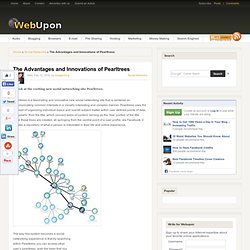
Pearltrees uses the concept of organizing individual topics and overall subject matter within user defined points of data, the ‘pearls’ from the title, which connect webs of content, serving as the ‘tree’ portion of the title. Connecting through Content. If the major characteristic of Web 1.0 is to connect people to content, than Web 2.0 allows people to connect with other people. Web 3.0 connects content to people, and Pearltrees is a great way to see how this works.
Most things about Pearltrees are backwards, although still intuitive (because of a cool user interface). Pearltrees!!!! + New .COMs $7.99/yr plus 18 cents/yr ICANN fee. Discount based on new one-year registration prices as of 1/27/2012 with sale price reflected in your shopping cart at checkout. Discount applies to new registrations and renewals and cannot be used in conjunction with any other offer or promotion. Domains purchased through this offer will renew at regular price after the initial term has expired. Offer ends May 31, 2012 5:00 pm (MST). † Good for one 1-year registration of any available .COM, .US, .BIZ, .INFO, .NET or .ORG ‡ Annual discounts available on NEW purchases only. GoDaddy.com is the world's No. 1 ICANN-accredited domain name registrar for .COM, .NET, .ORG, .INFO, .BIZ and .US domain extensions. Pearltrees: A Great New Tool for Bloggers and Journalists. Recently, I’ve been working with a new tool that I think anyone that uses the web regularly is really going to appreciate: Pearltrees.
The company – which is based in France – has been developing this tool for a few years but in the last few days they have released their latest version and in my opinion it is now ready for prime time. In a nutshell, Pearltrees allows you to very quickly and easily discover, organize and share the things you find on the web. This tool, which is truly a social web curation and collaboration tool, will enable you to quickly see a whole constellation of content specifically related to a post. PearlTrees better than bookmarking for organizing stuff online.
Pearltrees, socializing and curating content on the web. Content of any type is not useful unless you can find it, organize it and interact with it. In the enterprise companies have tried many different schemes to try and get business content collected in a central repository, organized, tagged, version controlled, and searchable.
This has often taken the route of "content management" systems. Content management systems to varying degrees, do an adequate job of getting some content into a controlled system environment. There are challenges with content management systems on two fronts though, getting content into the system in the first place (getting employees to participate in inputting content in some way) and getting the right content into the hands of the person who actually needs it. Search helps find content and tagging can increase searchability of course, but the whole system is only as good as the ability to input and tag the content, which inherently requires broad participation.
The concept is fairly simple really. Behind the Scenes with Pearltrees. « MobileGlobe's Yoann Valensi on Cheap Calls #tg09 | Main | Pavlov and the Crepe » December 17, 2009 Behind the Scenes with Pearltrees #tg09. I have been hooked by pearltrees. Real Life Pearl Tree Game. Organize, visualize and share your Web. November 26th, 2009 by Patricia Finding a title for this post to describe all Pearltrees‘ potential uses is near impossible. You’ll soon understand why. Pearltrees: Visually Organize and Share Web Bookmarks - informat. Organize the web – visually - Mind Mappi.
PearlTrees - A Way To Curate Your Web. Pearltrees – the first human organization on the web. Much more than bookmarking. Pearltrees: The Future of Social Bookmarking :sinlee.com.