Filabot, le robot ménager qui recycle vos plastiques pour l’impression 3D. L’impression 3D, c’est LE truc en vogue depuis plusieurs mois.
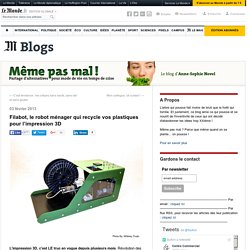
Révolution des Makers oblige, les garages modernes appelé « Fab Lab » se multiplient un peu partout dans le monde, et les plus geeks travaillent sur les améliorations à apporter à cet outil encore un peu venu du futur que sont les imprimantes 3D. Oui mais voilà, ces imprimantes, pour imprimer, consomment du plastique. Et alors que je me demandais l’autre jour si ces outils ne permettraient pas de créer un univers d’économie circulaire à la maison, je suis tombée nez à nez avec Filabot.
Magie ! Le concept est le même que si nous pouvions recycler le papier à la maison pour nos imprimantes traditionnelles. Printrbot’s New Iphone App. Filabot Personal Filament Maker for 3D Printers - Desktop Extruding System – Environmentally Friendly. Free 3D Models, Free CAD Models. Printing Nano-Electronics on Everything: Phones, Planes, Fish Tanks. Imagine you could print a thin layer of micro-electronics on any surface.
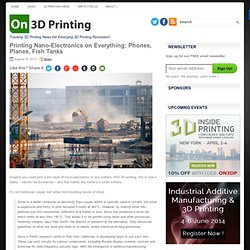
With 3D printing, this is now a reality – reports the Economist – and that makes any surface a smart surface. It’s not traditional copper, but rather micro-building blocks of silver. Silver is a better conductor of electricity than copper, which is typically used in circuits, but silver is expensive and tricky to print because it melts at 962°C. However, by making silver into particles just five nanometres (billionths of a metre) in size, Xerox has produced a silver ink which melts at less than 140°C.
That allows it to be printed using inkjet and other processes relatively cheaply, says Paul Smith, the director of research at the laboratory. The impact of this research is astounding. Read the full story at the Economist. Foxconn construction photo by Bert van Dijk used under Creative Commons license. Les imprimantes 3D peuvent aussi créer des armes à feu… Totalement fonctionnelles. Urbee : la voiture imprimée en 3D. 3D manufacturing: Print me a phone.
University of Washington Club 3D Prints a Boat with Recycled Materials. Students at University of Washington have achieved two amazing feats: 1) 3D print a 7-foot boat, and 2) use recycled milk cartons as the raw materials for the print.
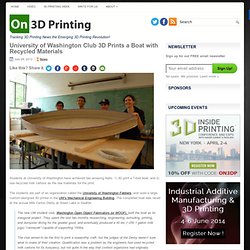
The new UW student club, Washington Open Object Fabricators (or WOOF), built the boat as its inaugural project. They spent the last two months researching, engineering, extruding, printing, and dumpster diving for the greater good, and eventually produced a 40 lbs (~250 1 gallon milk jugs) “canoeyak” capable of supporting 150lbs.The club aimed to be the first to print a seaworthy craft, but the judges of the Derby weren’t sure what to make of their creation. Qualification was a problem as the engineers had used recycled milk cartons for its buoyancy, but not quite in the way that contest organizers had originally envisioned. Designed to Win: 3D Printing Could Help Athletes Break World Records. Will 3D printing make a difference at the next Olympics?
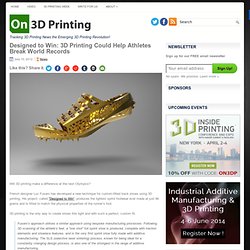
French designer Luc Fusaro has developed a new technique for custom-fitted track shoes using 3D printing. His project, called “Designed to Win”, produces the lightest sprint footwear ever made at just 96 grams and is fitted to match the physical properties of the runner’s foot. Libraries Of The Future. L’impression 3D fabrique son lobbying. Made in ma bibliothèque. Scientists Create Blood Vessels Using Sugar and 3D Printing. University researchers have discovered a way to 3D print blood vessels, using sugar as the “ink” and a RepRap 3D printer.
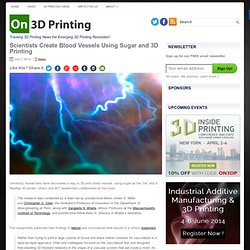
UPenn and MIT researchers collaborated on the study. The research was conducted by a team led by postdoctoral fellow Jordan S. Miller and Christopher S. Chen, the Skirkanich Professor of Innovation in the Department of Bioengineering at Penn, along with Sangeeta N. Bhatia, Wilson Professor at the Massachusetts Institute of Technology, and postdoctoral fellow Kelly R. The researchers published their findings in Nature and summarized their results in a UPenn statement. 3D Scanning and Printing Dinosaurs, Open-Sourcing Scientific Data.
In the past, scaling and reproducing fossils was cost prohibitive and was in the domain of artists.
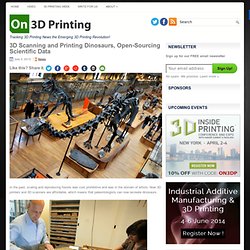
Now 3D printers and 3D scanners are affordable, which means that paleontologists can now recreate dinosaurs. In the video below, Professor Kenneth Lacovara says ”the best thing you could do in science is to falsify your hypothesis.” 3D digital technology allows scientists to “open-source” their empirical data, including original discoveries like fossils. Now, instead of asking colleagues to fly across the globe to help validate new findings, a scientist can just send a digital file and the finding can be 3D printed at the other end. Scanning fossils has further application with the use of the 3D printer, of course.
Crafting the Future: Dutch Arts Combine 3D Printing and Textiles [Video] Make Your Own Superhero: Your Face 3D Printed on Batman. Have you always wanted your own superhero action figure … of yourself?
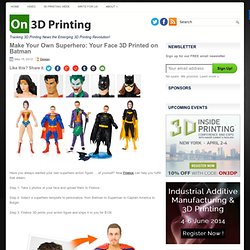
Now Firebox can help you fulfill that dream. Step 1: Take 2 photos of your face and upload them to Firebox. Step 2: Select a superhero template to personalize, from Batman to Superman to Captain America to Batgirl. 3D Printing Silver Jewelry: Perfect Fit, Unique Designs, All Glamorous. We have featured silver jewelry designs before, but we are continually impressed with the new designs that can be 3D printed.
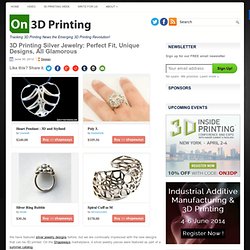
On the Shapeways marketplace, 4 silver jewelry pieces were featured as part of a summer catalog. Silver is one of the more expensive materials to use for 3D printing, so prices for a small piece might be $30 to $100, while a larger piece might be $175 or more. But is the price worth it knowing that you can customize a unique design? See the full feature on the Shapeways blog.
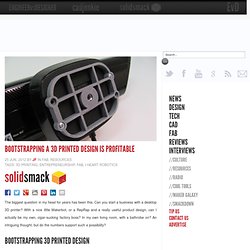
Vice President Joe Biden Shares the Vision for 3D Printing. Bootstrapping a 3D Printed Design is Profitable. The biggest question in my head for years has been this.
Wearable. Making 3D Printing Accessible: Interview with Tinkercad Founder. Kai Backman, co-founder and CEO of Helsinki-based Tinkercad, was interviewed by Wired magazine last week.
Tinkercad allows mainstream consumers to design 3D models in their web browser for free, competing with traditional professional software costing thousands of dollars. Below are some excerpts from the interview. What inspired you to create Tinkercad? Tinkercad was born from a very personal frustration. In 2009, I started researching the new emerging 3-D printing technology and eventually bought my first printer by the end of the year. On the Tinkercad Comunity. Chipotle Beware: BurritoBot Will 3D Print Your Lunch to Order. Marko Manriquez has two passions: digital fabrication and good food. Fulfilling both of these passions is his master’s thesis at the Tisch School of the Arts.
It’s called the BurritoBot, and it 3D prints burritos. Using an iPhone app to build your order, the BurritoBot will receive the data and start making your burrito. We don’t know when the BurritoBot will be ready for commercial prime time, but you can follow Manriquez’s project on his burritob0t website. Top 100 websites 2011 in 3D Printing Industry.