
Comment l’open data est devenu un objet politique … Le 1er jour d’Obama (photo The White House) Le 21 janvier 2009, le 44 ème président des Etats-Unis prend ses fonctions.
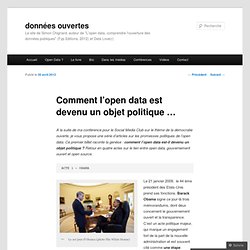
Barack Obama signe ce jour-là trois mémorandums, dont deux concernent le gouvernement ouvert et la transparence. C’est un acte politique majeur, qui marque un engagement fort de la part de la nouvelle administration et est souvent cité comme une étape importante pour l’open government. Un acte fondateur ? Peut-être, mais fruit du hasard, sûrement pas. Près d’un an avant l’entrée en fonction d’Obama, un groupe d’une trentaine d’activistes et de praticiens de l’open government se sont retrouvés à Sebastopol en Californie, à l’invitation de Tim O’Reilly et de Carl Malamud. Ils ont défini l’open government data … (photo David Orban) L’invitation mentionnait déjà l’ambition de la rencontre : définir les principes de l’open data et, si possible, les faire adopter par les candidats à l’élection présidentielle qui devait se dérouler l’année suivante. Like this: J'aime chargement… Cities Share Data, Software Applications. Over the past few years, cities have put a fair amount of energy into open data initiatives, and, through app contests and “hackathon” events, they’ve encouraged citizens and businesses to create new software applications based on the information.

But while cities have been good at promoting open data innovation, they haven’t been as good at coordinating their activities. Civic hackathon events in multiple cities often tackle the same problems and produce similar -- but incompatible -- applications. “We’re all trying to create the same applications over and over again,” says San Francisco CIO Jon Walton. “At some point, that doesn’t really make sense.” That’s about to change.
CNI: Data Management Plans Online How San Francisco Used City Data to Save $1 Million on Street Cleaning. The brilliant Code for America project — which connects cash-strapped city governments with cutting-edge web developers to achieve more impact with less money — has updated its blog with a story about how San Francisco used city data to save more than $1 million dollars on street cleaning.
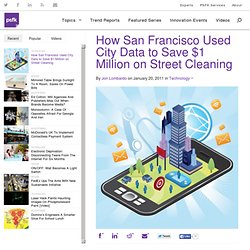
Ed Reiskin, Director of San Francisco’s Public Works department, noticed that some street cleaning trucks were returning with little or no trash on certain days or routes. This compelled Ed to ask for tonnage logs — how much trucks weigh going out vs. how much trucks weigh coming in — to determine how to optimize city cleaning. After about a month of study, Ed’s team concluded that they could find significant savings by re-routing certain routes and reducing others. These changes would help the city to save its money (less gas, parts, and labor) and protect its environment (less pollution and water usage).
Code for America is currently funded by a number of prominent philanthropic foundations.