
Mashup (web application hybrid) In the past years[when?]
, more and more Web applications have published APIs that enable software developers to easily integrate data and functions the SOA way, instead of building them by themselves. Mashups can be considered to have an active role in the evolution of social software and Web 2.0. Mashup composition tools are usually simple enough to be used by end-users. They generally do not require programming skills and rather support visual wiring of GUI widgets, services and components together. Therefore, these tools contribute to a new vision of the Web, where users are able to contribute. The broader context of the history of the Web provides a background for the development of mashups. The advent of Web 2.0 introduced Web standards that were commonly and widely adopted across traditional competitors and which unlocked the consumer data.
Mashup enablers have also been described as "the service and tool providers, [sic] that make mashups possible". Usability Review of Mashup Tools. A bumper crop of new mashup platforms. In today's mashup world, the apparent business potential of highly accessible and easy-to-use mashup creation tools like Yahoo!
Pipes and Microsoft's PopFly is still undermined by their apparent lack of readiness for the enterprise. Mashups could theoretically allow business users to move -- when appropriate -- from their current so-called "end-user development tools" such as Microsoft Excel that are highly isolated and poorly integrated to much more deeply integrated models that are more Web-based and hence more open, collaborative, reusable, shareable, and in general make better use of existing sources of content and functionality. Remember, business workers still spend a significant amount of time manually integrating together the data in their ever increasing number of business applications. So what's typically missing from today's mashup platforms to make them both useful and desirable in the enterprise? Are mashups really a major new development model?
Seventeen Mashup Platforms. Interface de programmation. Un article de Wikipédia, l'encyclopédie libre.
Pour les articles homonymes, voir API. Dans l'industrie contemporaine du logiciel, les applications informatiques se servent de nombreuses interfaces de programmation, la programmation se fait en réutilisant des briques de fonctionnalités fournies par des logiciels tiers. Cette construction par assemblage nécessite pour le programmeur de connaître la manière d’interagir avec les autres logiciels, qui dépend de leur interface de programmation. Le programmeur n'a pas besoin de connaître les détails de la logique interne du logiciel tiers, et celle-ci n'est généralement pas documentée par le fournisseur. Les informations publiques (open data) accessibles par une approche API – 1ère partie - OGDI (Open Government Data Initiative) France. Les informations publiques, ou données ouvertes (open data), sont aujourd’hui - en termes de potentiel, d’opportunités et d’enjeu - au cœur du développement de multiples innovations sociales et économiques grâce à leur mise en ligne par l’administration et les collectivités territoriales.
En effet, portées à la connaissance des citoyens, des chercheurs, des associations, des entreprises, ces informations statistiques, géographiques, urbanistiques, etc. peuvent devenir des mines d’or dès lors qu’elles sont retravaillées, croisées entre elles et mises en scène pour ainsi contribuer à la création de nouveaux services tout en favorisant la transparence de l’action publique. Pour cela, l’architecture de la solution prend en charge le style d’architecture REST (Representational State Transfer). Le kit de démarrage OGDI procure de nombreux avantages : Le kit de démarrage OGDI avec l’ensemble du code source est disponible sur le Centre de téléchargement Microsoft ici.
Rslnmag.pdf. Cloud. Supports Hybrid Cloud Environments Talend provides flexible and secure integration of hybrid IT environments - those that combine on-premise, private cloud, public cloud and SaaS applications.

Based on Talend’s Unified Integration Platform, the solution improves developer productivity by leveraging a common environment for managing the entire lifecycle of integration processes. Included is a graphical development environment, a deployment mechanism and runtime environment for operations and a monitoring console for management – all built on top of a shared metadata repository. Extensive Portfolio of Cloud and SaaS Connectors Talend provides automated deployment on cloud platforms such as Amazon EC2, Cloud.com and Eucalyptus. Delivers Elasticity and High Performance Talend Cloud is lightweight and easily embedded into applications, and supports the ability to expand and contract deployments as required. Open Data Tools - Tools Data. Wikidata Large free knowledge base and repository for structured data for the Wikipedia.
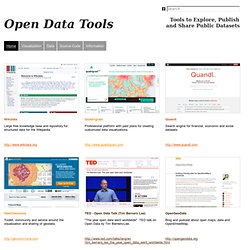
Quadrigram Professional platform with paid plans for creating customized data visualizations. Quandl Search engine for financial, economic and social datasets.