
Twitter Mood Predicts The Stock Market. There’s no shortage of people who say they know how to predict whether the stock market will go up or down on a particular day.
But there are few, if any, who can do it consistently better than tossing a coin. For many economists that’s easy to explain. Conventional economic theory holds that the movement of prices in a perfect market should follow a random walk and should be impossible to predict with an accuracy greater than 50 per cent. Commotion, le projet d'un Internet hors de tout contrôle.
GENI. Information for the World from Outer Space. The future of the open Internet is decentralized. The Internet is having a quarter-life crisis.
At just 25 years old, it suffers from two serious problems: Surveillance is carried out en masse, and citizens in many countries can access only the heavily censored or propagandized information available to them. Those woes have led to a growing chorus calling to decentralize the Internet—to take the power of the Web away from powerful corporations and governments and put it back in the hands of users. This movement toward a decentralized Internet—to a truly free space, where anyone can communicate privately with anyone else without censorship—does not originate from the White House, Pentagon, or the halls of the United Nations.
Zeiss Cinemizer OLED with head-tracking hands-on (video) The Carl Zeiss Cinemizer OLED has been a long time in the making -- we first heard about the video glasses at Macworld in 2008 -- but the company has yet to push the head-mounted display past the prototype phase.
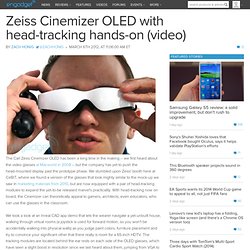
We stumbled upon Zeiss' booth here at CeBIT, where we found a version of the glasses that look mighty similar to the mock-up we saw in marketing materials from 2010, but are now equipped with a pair of head-tracking modules to expand the yet-to-be released marvel's practicality. With head-tracking now on board, the Cinemizer can theoretically appeal to gamers, architects, even educators, who can use the glasses in the classroom.
Zeiss Cinemizer OLED with head-tracking hands-on. Augmented Reality Event - Home. Pranav Mistry: The thrilling potential of SixthSense technology. Pranav Mistry. Un article de Wikipédia, l'encyclopédie libre.
LED Lights Make Augmented Vision a Reality. LED Lights Make Augmented Vision a Reality Okay, this is just freaky.
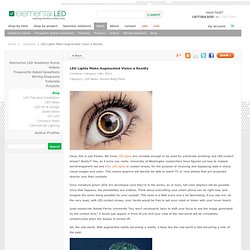
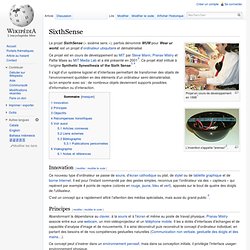
We know LED lights are versatile enough to be used for practically anything, but LED contact lenses? Really?! Yes, as it turns out, really. University of Washington researchers have figured out how to implant semitransparent red and blue LED lights in contact lenses, for the purpose of receiving and displaying data in sharp visual images and video. Tedtalkhaas.png (Image PNG, 1920x872 pixels) - Redimensionnée (66%) Harald Haas: Wireless data from every light bulb. LiFi Consortium. SixthSense - a wearable gestural interface (MIT Media Lab) SixthSense. Un article de Wikipédia, l'encyclopédie libre.
Emotiv - Brain Computer Interface Technology. Trends Watch. The Work of Jonathan Harris. ATAP Project Tango – Google. Sight. Bluefin Labs. Imagining the Internet. Latest Project: The 2014 Hall of Fame interviews, recorded in Hong Kong Hall of Famers share wisdom Imagining the Internet sent a team to the Internet Society's 2014 Internet Hall of Fame induction in Hong Kong to gather interviews with 28 top global Internet leaders. View four hours of interviews plus the Induction Ceremony and a panel discussion and a forum on the open Internet. The Evolution Will Be Socialized.
From the actions of the Egyptian government to the policies of Facebook, the monopolies of central banks to the corporatization of the Internet, we are witnessing the potential of a peer-to-peer networking become overshadowed by the hierarchies of the status quo.
It’s time for us to gather and see what is still possible on the net, and what, if anything, can be built to replace it. I have had a vague misgiving about the direction the net’s been going for, well, maybe 15 years. But until recently, it was more like the feeling when another Starbucks opens on the block, a Wal-Mart moves into town, or a bank forecloses unnecessarily on that cool local bookstore to make room for another bank. Lately, however, what’s wrong with the net has become quite crystalized for me. It started with the corporate-government banishment of Wikileaks last year, and reached a peak with Egypt shutting off its networks to stave off revolution. HTML5. Un article de Wikipédia, l'encyclopédie libre.

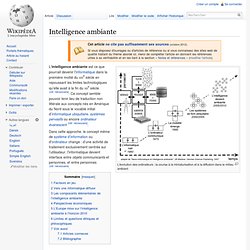
HTML5 (HyperText Markup Language 5) est la dernière révision majeure d'HTML (format de données conçu pour représenter les pages web). Cette version est en développement en 2013. Intelligence ambiante. Un article de Wikipédia, l'encyclopédie libre.
The Future Is All About Context: The Pragmatic Web. The semantic Web has long been heralded as the future of the Web.

Proponents have said that Web experiences will some day become more meaningful and relevant based on the AI-esque computational power of natural-language processing (NLP) and structured data that is understandable by machines for interpretation. However, with the rise of the social Web, we see that what truly makes our online experiences meaningful is not necessarily the Web's ability to approximate human language or to return search results with syntactical exactness. The value of the semantic Web will take time because the intelligent personal agents that are able to process this structured data still have a long way to go before becoming fully actualized. This guest post was written by Alisa Leonard-Hansen. Rather, meaningful and relevant experiences now are born out of the context of our identities and social graph: the pragmatics, or contextual meaning, of our online identities. Android-powered Google Glasses: The augmented reality HUD dream is coming. It’s about time: By the end of 2012, Google will launch a pair of Android-powered, augmented reality, head-up display (HUD) glasses.
Anonymous Google employees, speaking to The New York Times, say that the glasses will resemble a pair of Oakley Thumps (pictured above), will have 3G or 4G connectivity, a forward-facing camera, GPS, and a full array of movement sensors. They will cost “around the price of current smartphones.” Informatique ubiquitaire. Un article de Wikipédia, l'encyclopédie libre. L'évolution des ordinateurs : la course à la minaturisation et à la diffusion dans le milieu ambiant[1].
L´informatique ubiquitaire est la troisième ère de l'histoire de l'informatique, qui succède à l'ère des ordinateurs personnels et celle des mainframe. Internet Traffic is now 51% Non-Human. So you thought the Internet was made by and for people? Think again. A study by Incapsula, a provider of cloud-based security for web sites (mind you where this data comes from), concludes that 51% of all Internet traffic is generated by non-human sources such as hacking software, scrapers and automated spam mechanisms.
While 20% of the 51% non-human traffic is’ good’, the 31% majority of this non-human traffic is potentially malicious. The study is based on data collected from 1,000 websites that utilize Incapsula’s services, and it determined that just 49% of Web traffic is human browsing. 20% is benign non-human search engine traffic, but 31% of all Internet traffic is tied to malicious activities. 19% is from ” ‘spies’ collecting competitive intelligence,” 5% is from automated hacking tools seeking out vulnerabilities, 5% is from scrapers and 2% is from content spammers.
L’internet des objets va-t-il changer la nature des objets. The Evolution of People-Powered Markets: 60 Resources. There is a growing movement towards peer-to-peer value exchange and production, prompted by a variety of things, like economic conditions, shifting cultural values, exploration into collective intelligence, and further enabled by social technologies. I’ve been tracking the online marketplaces that have been cropping up for sharing, swapping, gifting and renting, as well as sites that give people different kinds of opportunity to share skills and knowledge, innovate, and work collaboratively both on and offline.
Below are a few sites I’ve come across, please add any I’ve missed. Augmented Reality Software : E-Commerce : Gaming : Video Conferencing. Comment l’internet transforme-t-il la façon dont on pense ? (4/5) : l’internet n’a-t-il rien changé. Quand l’homme sert de machine à la machine. 5 Major Changes Facing the Internet in 2012. Network World - 2012 is poised to go down in Internet history as one of the most significant 12-month periods from both a technical and policy perspective since the late 1990s, when this network-of-networks stopped being a research project and became an engine of economic growth.
This year the Internet will face several milestones as it undergoes its biggest-ever technical upgrade, from Internet Protocol version 4 to version 6. In addition, key contracts that the U.S. federal government controls for Internet infrastructure and operations are being re-bid. Taken together, these events could result in monumental changes in both who operates the Internet infrastructure as well as how these operations are handled: 1.
The root servers may have a new operator. The Internet Corporation for Assigned Names and Numbers (ICANN) has overseen the operation of the Internet root servers since the non-profit was founded in 1998. 2. Verisign has operated the .com domain since 1999. 3. Newspaper_Extinction_Timeline.pdf (Objet application/pdf) Future of Sex. The Internet Gets Physical. 10 projets technologiques fascinants financés par des internautes. Tu connais peut-être Kickstarter, le site où les inventeurs de tout horizon peuvent essayer de convaincre des internautes de financer leurs projets pour les réaliser. Ce n'est pas le seul site sur ce créneau, citons par exemple les français de Ulule ou de Octopousse. Mais Kickstarter est sans doute l'un des plus célèbres, qui réunit un nombre impressionnant de projets et d'investisseurs, avec des sommes parfois colossales (la barrière des 10 millions de dollars pour un projet a été franchie au mois de mai.
Oui tu as bien lu. Tout ça avec l'argent de gentils internautes qui acceptent de recevoir, selon les cas et le montant de leur apport, soit un ou plusieurs exemplaire(s) du produit, soit de simples goodies). Voici une sélection personnelle de projets relatifs à la technologie que j'ai trouvé vraiment intéressants et originaux. Si tu vois ce que je veux dire. MYO - The Gesture Control Armband. Shapeways - Make & Share Your Products with 3D Printing.
Insights show how consumers use different devices together. Www.dontclick.it. The Future Will Be Personalized. When my partners and I joined MySpace, we were lucky enough to be at the leading edge of the social revolution that changed how we use the Internet. A new groundswell is coming, transforming the web once again: the personal revolution.
Information Overload Today, we live in a world where we’re constantly overwhelmed by information. There are over 90M tweets per day, 34 hours of YouTube video uploaded every minute, and every Facebook user has an average of 130 friends who are becoming more and more active all the time. The Future Of Work Is Play.
Humans love games. Just check the current news cycle for evidence: The Xbox 360’s sleek, new controller-free gaming device, Kinect, is the fastest-selling consumer electronic product ever. Predictions for 2010 and the new decade. Home. Envisioning-technology-2011-02-25.pdf (Objet application/pdf) Jane McGonigal: Gaming can make a better world. You found me. Urgent Evoke.
Le jeu vidéo de politique financé par l'armée française - guerrelec. Quel futur pour les “mindgames” Par Rémi Sussan le 03/04/08 | 3 commentaires | 6,455 lectures | Impression Les premières interfaces cerveau-machine pour joueurs devraient arriver sur le marché cette année. On commence à en savoir un peu plus sur les technologies employées par les casques Emotivet Neurosky, que nous avons déjà évoqués dans nos colonnes. Un article de Physorg détaille en effet le fonctionnement de ces nouvelles machines grand public. Elles reposent non pas sur une seule technologie, mais sur plusieurs, toutes assez anciennes. An Idea Worth Spreading: The Future is Networks. What's a zettabyte? By 2015, the internet will know, says Cisco. Elements of the Web's Next Generation.
Future of Internet Search: Mobile version on the Behance Network. Les smartphones du futur capteront les émotions, selon Intel. Feel, Act, Make sense. Mevoked. Supermechanical : objects that connect us. HumanAPI: An API platform for human health data. Augmented Reality on Mobile Internet Devices. Researchers claim quantum breakthrough › News in Science (ABC Science)