
The Memory Practice. Synaptic Plasticity. Ide. Neurons gonna make cells in your mind, there are 100 billion in your brain all combined. They communicate through electrical and chemical means. So many different types that help you think and move, working together when you’re in the video game groove. Ones that fire when you touch the controller, others that help you respond to prevent game over. These changes happen at the synapse. Synapses are the way neurons talk. You get an electrical signal called an action potential, calcium released means vesicles combine, and then your electrical signal is on a roll. Aviso de redirección. The Human Brain - Exercise. In a sedentary group of people aged 60 to 75, University of Illinois researchers introduced them to a fitness regime.
For six months the elders had either an aerobic or non-aerobic workout for up to 90 minutes, three times a week. "We chose couch potatoes," said the study's lead author, cognitive neuroscientist Arthur Kramer. The 214 healthy adults hadn't been involved in any physical exercise for the previous 5 to 10 years.
What the Supercool Arctic Ground Squirrel Teaches Us about the Brain's Resilience. Every September arctic ground squirrels in Alaska, Canada and Siberia retreat into burrows more than a meter beneath the tundra, curl up in nests built from grass, lichen and caribou hair, and begin to hibernate.

As their lungs and hearts slow, the rivers of blood flowing through their bodies dwindle and their core body temperatures plummet, dipping below the freezing point of water. Electrical signals zipping along crisscrossing neural highways vanish in many areas of the brain. Seven months later the squirrels wake up and return to the surface—famished, eager to mate and perfectly healthy. Can We Trust Neuroscience? When a study like this comes out a flurry of activity hits the web through news articles and blogs, but what does it really mean?
Does an increase in gray matter mean that if we practice mindfulness meditation for 30-minutes a day for 8 weeks we’ll be smarter, be able to retain more information or have less fear? The truth is, the field of neuroscience, while enjoying an explosion of new research is still in its infancy. Mindfulness and Neuroplasticity. William James was one of the first psychologists to address the notion of neuroplasticity back in his late 19th century text, “The Principles of Psychology.”
The central idea behind neuroplasticity is that our brain can restructure itself based on our experience. One great example of neuroplasticity is sensory substitution. For instance, if a person is born blind, often the visual parts of the brain will be taken over by another sense, such as hearing or touch. This is the brain’s way of re-allocating unused processing power only to what we are actually experiencing.
3D Mind Map of Cognitive Science. The Rockefeller University » Scientists & Research. Throughout life, hormones alter behavior and mood, regulate neuroendocrine activity, protect the brain from stress and regulate brain aging and certain disease processes. Dr. McEwen’s laboratory studies how stress and sex hormones act on the brain, taking an interdisciplinary approach that combines behavioral analysis and measurements of hormone levels with neurochemical, morphological, neuropharmacological, cellular and molecular methodologies and collaborative translational studies.
The neuroendocrine system links behavior and experience with hormone secretion. People control thoughts better when they see their brain activity. The brain's rostrolateral prefrontal cortex region (credit: UBC Dept. of Psychology) Researchers at the University of British Columbia have discovered that people can gain greater control over their thoughts with real-time brain feedback.
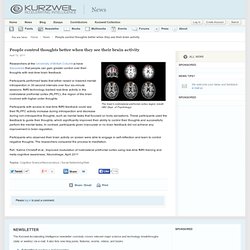
Participants performed tasks that either raised or lowered mental introspection in 30-second intervals over four six-minute sessions. fMRI technology tracked real-time activity in the rostrolateral prefrontal cortex (RLPFC), the region of the brain involved with higher-order thoughts. Polyglots Might Have Multiple Personalities. Our most traumatic memories could be erased, thanks to the marine snail.
Neuroplasticity. Searching for Health. The Wellspring Institute For Neuroscience and Contemplative Wisdom. Author of Buddha's Brain: The Practical Neuroscience of Happiness, Love and Wisdom. Neuroplasticity. Contrary to conventional thought as expressed in this diagram, brain functions are not confined to certain fixed locations.
Neuroplasticity, also known as brain plasticity, is an umbrella term that encompasses both synaptic plasticity and non-synaptic plasticity—it refers to changes in neural pathways and synapses which are due to changes in behavior, environment and neural processes, as well as changes resulting from bodily injury.[1] Neuroplasticity has replaced the formerly-held position that the brain is a physiologically static organ, and explores how - and in which ways - the brain changes throughout life.[2] Neuroplasticity occurs on a variety of levels, ranging from cellular changes due to learning, to large-scale changes involved in cortical remapping in response to injury. The role of neuroplasticity is widely recognized in healthy development, learning, memory, and recovery from brain damage. Neurobiology[edit] Cortical maps[edit] Applications and example[edit] Vision[edit]
Neuroplasticity definition. Neuroplasticity: The brain's ability to reorganize itself by forming new neural connections throughout life.

Neuroplasticity allows the neurons (nerve cells) in the brain to compensate for injury and disease and to adjust their activities in response to new situations or to changes in their environment. Brain reorganization takes place by mechanisms such as "axonal sprouting" in which undamaged axons grow new nerve endings to reconnect neurons whose links were injured or severed. Undamaged axons can also sprout nerve endings and connect with other undamaged nerve cells, forming new neural pathways to accomplish a needed function.
For example, if one hemisphere of the brain is damaged, the intact hemisphere may take over some of its functions. Www.rickhanson.net/wp-content/files/SlidesNeuroplasticity.pdf.