
-ome - definition of -ome by the Free Online Dictionary. Trapezius muscle. In human anatomy, the trapezius (/trəˈpiːzi.əs/) is a large superficial muscle that extends longitudinally from the occipital bone to the lower thoracic vertebrae and laterally to the spine of the scapula (shoulder blade).
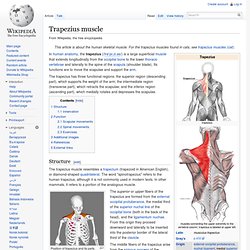
Its functions are to move the scapulae and support the arm. Lipidome. The lipodome in connection with the total interactome of a cell.
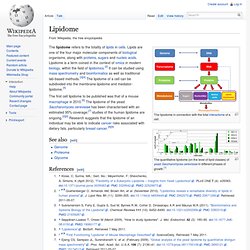
The first cell lipidome to be published was that of a mouse macrophage in 2010.[6] The lipidome of the yeast Saccharomyces cerevisiae has been characterised with an estimated 95% coverage;[7] studies of the human lipidome are ongoing.[2][6] Research suggests that the lipidome of an individual may be able to indicate cancer risks associated with dietary fats, particularly breast cancer.[8][9] See also[edit] References[edit] Jump up ^ Klose, C; Surma, MA.; Gerl, MJ.; Meyenhofer, F; Shevchenko, A; Simons, K (April 2012). Lipid bilayer. The lipid bilayer is a thin polar membrane made of two layers of lipid molecules . These membranes are flat sheets that form a continuous barrier around cells . The cell membrane of almost all living organisms and many viruses are made of a lipid bilayer, as are the membranes surrounding the cell nucleus and other sub-cellular structures.
The lipid bilayer is the barrier that keeps ions , proteins and other molecules where they are needed and prevents them from diffusing into areas where they should not be. Lipid bilayers are ideally suited to this role because, even though they are only a few nanometers in width, they are impermeable to most water-soluble ( hydrophilic ) molecules. Bilayers are particularly impermeable to ions, which allows cells to regulate salt concentrations and pH by pumping ions across their membranes using proteins called ion pumps . Microsphere. Microspheres are small spherical particles, with diameters in the micrometer range (typically 1 μm to 1000 μm (1 mm)).
Microspheres are sometimes referred to as microparticles. Microspheres can be manufactured from various natural and synthetic materials. Glass microspheres, polymer microspheres and ceramic microspheres are commercially available. Metallome. Hiroki Haraguchi gave an alternative definition of "metallomes" as metalloproteins or any other metal-containing biomolecules, and "metallomics" as a study of such biomolecules.
In the study of metallomes the transcriptome, proteome and the metabolome will constitute the whole metallome. A study of the metallome is done to arrive at the metallointeractome. Substrate (printing) Substrate. From Wikipedia, the free encyclopedia Substrate may refer to:
Contrast medium. A medical contrast medium (or contrast agent) is a substance used to enhance the contrast of structures or fluids within the body in medical imaging.[1] It is commonly used to enhance the visibility of blood vessels and the gastrointestinal tract.

Types[edit] X-ray attenuation[edit] MR signal enhancing[edit] This would include gadolinium for use in magnetic resonance imaging as a MRI contrast agent. In the 3+ oxidation state the metal has 7 unpaired f electrons. Peptidomimetic. A peptidomimetic is a small protein-like chain designed to mimic a peptide.
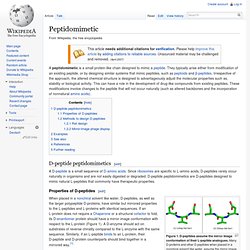
They typically arise either from modification of an existing peptide, or by designing similar systems that mimic peptides, such as peptoids and β-peptides. Irrespective of the approach, the altered chemical structure is designed to advantageously adjust the molecular properties such as, stability or biological activity. This can have a role in the development of drug-like compounds from existing peptides. These modifications involve changes to the peptide that will not occur naturally (such as altered backbones and the incorporation of nonnatural amino acids). Cyclic peptide. Cyclic peptides (or cyclic proteins) are polypeptide chains wherein the amino termini and carboxyl termini, amino termini and side chain, carboxyl termini and side chain, or side chain and side chain are linked with a covalent bond that generates the ring.
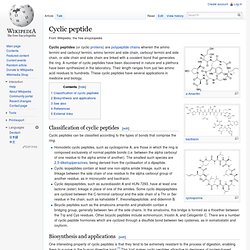
A number of cyclic peptides have been discovered in nature and a plethora have been synthesized in the laboratory. Their length ranges from just two amino acid residues to hundreds. These cyclic peptides have several applications in medicine and biology. Single-domain antibody. A single-domain antibody (sdAb, called Nanobody by Ablynx, the developer[1]) is an antibody fragment consisting of a single monomeric variable antibody domain.
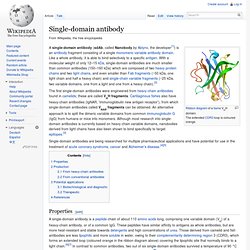
Like a whole antibody, it is able to bind selectively to a specific antigen. With a molecular weight of only 12–15 kDa, single-domain antibodies are much smaller than common antibodies (150–160 kDa) which are composed of two heavy protein chains and two light chains, and even smaller than Fab fragments (~50 kDa, one light chain and half a heavy chain) and single-chain variable fragments (~25 kDa, two variable domains, one from a light and one from a heavy chain).[2] Glucosepane. Glucosepane is a lysine-arginine protein cross-linking product and advanced glycation end product (AGE) derived from D-glucose.[1] It is an irreversible, covalent cross-link product that has been found to make intermolecular and intramolecular cross-links in the collagen of the extracellular matrix (ECM) and crystallin of the eyes.[2] Covalent protein cross-links irreversibly link proteins together in the ECM of tissues.
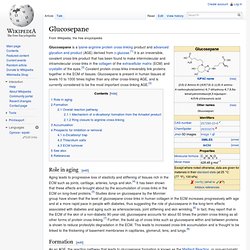
Glucosepane is present in human tissues at levels 10 to 1000 times higher than any other cross-linking AGE, and is currently considered to be the most important cross-linking AGE.[3] Role in aging[edit] Formation[edit] As an AGE, the reaction pathway that leads to glucosepane formation is known as the Maillard Reaction, or non-enzymatic browning. RAGE (receptor) Schematic of the relation between an immunoglobulin and RAGE Schematic of the RAGE gene and its products The interaction between RAGE and its ligands is thought to result in pro-inflammatory gene activation.[2] Due to an enhanced level of RAGE ligands in diabetes or other chronic disorders, this receptor is hypothesised to have a causative effect in a range of inflammatory diseases such as diabetic complications, Alzheimer's disease and even some tumors. Isoforms of the RAGE protein, which lack the transmembrane and the signaling domain (commonly referred to as soluble RAGE or sRAGE) are hypothesized to counteract the detrimental action of the full-length receptor and are hoped to provide a means to develop a cure against RAGE-associated diseases.
Tissue transglutaminase. Tissue transglutaminase (abbreviated as tTG or TG2) is a 78-kDa, calcium dependent enzyme (EC 2.3.2.13) of the protein-glutamine γ-glutamyltransferases family (or simply transglutaminase family).[1][2] Like other transglutaminases, it crosslinks proteins between an ε-amino group of a lysine residue and a γ-carboxamide group of glutamine residue, creating an inter- or intramolecular bond that is highly resistant to proteolysis (protein degradation).
Aside from its crosslinking function, tTG catalyzes other types of reactions including deamidation, GTP-binding/hydrolyzing, and isopeptidase activities.[3] Unlike other members of the transglutaminase family, tTG can be found both in the intracellular and the extracellular spaces of various types of tissues and is found in many different organs including the heart, the liver, and the small intestine. Sorting algorithm. The output is in nondecreasing order (each element is no smaller than the previous element according to the desired total order);The output is a permutation (reordering) of the input. Further, the data is often taken to be in an array, which allows random access, rather than a list, which only allows sequential access, though often algorithms can be applied with suitable modification to either type of data. Since the dawn of computing, the sorting problem has attracted a great deal of research, perhaps due to the complexity of solving it efficiently despite its simple, familiar statement.
For example, bubble sort was analyzed as early as 1956.[1] A fundamental limit of comparison sorting algorithms is that they require linearithmic time – O(n log n) – in the worst case, though better performance is possible on real-world data (such as almost-sorted data), and algorithms not based on comparison, such as counting sort, can have better performance. Attractor. Visual representation of a strange attractor In the mathematical field of dynamical systems, an attractor is a set of numerical properties toward which a system tends to evolve, for a wide variety of starting conditions of the system.[1] System values that get close enough to the attractor values remain close even if slightly disturbed.
A trajectory of the dynamical system in the attractor does not have to satisfy any special constraints except for remaining on the attractor, backward and forward in time. The trajectory may be periodic or chaotic. Photomultiplier. Photomultiplier. Identifier. Quaternary compound. Spectrum. Spectrum has since been applied by analogy to topics outside of optics. G protein-coupled receptor. Growth curve. Growth curves are employed in many disciplines besides biology, particularly in statistics, which has an extensive literature on growth curves.[1] In mathematical statistics, growth curves are often modeled as being continuous stochastic processes, e.g. as being sample paths that almost surely solve stochastic differential equations.[2]
Erythropoietin. Erythropoietin, (/ɨˌrɪθrɵˈpɔɪ.ɨtɨn/, UK /ɛˌrɪθroʊ.poʊˈiːtɪn/) also known as EPO, is a glycoprotein hormone that controls erythropoiesis, or red blood cell production. Equity (finance) At the very start of a business, owners put some funding into the business to finance operations. Gear. Two meshing gears transmitting rotational motion.
Note that the smaller gear is rotating faster. Although the larger gear is rotating less quickly, its torque is proportionally greater. Nucleophile. Basal metabolic rate. Baseline. Landscape. Neuron. Nanowire. Fullerene. Microsystem. Active site. Integrated circuit. Acoustic metamaterials. Carboxylic acid. Proline. Glutamic acid. Shuttle - definition of shuttle by the Free Online Dictionary. Resin (disambiguation) AKT. Phosphatidylinositol (3,4,5)-trisphosphate. Beacon (disambiguation) Cutoff. Antiproliferative - Medical Definition and More from Merriam-Webster. Protein primary structure. Structural motif. Sequence motif. Recognition sequence. Polyvinylidene fluoride. Synthetic membrane. Chaotropic agent. Matroid. Flow network. Organization.
Web application framework. Ectodomain. Proxy server. Biotin. Streptavidin. Toxin-antitoxin system. Dipole. Resource. Verbal memory. Template. Blood plasma. Peroxisome. Plasma (physics) Proton. Proton. Geroprotector. Metabolism. Bio-MEMS. Landing page. Experiment. Biofilm. Aquaporin 3. Gel. Nitrotyrosine. Tryptophan. S-Nitrosothiol. Subunit. Unit. Euler spiral. Stabilizer. Lab-on-a-chip. Molar concentration. Molecular propeller. Nanomotor. Synthetic molecular motor.
Protein domain. Molecular motor. Self-propelled particles. Vesicle (biology and chemistry) Fragment. Mode. Gradient. Glycan.