
Memristor found: HP Labs proves fourth integrated circuit elemen. In the memristor work, the researchers built on their extensive experience - Williams founded the precursor lab to IQSL in 1995 - in building and studying nanoscale electronics and architectures.

One goal of this work has been to move computing beyond the physical and fiscal limits of conventional silicon chips. For decades, increases in chip performance have come about largely by putting more and more transistors on a circuit. Higher densities, however, increase the problems of heat generation and defects and affect the basic physics of the devices. "Instead of increasing the number of transistors on a circuit, we could create a hybrid circuit with fewer transistors but the addition of memristors - and more functionality," Williams says.
Alternately, memristor technologies could enable more energy-efficient high-density circuits. In 2007, the team developed an architecture for such a hybrid chip using conventional CMOS technology and nanoscale switching devices. HP Discovers Potential "God Particle" of Electronics. Silicon Valley is mostly a world of practical technology—applying principles from pure science to create handy gadgets.
But today, Hewlett Packard announced a new electrical component born of theoretical physics. The device, a nanoscale component called a "memristor," requires no power to retain data, which it can store more densely than a hard drive and access about as fast as a computer's RAM memory—potentially allowing it to replace both components in the future. Memristors can function in either a digital mode, in which a memory cell is "on" or "off," or in analog mode, in which each cell holds some value in between. These values grow every time the cell receives an electrical signal, mimicking the way neurons in the brain build stronger memories the more they are stimulated. The memristor was theorized in the early seventies by an electrical engineer name Leon Chua, but it took decades before anyone could prove it exists.
First PCs Then Androids? How it Works. Memristor. Leon Chua has more recently argued that the definition could be generalized to cover all forms of two-terminal non-volatile memory devices based on resistance switching effects[2] although some experimental evidence contradicts this claim, since a non-passive nanobattery effect is observable in resistance switching memory.[5] Chua also argued that the memristor is the oldest known circuit element, with its effects predating the resistor, capacitor and inductor.[6] Background[edit] Conceptual symmetries of resistor, capacitor, inductor, and memristor.
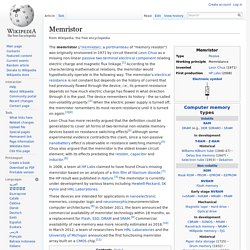
In his 1971 paper, Chua extrapolated a conceptual symmetry between the nonlinear resistor (voltage vs. current), nonlinear capacitor (voltage vs. charge) and nonlinear inductor (magnetic flux linkage vs. current). He then inferred the possibility of a memristor as another fundamental nonlinear circuit element linking magnetic flux and charge. Leon O. Chua. Leon Ong Chua (/ˈtʃwɑː/; Chinese: 蔡少棠; pinyin: Cài Shàotáng; Pe̍h-ōe-jī: Chhòa Siáu-tông; born June 28, 1936) is an IEEE Fellow and a professor in the electrical engineering and computer sciences department at the University of California, Berkeley, which he joined in 1971.
Dr. Leon O. Chua contributed to nonlinear circuit theory and Cellular neural network (CNN).[1] He is also the inventor and namesake of Chua's circuit[2] and was the first to conceive the theories behind, and postulate the existence of, the memristor.[3] Thirty-seven years after he predicted its existence, a working solid-state memristor was created by a team led by R. Stanley Williams at Hewlett Packard.[4][5] Early life and education[edit] A Chinese American, Chua and his twin sister grew up as members of the Chinese ethnic minority in the Philippines[6] under the reign of the Empire of Japan during World War II. Career[edit] Awards and honors[edit] References[edit] External links[edit] Chua's homepage at Berkeley. Spectrum: The Mysterious Memristor. Photo: R.

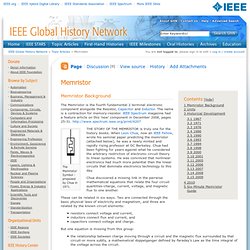
Stanley Williams 1 May 2008--Anyone familiar with electronics knows the trinity of fundamental components: the resistor, the capacitor, and the inductor. In 1971, a University of California, Berkeley, engineer predicted that there should be a fourth element: a memory resistor, or memristor. But no one knew how to build one. Now, 37 years later, electronics have finally gotten small enough to reveal the secrets of that fourth element. The memristor's story starts nearly four decades ago with a flash of insight by IEEE Fellow and nonlinear-circuit-theory pioneer Leon Chua. But the hypothetical device was mostly written off as a mathematical dalliance. The reason that the memristor is radically different from the other fundamental circuit elements is that, unlike them, it carries a memory of its past. The classic analogy for a resistor is a pipe through which water (electricity) runs. Image: J. So why hadn't anyone seen memristance?
Memristor - GHN. From GHN.
The Miraculous Memristor - Logic And Memory Plus Going Beyond Mo. Posted by Tom Foremski - April 19, 2010 I recently visited HP Labs and spoke with Stan Williams, senior fellow at Hewlett-Packard and director of Quantum Science Research, about an incredible semiconductor device -- the memristor. Until fairly recently, the memristor, short for memory resistor, was a mythical electronic component. It had been predicted to exist by a mathematician, Leon Chua, a professor at UC Berkeley, in an 1971 paper. No one had made a memristor until Stan Williams and his team cracked it in 2008. The memristor can: - store data like DRAM or Flash but it doesn't require any energy to maintain the data storage. - the memristor chips can be laid down in layer upon layer upon layer, creating three-dimensional structures that can store and process data. - the memristor is easy to make and completely compatible with today's CMOS chip making processes. - it can be scaled to very small geometries without losing its properties. - This gets interesting.