Articles shared by gangsters

FacebookTwitter
For the past five years, PATH has worked extensively with developing country small- and medium-sized enterprises and social organizations (such as local nongovernmental organizations or NGOs) to build commercial capacity and create, test, and refine social business models that can have a meaningful impact on important health issues. The Commercialization Toolkit consists of a combination of approaches that were successful in making health products available to low-income households. It illustrates how PATH has helped partners through the commercialization process in several developing countries. The toolkit is organized into eight modules, each covering a different commercial discipline or approach.
Commercialization Toolkit - PATH

http://sites.path.org/commercializationtoolkit/
Games for good

Next step to understanding Selco customers’ experience in dealing with solar loans was the bank managers’ office. But before talking about what the bankers told (and taught) me, let’s put things into perspective. Let’s try to understand the Indian context regarding financial literacy and inclusion. Why is financial literacy and inclusion so important in (rural) India? “Today, a vast section of rural population is denied much needed financial services resulting in financial and social exclusion” (Syndicate Bank in its first 2011 semester report). You will tell me this statement could apply to any of the blue countries above http://creatingbridges.org/2011/10/24/step-2-what-is-financial-inclusion-m-banker/

Step 2: What is financial inclusion M. Banker? | creatingbridges.org

(It’s pretty hard to change the world, if no one wants to follow your thinking…) Curtis Faith has been asking us all about stories. What is your story? Who is the hero? How will it end?
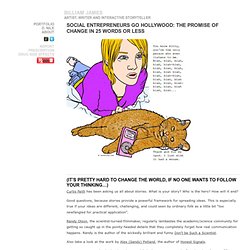
Social entrepreneurs go Hollywood: The promise of change in 25 words or less

http://www.billiamjames.com/25-words/

MakeSense dans les inrocks

les inrockuptibles 14.09.2011 i certains doutent encore de l’utilité des réseaux sociaux, MakeSense pourrait bien les faire changer d’avis. Ce projet, créé par deux anciens étudiants à l’Ec ole de commerc e marseillaise Euromed, Christian Vanizette et Romain Raguin, utilise toutes les possibilités du web 2.0 pour développer le bénévolat auprès d’entreprises sociales. Selon la définition de Muhammad Yunus, le père du microcrédit, une entreprise sociale est une société qui agit pour une cause sociale et/ou environnementale, à laquelle elle consacre la totalité de ses bénéfices. Pour fonctionner, elles ont besoin d’argent mais aussi de bénévoles qui apportent expérience et compétences. MakeSense propose précisément http://fr.scribd.com/doc/68105319/MakeSense-dans-les-inrocks