
Penn Students Leave School to Launch CourseKit With $1 Million Seed Round. Three students at the University of Pennsylvania—Joseph Cohen, Dan Getelman, and Jim Grandpre—are quitting school to launch a new education startup called Coursekit, and they’ve raised $1 million in a seed round to do it.

(Peter Thiel would be proud). The New York City startup just closed a seed round from Founder Collective, IA Ventures, Shasta Ventures and some angels. IA Ventures led the round. Coursekit is like Facebook or Yammer for courses. Like many other students frustrated with Blackboard, the current online course management standard, the Coursekit founders think they can do a better job. The service will launch later this summer in time for the Fall semester. But it is also a social messaging system for students to communicate with each other. Coursekit Is Ready for Its Closeup. By Adrianne Jeffries 11/29/11 12:58pm Share this: Coursekit, the TechStars company that raised $1 million from Founder Collective, IA Ventures, TechStars and a few angels before the program even started, just launched to the public.
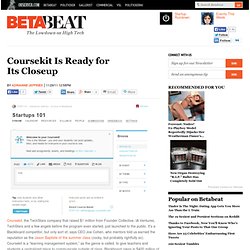
It’s a Blackboard competitor, but only sort of, says CEO Joe Cohen, who mentors told us earned the reputation as the Jason Baptiste of the summer class (cocky, but probably rightfully so). Coursekit is a “learning management system,” as the genre is called, to give teachers and students a centralized place to communicate outside of class. Blackboard rakes in $400 million of the $500 million spent on this type of software per year, he said, but Coursekit isn’t interested in that money.
All sorts of things! “Higher education accounts for half a trillion of our GDP,” he said gravely. That means distributing electronic textbooks for McGraw-Hill, for example, he said. Blackboard dominates the market because universities are slow and bureaucratic, Mr. Mediander Undo. New Course-Management Software Promises Facebook-Like Experience - Wired Campus. Three University of Pennsylvania students who recently dropped out to start an upstart course-management system today unveiled their software, called Coursekit, after having raised more than $1-million in venture capital.

The trio, frustrated with the systems offered by universities, such as Blackboard, decided to team up and design their own online course platform, which emphasizes social networking and an easy-to-use interface. By May, the founders, Joesph Cohen, Dan Getelman, and Jim Grandpre, had raised so much start-up cash, from sources including the Founder Collective and IA Ventures, that they decided to quit school to focus on developing Coursekit. Thirty universities tested Coursekit this fall, including Stanford and the University of Pennsylvania. Coursekit offers a platform for hosting discussions, posting grades and syllabi, sharing calendars and links, and creating student profiles. Return to Top. Coursekit. Will Coursekit Launch Up-End Blackboard? Coursekit Aims To Overhaul How Teachers Run Their Classrooms. A couple years ago, I sat in on a "Technology in the Classroom" course.

We spent the early part of the day talking about new tools that were available. The discussion turned into a litany of complaints: IT policies that prevented the installation of new software, draconian site-blocking measures, thimble-sized storage allowances. At every turn, each new tool that a teacher wanted to try out would require a fight with administration. The frustration was palpable. "Why are the IT people making pedagogical decisions? " Joseph Cohen, cofounder and CEO of Coursekit, agrees. In the educational market, the role of BlackBerry is played by Blackboard, the dominant player in learning management systems.
To solve this, Coursekit is going straight to the users--teachers and students. "Everyone’s a designer, whether or not they know they’re in design," he told me, "The business design is just as important as the product if we want to do any damage in this space. " Take the Facebook wall.