
Unusual Long Exposure Firework Photographs by David Johnson. While attending the International Fireworks Show in Ottawa, Canada earlier this month photographer David Johnson had his camera in hand to document the night.
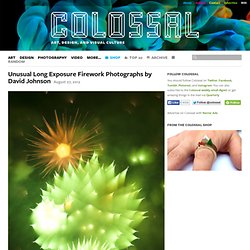
When Spain’s entry into the competition begin he decided to try something a little different resulting in the photos you see here which are unlike any long exposure firework shots I’ve ever seen. Via email David tells me how he accomplished the effect: The technique I used was a simple refocus during the long exposure. Each shot was about a second long, sometimes two.
I’d start out of focus, and when I heard the explosion I would quickly refocus, so the little stems on these deep sea creature lookalikes would grow into a fine point. What’s interesting is that unlike usual firework photos that seem to make long trails across the sky, Johnson’s photos look like flowers with little triangular plumes coming to a point. LIFE Magazine Looks at an LSD-Inspired Art Show, 1966. On April 16, 1943, a Swiss chemist named Albert Hofmann accidentally dosed himself with a miniscule amount of a new, virtually unknown, clinically-synthesized compound, lysergic acid diethylamide, or LSD-25 — becoming, in the process, the first human being to trip on acid.

A few days later, Hofmann experienced a full-blown intentional acid trip when he self-administered 250 micrograms. The 250 micrograms with which Hofmann dosed himself represented what he believed to be a “threshold” amount, i.e., a dose that would spark a noticeable and perhaps even quantifiable response in the test subject. Subsequent clinical studies indicate that a threshold dose of LSD is actually closer to 20 micrograms. Amid throbbing lights, dizzying designs, swirling smells, swelling sounds, the world of art is “turning on.”
It is getting hooked on psychedelic art, the latest, liveliest movement to seethe up from the underground. Psychedelic art is not all new. Light drawing workshop with robotic arms. Video below is the result of a workshop held last week at SCI-Arc teaching students about synchronous robotics.

We already covered SCI-Arc robotics here, but the results this time are bullet time light drawings which instead of being constrained to a bullet time camera rig have the freedom to be viewed from any perspective. LEDs are attached to corners and centres of the panels whereas the DSLR camera is attached to one of the robotic arms. As the panels move in sync, the camera takes pictures of LED paths. No video editing was done to the light drawings, simply a series of still images. Below is also the original proof of concept for the workshop. Robot Control Software: esperantorobotics.com Research Institution: sciarc.edu, estm.us Instructors: Brandon Kruysman & Jonathan Proto thecognomen.net Students: TeamA: Al Ataide, Mehrzad Rafeei, Somayyeh Ramezani, Peter Vikar TeamB: Amir Habibabadi, Francisco Moure, Juan Osorio TeamC: Peter Kaoud, Eugene Kosgoron, Mira Lee (Thanks Jonathan) Perspective_pic: Moon art.