
15 Effective Tools for Visual Knowledge Management. Since I started my quest a few years ago searching for the ultimate knowledge management tool, I’ve discovered a number of interesting applications that help people efficiently organize information.
There certainly is no shortage of solutions for this problem domain. Many tools exist that offer the ability to discover, save, organize, search, and retrieve information. Untitled. Does Gamification work in a Knowledge Management environment? I spoke last week on the topic of gamifcation with Andrzej Marczewski (@daverage) and Stephen Dale (@stephendale).

Both have more than a passing interest in this topic: Andrzej is currently ranked the #1 ‘Gamification Guru’ (in a US online poll) who focuses on inter alia User Types, who blogs and publishes the Gamification News;Steve who has a long and distinguished career in Knowledge & Information (and who has chaired Online for a number of years) is interested in how behaviours are influenced by gamification and recently ran a well received workshop for NetIKx ‘#Gamification strategies for incentivising knowledge sharing and engagement: I first heard Andrzej at Ana Neves’ excellent 2013 Social Now event in Lisboa where many of the presenters described how they’d used gamification techniques.
It occured to me then that as communicators and marketers are increasingly using Gamification for engaging with staff and external stakeholders, so why should Knowledge Managers be different? Mind Mapping Software, Brainstorming, GTD and Knowledgebase Software. 100 Companies That Matter in Knowledge Management. With the juggernaut of consolidation growing ever louder since we first put this list together in 2000, you'd think identifying a hundred companies that matter in knowledge management would be increasingly easier to assemble, right?
Heck, it simply follows that with fewer companies to choose from, it would be simpler to pick 100. Not at all. It's harder than ever because of the increasing cross-functionality of today's solutions. As is the case since we first published it in 2000, compilation of the list is a yearlong collaborative effort among colleagues, analysts, system integrators and a select group of users. As it has been for 13 years, the list is intended to spark a larger discussion of knowledge management. Criteria for inclusion vary, but all companies have things in common. We encourage you to visit the websites of the 100 companies we listed. Knowledge Management using Mind Maps. Click to download this Mind Map document.
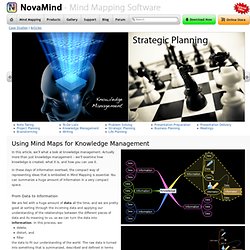
In this article, we’ll what a look at knowledge management. Actually more than just knowledge management – we’ll examine how knowledge is created, what it is, and how you can use it. In these days of information overload, the compact way of representing ideas that is embodied in Mind Mapping is essential. You can summarize a huge amount of information in a very compact space. From Data to Information We are fed with a huge amount of data all the time, and we are pretty good at sorting through the incoming data and applying our understanding of the relationships between the different pieces of data and its meaning to us, so we can turn the data into information.
Delete, distort, and filter the data to fit our understanding of the world. 3-Visualizations & mapping. Knowledge Management using NovaMind Mind Mapping Software. Outils pour Document & Information Manager (D&iM) KNOWLEDGE PLAZA – knowledge management - social km - km 2.0 - gestion des connaissances. What is Social Knowledge Management, Anyway? It seems like everyone is talking traditional knowledge management (KM 1.0) versus Social KM these days.
To get the scoop, I interviewed four industry and government experts on the very hot topic. Here are Three Key Takeaways for agencies/organizations looking to build communities of knowledge, enable change, and crowdsource innovation…from the inside. 1. What is Social KM? Knowledge Management Online. Knowledge Management Software. Moxy Knowledge Management. Free Knowledge Management Software. Knowledge Management Tools. Personal Knowledge Management. Edtechpost - PLE Diagrams. Knowledge Management Software. Knowledge Management Software to Locate, Capture and Share Information With Your Team.
Interspire Knowledge Manager allows you to share information from your website or Intranet with an enterprise-grade knowledge base, reducing customer support, improving staff productivity and eliminating time wasted searching for information across disparate systems such as shared folders and paper documents. Share knowledge easily & securely Already in use by over 2,000 small businesses, universities, non-profits and enterprise organizations, Interspire Knowledge Manager can be used to: Reduce in-bound customer support.
The web-based self help interface makes it easy for customers to find answers to their own problems instead of submitting emails or calling your support department. Powerful & Fully Featured Knowledge Management Software Features to reduce customer support: Features to make sharing company documents and procedures easier: Features to reduce staff training time: Next Steps. Triviumsoft - Talent Management Software. Everyone and Everything Intelligently Connected. Tools and techniques for knowledge management. Welcome // ISS Seminar on Knowledge Management. March 17-18, 1998 (2 days) Scope and Objectives The seminar presents a balanced synthesis of the state of our understanding about effective knowledge mangement strategies, practices and technologies.

The seminar: Knowledge retrieval. Knowledge Retrieval seeks to return information in a structured form, consistent with human cognitive processes as opposed to simple lists of data items.
It draws on a range of fields including epistemology (theory of knowledge), cognitive psychology, cognitive neuroscience, logic and inference, machine learning and knowledge discovery, linguistics, and information technology. Overview[edit] In the field of retrieval systems, established approaches include: Data Retrieval Systems (DRS), such as database management systems, are well suitable for the storage and retrieval of structured data.Information Retrieval Systems (IRS), such as web search engines, are very effective in finding the relevant documents or web pages. Both approaches require a user to read and analyze often long lists of data sets or documents in order to extract meaning. The Knowledge Management Programme. Knowledge extraction. Knowledge extraction is the creation of knowledge from structured (relational databases, XML) and unstructured (text, documents, images) sources.
The resulting knowledge needs to be in a machine-readable and machine-interpretable format and must represent knowledge in a manner that facilitates inferencing. Although it is methodically similar to information extraction (NLP) and ETL (data warehouse), the main criteria is that the extraction result goes beyond the creation of structured information or the transformation into a relational schema.
It requires either the reuse of existing formal knowledge (reusing identifiers or ontologies) or the generation of a schema based on the source data. Overview[edit] After the standardization of knowledge representation languages such as RDF and OWL, much research has been conducted in the area, especially regarding transforming relational databases into RDF, identity resolution, knowledge discovery and ontology learning. Examples[edit] How to Create a Robust and Meaningful Personal Learning Network [PLN]
This post describes how educators can develop a personal learning network that supports meaningful and relevant learning.
![How to Create a Robust and Meaningful Personal Learning Network [PLN]](http://cdn.pearltrees.com/s/pic/th/meaningful-personal-learning-49716309)
The MOOC, Education Technology & Media, etmooc, is used here as a working example of how to develop a PLN. “My Personal Learning Network is the key to keeping me up-to-date with all the changes that are happening in education and how technology can best support and engage today’s students.” Brian Metcalfe: teacher, blogger at lifelonglearners.com A visual image of participants in an open, online course- etmooc, which shows the potential to find and create personal connections as part of one’s PLN. (image credit: Alec Couros) I wrote a post recently about how to develop a personal learning environment [PLE], the need and benefits of doing so, for educators in particular. How To Create a ‘Personal Learning Environment’ to Stay Relevant in 2013. “Our understanding of learning has expanded at a rate that has far outpaced our conceptions of teaching.
A growing appreciation for the porous boundaries between the classroom and life experience…has created not only promising changes but also disruptive moments in teaching.” EDUCAUSE Review, 2012 This quote from Disrupting Ourselves: The Problem of Learning in Higher Education (Bass, 2012), gives a good a reason as any for educators to develop a Personal learning Environment [PLE]; a space where we can keep up with the experimental modes of learning, instruction, changing pedagogy and instructional methods that surfaced in 2012.