
Spring Data MongoDB hello world example. In this tutorial, we show you how to use “SpringData for MongoDB” framework, to perform CRUD operations in MongoDB, via Spring’s annotation and XML schema.

Updated on 1/04/2013 Article is updated to use latest SpringData v 1.2.0.RELEASE, it was v1.0.0.M2. Tools and technologies used : Spring Data MongoDB – 1.2.0.RELEASESpring Core – 3.2.2.RELEASEJava Mongo Driver – 2.11.0Eclipse – 4.2JDK – 1.6Maven – 3.0.3. Js - JavaScript 3D library. Spring framework. Un article de Wikipédia, l'encyclopédie libre.
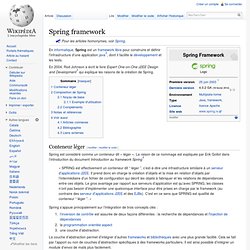
Pour les articles homonymes, voir Spring. En 2004, Rod Johnson a écrit le livre Expert One-on-One J2EE Design and Development[3] qui explique les raisons de la création de Spring. Conteneur léger[modifier | modifier le code] Spring est considéré comme un conteneur dit « léger ». La raison de ce nommage est expliquée par Erik Gollot dans l’introduction du document Introduction au framework Spring[4] « SPRING est effectivement un conteneur dit “ léger ”, c’est-à-dire une infrastructure similaire à un serveur d'applications J2EE. Spring s’appuie principalement sur l’intégration de trois concepts clés : l’inversion de contrôle est assurée de deux façons différentes : la recherche de dépendances et l'injection de dépendancesla programmation orientée aspectune couche d’abstraction. La couche d’abstraction permet d’intégrer d’autres frameworks et bibliothèques avec une plus grande facilité. Spring - Hibernate with MongoDB.
Spring Data - MongoDB. Introduction The Spring Data MongoDB project provides integration with the MongoDB document database.

Key functional areas of Spring Data MongoDB are a POJO centric model for interacting with a MongoDB DBCollection and easily writing a Repository style data access layer. Features Spring configuration support using Java based @Configuration classes or an XML namespace for a Mongo driver instance and replica sets.MongoTemplate helper class that increases productivity performing common Mongo operations. Quick Start. Build a Spring-Data project with MongoDB in under 5 minutes using Netbeans 7 and Maven. Spring-Data is a rapidly moving project and has support for many technologies such as non-relational databases, map-reduce frameworks, and cloud based data services as well as providing support for relational databases.

Today I’m going to focus on their support for MongoDB. Note: I’m going to borrow the starter code from the Spring-Data documentation. I will be changing the version from M3 to M4 however and the current Spring-Data documentation is assuming M3 (as of the date of this article) and it looks like they did some namespace changes from M3 to M4 so I’m fixing that in the code for this article. By the time you read this however the documentation on their site might be updated to M4 or newer. I am using Netbeans 7 with the Maven support to build and run the project. With Netbeans create a new Maven Java Application called: SpringDataMongoDB Modify the pom.xml to include the following new repository: We need to add one dependency to the pom.xml as well: Expected results: Migrating a Spring/Hibernate application to MongoDB - Part 1. Backgorund For the past few years ORM have been the de facto solution for bridging the gap between object oriented programming languages and relational databases.Well, most of the developers using ORM care about writing less persistence code and SQL than they care about the object-relational impedance mismatch.

As time passed and more experience gained, some people started to claim that maybe ORM is not the best solution available. Another option for storing your objects, which have been there for quite some time, are non-SQL databases. With recent explosion of non-relational databases and the NoSQL movement ("Not Only SQL") this option is becoming more and more viable. There are a lot of examples showing how to develop a new application based on a non-relational database. The application The example application is a very simple blogging engine implemented using the Spring/Hibernate (JPA) stack. Setting up and connecting to MongoDB Setting up MongoDB is a pretty simple procedure. Next part.