The WINEP crusade to discredit the Egyptian revolution. A few days ago I noted a pretty awful piece by WINEP's Robert Satloff and Eric Trager in WSJ.
But there is more: WINEP fellow Eric Trager has had more negative pieces on the Egyptian uprising, focusing on how nasty Islamists are, than anyone. His latest, published on the revolution's anniversary, is titled Happy Birthday To Egypt’s Doomed Revolution. I share Trager's concerns over the Islamist ascendency but the entire premise of many his pieces is wrong: he argues that somehow the West was fooled into thinking this was a liberal secular revolution.
It was not, and it was obvious from the start. Defending Dennis Ross. Give Stephen M.

Walt his due. After Prime Minister Benjamin Netanyahu's tense visit to Washington last month, a cowardly U.S. government official lobbed an "Israel vs. America" dual loyalty canard at my former colleague, National Security Council advisor Dennis Ross. But while he or she hid behind a cloak of journalistic anonymity shamelessly provided by Politico's Laura Rozen, Walt at least has the gumption to stand up and make his McCarthyite case in his own name. And while Rozen's muse only attacked one person's bona fides, Walt pilloried the professional credentials of several dozen of our nation's leading Middle East experts. For the record, Ross, who was a distinguished fellow at the Washington Institute for Near East Policy (WINEP) throughout George W. Of course, "McCarthyite" is a term one should be reluctant to throw around, but I can think of no more accurate word for fact-free accusations designed to smear reputations with an appeal to patriotism.
On "Dual Loyalty" (2): A Response to Robert Satloff. If you would like to read a textbook example of a dust-kicking operation, please look at Robert Satloff's heated response to my recent post explaining the problems that can arise when top-level foreign policy officials have strong attachments to a foreign country.

I seem to have struck a nerve. There are only two important issues here, and Satloff ignores both of them. First, do some top U.S. officials -- and here we are obviously talking about Dennis Ross -- have a strong attachment to Israel? Second, might this situation be detrimental to the conduct of U.S. Middle East policy? Regarding the first question, there is abundant evidence that Ross has a strong -- some might even say ardent -- attachment to Israel. Ross belongs fairly and squarely in the pro-Israel camp. Washington Institute for Near East Policy. Is Israel REALLY a "Strategic Asset?" Last week the Washington Institute of Near East Policy released a brief report entitled "Israel: A Strategic Asset for the United States.

" Such an event is not exactly headline news, insofar as the report is precisely the sort of analysis that you'd expect a "pro-Israel" think tank like WINEP to promote. What is slightly more interesting are the study's authors: Robert Blackwill and Walter Slocombe. Blackwill was formerly U.S. Ambassador to India (and a former colleague of mine here at the Kennedy School); Slocombe is a long-time Washington insider perhaps best known for helping mismanage the occupation of Iraq. Their report checks in at a modest 17 pages of large type, and it offers few arguments that experienced Middle East mavens haven't heard before. Blackwill and Slocombe (hereafter B&S) begin by rehearsing the familiar claim that the United States and Israel are bound together by shared values, and by America's "moral responsibility" to defend the Jewish state.
The answer is no. WINEP Fellow: Disingenuous To Frame Military Action Against Iran As a Simple 'Raid' By Eli Clifton on June 17, 2011 at 4:16 pm "WINEP Fellow: Disingenuous To Frame Military Action Against Iran As a Simple ‘Raid’" Jeffrey White While Iran-hawks in Washington are quick to casually throw around mentions of the “military option” or, as some call it, “the kinetic option,” many realists and military strategists have been trying to call attention to exactly what a war with Iran would entail.

WINEP official says U.S. strategy is aimed at provoking 'Pearl Harbor' that justifies war with Iran. Dennis Ross Redux: Haaretz reveals White House - WINEP hotline. Benjamin Netanyahu and Dennis Ross Last week, Haaretz’s Barak Ravid broke the story that Dennis Ross, late of the Obama administration, had never actually given up his security clearance and was still playing an outsized, and seemingly unchecked, role in advising the president.
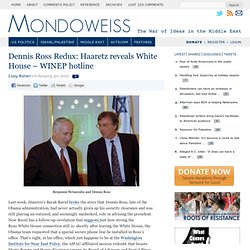
Now Ravid has a follow-up revelation that suggests just how strong the Ross-White House connection still is: shortly after leaving the White House, the Obama team requested that a special secure phone line be installed in Ross’s office. That’s right, in his office, which just happens to be at the Washington Institute for Near East Policy, the AIPAC-affiliated neocon redoubt that boasts Marty Peretz and Henry Kissinger among its Board of Advisors and Daniel Pipes among its “adjunct scholars.”
If there was ever a metaphor for the special relationship between Israel lobbyists and the White House this surely would be it. The Washington Institute for Near East Policy - Insight and Analysis on U.S. Middle East Policy. المرصد السياسي 2661 يعقوب أوليدورت و ماركوس شيف تروّج الكتب الدراسية والأدب التوجيهي لـ تنظيم «الدولة الإسلامية» الهوية السنيّة بمعناها الأصولي والحصري والتفسير السلفي للإسلام الذي يرتكز على القرآن والحديث فحسب.