
Israel in US politics. Norman Finkelstein - Political scientist - BBC HARDtalk 2012. Resources. Peter Beinart's liberal Zionist fantasy. Irvine, CA - Poor Peter Beinart.

"Liberal Zionism": A Contradiction in Terms. The comedian and filmmaker has been the smartest and funniest person in the room since he was in high school (maybe even earlier).

Here he's profiled just after making his first film. Albert Brooks’ second album, A Star is Bought, is the best comedy record most of you have probably never heart. It was never released on CD and it’s not available on ITunes.
Obama, Sarkozy are right to not believe Netanyahu. Obama and the peace process. Bill Clinton: Netanyahu isn't interested in Mideast peace deal. Democratic congressional candidate: 90% Democrat, 100% Israel. Israel bias Cantor-productive in Washington. Leave it to House majority leader Eric Cantor (R-VA).
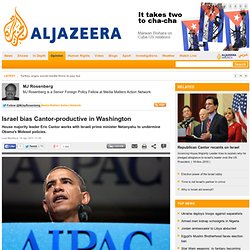
With president Barack Obama expected to deliver a major speech outlining a new (or, at least, revised) Middle East peace strategy soon, Cantor decided it was time to invite Israeli prime minister Binyamin Netanyahu to deliver a speech before a joint session of Congress. Today's borders are the 'indefensible' ones. A dangerous shift on 1967 lines - The Palestine Papers. One of the more astonishing revelations in The Palestine Papers -- detailed records and minutes of the Middle East peace process leaked to Al Jazeera -- is that the administration of US President Barack Obama effectively repudiated the Road Map, which has formed the basis of the "peace process" since 2003.

In doing so it has backed away even from commitments made by the George W. Bush administration and blown an irreparable hole in the already threadbare "two-state solution. " But even worse, the US position perhaps unwittingly opens the door to dangerous Israeli ambitions to transfer -- or ethnically cleanse -- non-Jewish Palestinian citizens of Israel in order to create an ethnically pure "Jewish state.
" Shortly after it took office in January 2009, the Obama administration publicly called on Israel to freeze all settlement construction in the occupied West Bank, including East Jerusalem. Dropping the 1967 border But this did not satisfy the Palestinians. "Two states for two peoples" Ira Chernus, The Great Israeli Security Scam.
Whiff of Desperation - By Stephen M. Walt. It is an ambassador's job to burnish his government's image; fidelity to the usual canons of logic and evidence are neither required nor expected.

The Ultimate Ally - By Michael Oren. What is the definition of an American ally?

On an ideological level, an ally is a country that shares America's values, reflects its founding spirit, and resonates with its people's beliefs. Tactically, an ally stands with the United States through multiple conflicts and promotes its global vision. From its location at one strategic crossroads, an ally enhances American intelligence and defense capabilities, and provides ports and training for U.S. forces. Its army is formidable and unequivocally loyal to its democratic government. Is Israel REALLY a "Strategic Asset?" Last week the Washington Institute of Near East Policy released a brief report entitled "Israel: A Strategic Asset for the United States.

" Such an event is not exactly headline news, insofar as the report is precisely the sort of analysis that you'd expect a "pro-Israel" think tank like WINEP to promote. What is slightly more interesting are the study's authors: Robert Blackwill and Walter Slocombe. Blackwill was formerly U.S. Ambassador to India (and a former colleague of mine here at the Kennedy School); Slocombe is a long-time Washington insider perhaps best known for helping mismanage the occupation of Iraq.
Their report checks in at a modest 17 pages of large type, and it offers few arguments that experienced Middle East mavens haven't heard before.
Aaron David Miller - Israel's Lawyer. I'm not a lawyer by training, but I know one when I see one.
For far too long, many American officials involved in Arab-Israeli peacemaking, myself included, have acted as Israel's attorney, catering and coordinating with the Israelis at the expense of successful peace negotiations. If the United States wants to be an honest and effective broker on the Arab-Israeli issue, than surely it can have only one client: the pursuit of a solution that meets the needs and requirements of both sides. The case for Israel-first advocacy is compelling. Israelis live in a dangerous neighborhood; they have only one real friend and critically important security requirements that the United States is committed to furthering. Practically speaking, Israel sits on land the Arabs want, so without Israel's trust and confidence there can be no peace process. Having worked for the past six secretaries of state on Arab-Israeli negotiations, I believe in the importance of a strong U.S.
Yet none of this is fatal. American Jews Rethink Israel. The Jewish push for peace is surging through the grassroots, but leaders and policy-makers are still turning a deaf ear.

To sort...