
‘I am an illegal alien on my own land’ The Birth of the Palestinian Refugee Problem Revisited. Morris' earlier work exposed the realities of how 700,000 Palestinians became refugees during the 1948 Arab-Israeli war.
While the focus of this edition remains the war and exodus, new archival material considers what happened in Jerusalem, Jaffa and Haifa, and how these events led to the collapse of urban Palestine. Revealing battles and atrocities that contributed to the disintegration of rural communities, the story is harrowing. The refugees now number four million and their cause remains a major obstacle to regional peace. First Edition Hb (1988): 0-521-33028-9 First Edition Pb (1989): 0-521-33889-1 "The Birth of the Palestinian Refugee Problem, a book of extraordinary power and integrity written by a young Israeli scholar and journalist, Benny Morris, takes that great tale of flight and conquest and tells it as it has never been told before: with precision and moral economy, with awesome detail and honesty. " Erasing the Nakba. Israel’s tireless efforts to conceal the historical events leading to its creation. nakba I first heard about the Nakba in the late 1980s, while I was an undergraduate student of philosophy at Hebrew University.
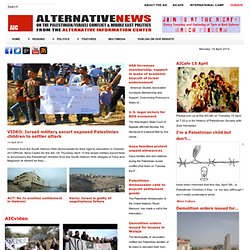
This, I believe, is a revealing fact, particularly since, as a teenager, I was a member of Peace Now and was raised in a liberal home. I grew up in the southern city of Be'er-Sheva, which is just a few kilometres from several unrecognised Bedouin villages that, today, are home to thousands of residents who were displaced in 1948. I now know that the vast majority of the Negev's Bedouin population was not as lucky, and that, in the late 1940s and early 1950s, most Bedouin either fled or were expelled from their ancestral lands to Jordan or Gaza. Despite the Nakba's immediacy, many tactics have been successfully deployed to hide its traces. At around the same time, the first intifada erupted (December 1987).
The War for Palestine. Dr Eugene L. Rogan - Academic Staff - Faculty of Oriental Studies - University of Oxford. Purchase by Other Means: The Palestine Nakba and Zionism’s Conquest of Economics. Abstract This article questions the singularity of the Palestine Nakba.
It highlights some of the historical preconditions that enabled the Nakba to occur, revealing it to have been a consolidation rather than a point of origin. The preconditions that had equipped the Zionists for settlement before they first set foot in Palestine combined economic, technological, military, cultural and moral attributes that were the cumulative outcome of centuries of Eurocolonial history. The article introduces the concept of preaccumulation to characterise this complex historical endowment that settlers imported with them. The article also argues that the donors who funded the world Zionist project differed from the speculators who financed territorial expansion in other settler colonies in that they did not require a return on their investment.
Ilan Pappe - The ethnic cleansing of Palestine. Palestine, Israel and the Internal Refugees: Essays in Memory of Edward Said. Why Jews need to talk about the Nakba. A personal journey The ruins of Lifta, a Palestinian village near Jerusalem (photo: Ester Inbar) A childhood memory: A group of kids and their teacher on a school trip. They are walking through excavations, listening to explanations from a tour guide about their ancestors who lived there two thousand years ago.
After a while, one of the kids points to some ruins between the trees. “Are these ancient homes as well?” “These are not important,” comes the answer. Growing up in the seventies and the eighties you couldn’t miss those small houses scattered near fields, between towns and Kibbuzim and in national parks. Those pieces of the local landscape are gradually disappearing – partly due to the “development” trends which have left very few corners of this country untouched, but also due to a policy that is meant to erase any memory of the people who used to live in this land.
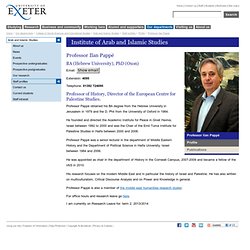
As a kid, I never gave those ruins much thought. I don’t remember if I ended up going on this trip or not. The Ethnic Cleansing of Palestine. Professor Ilan Pappé - Arab and Islamic Studies. BA (Hebrew University), PhD (Oxon) Extension: 4095 Telephone: 01392 724095.
Lila Abu-Lughod.