
Reflections By An Arab Jew - Ella Shohat. Past is Present: Settler Colonialism in Palestine (New Issue of Settler Colonial Studies) Follow Us From the Editors Don't miss Tadween Publishing Blog Mar 30 2012by Jadaliyya Reports [Cover of most recent issue of Settler Colonial Studies.
Image from ojs.lib.swin.edu.au]
Occupied by Memory: The Intifada Generation. Review "One of the best illustrations of contemporary scholars' fascination with the concept of memory as a concept closer to experience, a more human, subjective, and politically subversive notion than History.
" --Critique of Anthropology "In this fascinating ethnographic account, John Collins shows how Palestinians remember, re-shape, and reinvent in their popular imagination the first Inti-fada, or uprising, of 1987-1993. " --Middle East Journal The book will be of interest not only to scholars of the Middle East, but also to those interested in nationalism, discourse analysis, social movements and oral history.
" --Advance News "Theoretically sharp and well written, Occupied by Memory propels the scholarship on Palestinians and perpetual states of violence in new and promising directions. A History of Modern Palestine. "The Lemon Tree" by Sandy Tolan. Very few in the West can honestly claim to have been able to appraise the Israeli-Palestinian conflict from an objective point of view that takes into account nothing but the facts. In all fairness, until quite recently, it has been tricky to find complete information that was not deformed and manipulated by heavy ideological filters. Surprisingly, that same claim can be made for many who live in the heart of the land itself, neighbours to an “enemy” who has a destiny that is entwined, but without an idea of who this “enemy” is and what motivations drive him.
Our beliefs and any actions we might take regarding the conflict are influenced by the version of the story that was made available to us, often without our being aware of how simple it is to distort facts, and usually out of good faith, we in the West have accepted almost entirely the veracity of the version that is dominant in our society. Primer on Palestine, Israel and the Arab-Israeli Conflict. Contents The conflict between Palestinian Arabs and Zionist (now Israeli) Jews is a modern phenomenon, dating to the end of the nineteenth century.
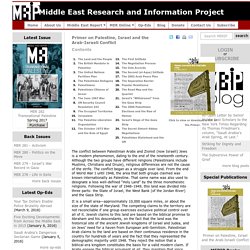
Although the two groups have different religions (Palestinians include Muslims, Christians and Druze), religious differences are not the cause of the strife. The conflict began as a struggle over land. From the end of World War I until 1948, the area that both groups claimed was known internationally as Palestine. AUB - The Origins and Evolution of the Arab-Israeli Conflict. "Occupation 101" - Essential Viewing. I always struggle to know where to point people who just want a basic background on the Palestinian-Israeli conflict.

I have reams and reams of books, websites, articles and such I can point them to, but they're either too complex, too over-simplified, too specialized, too de-personalized, assume too much knowledge, or otherwise don't really do the "101" job of explaining things with the right balance of providing sufficient information while not overwhelming. Well, I think I finally found a good one. An hour-and-a-half documentary, apparently around a year old, called Occupation 101. Click that link for the film's website and if you want to order DVDs (I'm going to have to order one). But somebody (for now at least) has also put it up on YouTube, broken up into 11 roughly 8 minute chunks. It is not an attempt to split the baby between Israelis and Palestinians. Part 1: Part 2: OCCUPATION 101 [full documentary] The Zionist Story. Israeli-Palestinian Conflict 101.
Watch this short, historically accurate animated introduction to Israel-Palestine 101: Stay informed by signing up for JVP news and action alerts: Join our online communities by following us on Facebook or Twitter. After watching this video, we highly urge you to read a more in-depth primer like Phyllis Bennis' "Understanding the Israeli-Palestinian Conflict--A Primer" downloadable here: Notes: 1) The British government's first formal proposal to partition Palestine into Jewish and Arab states - the 1937 Peel plan - envisioned "transferring" Palestinian Arabs from the proposed Jewish state. This plan was not implemented. But, from then on, Zionist military and political leaders increasingly understood that it would be necessary to "transfer" - in fact, expel - Palestinian Arabs in order to establish a Jewish state.
Scroll to bottom for downloadable primers. Adapted from the the Institute of Middle East Understanding (IMEU)'s background briefings. Palestinian Nakba: Forever a memory. Aziz Abu Sarah.
Institute for Palestine Studies - Home. DOCUMENTS COLLECTION. Documentaires. UN resolutions. Related Human rights Groups. The Partition of Palestine. The 1948 War. Comrades and Enemies. Comrades and Enemies : Zachary Lockman. MEIS > Faculty > Zachary Lockman. LRB · Edward Said · Permission to narrate. Palestine under the British mandate. Historians of the conflict.