
Should we call it apartheid? (Image: Carlos Latuff)

HSRC Democracy and Governance Programme - Occupation, Colonialism, Apartheid? To sort... UN Committee 2012 Session Concludes Israeli System Tantamount to Apartheid. Apartheid Israel: Possibilities for the Struggle Within - Uri Davis. 'We've gone way beyond Apartheid' I caught up with Jeff Halper, long time Israeli peace activist, director of the Israeli Committee Against House Demolitions (ICAHD) and author of numerous books, while he was on a European speaking tour.

Here is what he had to say about the situation in Palestine/Israel: Frank Barat: I'd like to start by talking about what's happening in Jerusalem. When I came in 2007, you took us to Silwan, explaining the huge house demolition plan the Israeli government had in mind, telling us that thanks to the efforts of many and including an intervention by the US, the demolitions didn't happen. Today, nonetheless, it looks like the demolitions will take place.
Could you give us an update on this, and also give us a broader view of what people now often refer to as the 'ethnic cleansing' of Jerusalem? Jeff Halper: Well let me give you a broader picture about the whole thing and then we can go back and put it into context. Barghouti to U.S. Jews: I know you dont like the word apartheid, but what do you call a system that gives a settler 50 times more water than a Palestinian? Mustafa Barghouti On March 26, at the J Street conference in Washington, D.C., Palestinian leader Mustafa Barghouti described apartheid in Palestine to a largely-Jewish audience.

As he spoke, you could have heard a pin drop in a room jammed with 500 people hearing about the one-state option. His comments have resonated in the weeks since. It is a marvel, and a tragedy, that this description of Palestinian conditions has not been published in America. Here is a substantial portion of his remarks. Pluto Press - Israeli Apartheid. This site uses cookies to store some basic information on your computer.

The majority of the cookies on this site are essential for the operation of the site. These cookies are set only for the length of your session on the site, contain no personal information and help us to organise which items you have viewed and which added to the shopping cart. We also use some non-essential cookies to anonymously track visitors and develop improvements to the site.
If you're not happy with this, we won't set these cookies but some nice features of the site may be unavailable.. By using our site you accept the terms of our Privacy Policy. Remove Consent about this tool About Cookie Control. New book explores Israel’s military legal system. Threat: Palestinian Political Prisoners in Israel Edited by Abeer Baker and Anat Matar The Israeli military legal system is one of the most under reported yet crucial components of Israel’s system of control over Palestinians in the occupied West Bank.
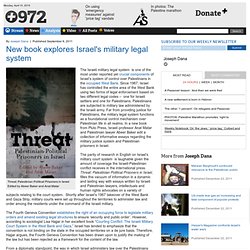
Since 1967, Israel has controlled the entire area of the West Bank using two forms of legal enforcement based on two different legal codes – one for Israeli settlers and one for Palestinians. Palestinians are subjected to military law administered by the Israeli army. Far from providing justice for Palestinians, the military legal system functions as a foundational control mechanism over Palestinian life in all realms. In a new book from Pluto Press, Israeli professor Anat Matar and Palestinian lawyer Abeer Baker edit a collection of informative essays regarding the military justice system and Palestinian prisoners in Israel. You can purchase Threat: Palestinian Political Prisoners in Israel through Pluto Press. The 8th Annual Israeli Apartheid Week 2012. Israel has 101 different types of permits governing Palestinian movement. Apartheid on Steroids. I grew up in a small town in Massachusetts where my parents headed our local synagogue, Hadassah and the United Jewish Appeal.

My first trip abroad after university, in 1962, included a week-long visit to Israel, where I was awed by its accomplishments, as well as by its vulnerability. After the Six-Day War in 1967, I basked in the courage and military prowess of my fellow Jews. The eloquence of foreign minister Abba Eban, defending his beleaguered country at the United Nations, still fills me with pride. In the years since, I’ve been a contributor and fundraiser for the UJA-Federation of New York, a governor of the American Jewish Committee, which is dedicated to fighting anti-Semitism, and a founding director of the Museum of Jewish Heritage—A Living Memorial to the Holocaust. I’ve made five additional visits to Israel since 1962, the last this summer as part of a humanitarian aid trip to East Jerusalem and the West Bank. We Recommend. Israel: an apartheid state? BISHOP DESMOND TUTU, the South African Nobel Prize winner, described how he saw on his visit to Israel "much like what happened to us black people in South Africa.

I have seen the humiliation of the Palestinians at checkpoints and roadblocks, suffering like us when young white police officers prevented us from moving about" (1). Comparisons between apartheid South Africa and Israel/Palestine have often been made, but not always clearly explained. Many factors have made the comparison attractive. The first, perhaps most important, is the historical colonialist foundation of the two conflicts. White settlers in South Africa, like Zionist pioneers, colonised a land already inhabited. However, admitting that Israel’s foundation was colonialist does not mean that it is compar able to apartheid South Africa.
White South Africans and Israelis dealt differently with the indigenous demographic reality. South Africa was different. Israel and the Apartheid Slander. Israel and the A-word. Former US president Jimmy Carter has been in deep trouble with the large, powerful and vociferous American Jewish community for his recent book Palestine: Peace Not Apartheid.

Critics have accused him of anti-semitism, plagiarism and factual inaccuracies and objected to his assertion that pro-Israel lobbyists have effectively stifled debate in the USA - but what riled them most was his use of the word "apartheid" to describe the human rights abuses committed by Israel in the occupied territories. The word is guaranteed to offend Jewish sensitivities, given Judaism's insistent teachings about justice and human rights and the prominent role played by South African Jewish activists in helping to topple that odious regime.