
After Zionism. Bean Counting States. After 9/11 more private contractors took over security responsibilities on military bases as troops headed overseas.
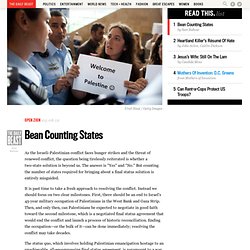
Recent veterans weigh in on the impact of that shift. The most recent catastrophe at Fort Hood has Congress asking questions: how can we prevent this from happening again? Along with talk about treating and screening for service members with mental health issues, the focus has been on the security procedures at military bases and how it might be improved. As CNN reported April 6th, lawmakers are examining how the military secure its installations, and whether current controls are sufficient.
Along with looking at physical security measures to prevent the transport of illegal firearms on base another issue being reviewed is whether the military should return to using troops to guard checkpoints, rather than the private security contractors common today. Potential changes also need to consider the impact that invasive security measures would have on morale. No Easy Answers. For Syrians displaced by their country’s war, homeless in their own land, life inside refugee camps is a desperate existence.

The refugee camp in the Turkish city of Kilis has been called “a five-star hotel.” Residents have access to electricity, playgrounds, and schools. They receive money for food, and satellite dishes adorn many of the housing units. Crime is low, and gratitude is high. Indeed, for the approximately 14,000 people living there, the Turkish government has built—in the words of the New York Times—the “perfect refugee camp.” Ever since the uprisings against Syrian President Bashar al-Assad exploded into civil war in 2011, the UN estimates (PDF) that over 9 million people have been displaced from their homes. Of the over 650,000 Syrian refugees in Turkey, only about one third are living in camps, the rest are struggling to get by and fending for themselves.
Netanyahu says “no” to the two-states solution. Netanyahu’s response to Obama expose his, and the Israeli’s center-right, true face For years, Israeli politicians used to say their actions were intended to “expose the true face of the Palestinians”; this used to be a specialty of Ehud Barak. Senior pundits spent lakes of ink on the proposition that Israel should agree to peace proposals, or even present some of its own, even though they thought there was no point in them: Doing so would expose the “true face” of the Palestinians/Arabs as peace refuseniks.
This game is over. Netanyahu and the one-state solution. Prime Minister Benjamin Netanyahu will address US legislators on Tuesday.
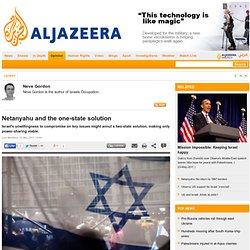
He will, no doubt, tell members of Congress that he supports a two-state solution, but his support will be predicated on four negative principles: no to Israel's full withdrawal to the 1967 borders; no to the division of Jerusalem; no to the right of return for Palestinian refugees; and no to a Palestinian military presence in the new state. The problem with Netanyahu's approach is not so much that it is informed by a rejectionist worldview. The problem is not even Netanyahu's distorted conception of Palestine's future sovereignty, which Meron Benvenisti aptly described as "scattered, lacking any cohesive physical infrastructure, with no direct connection to the outside world, and limited to the height of its residential buildings and the depth of its graves.
The airspace and the water resources will remain under Israeli control... " At this new intersection, there are two signs. 1. 2. 3. At the UN, the funeral of the two-state solution. Israel must understand it cannot be like America. Why the United States needs to press for a "two-state" solution NOW. Lots of smart people have been focusing on the Israeli elections and trying to make sense of their immediate implications for the peace process.

I can’t improve on the analyses provided by Glenn Greenwald, Yossi Alpher, Bernard Avishai, or Uri Avnery, who explain why there is little reason to be optimistic and many reasons to be worried. I want to focus on a different issue, which is likely to be more important in the long run. It's this: What do we do if a "two-state solution" becomes impossible?
Moment of Truth for Liberal Zionism. For the last ten plus years, advocates of a two-state solution in Israel/Palestine have been warning that the “window of opportunity” for a two-state solution is closing fast.
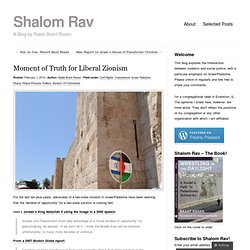
Here’s Jordan’s King Abdullah II using the image in a 2005 speech: Israelis and Palestinians must take advantage of a “small window of opportunity” for peacemaking, he warned. “If we don’t do it, I think the Middle East will be doomed, unfortunately, to many more decades of violence.” From a 2007 Boston Globe report: Zionism - perspectives... Two Peoples...One Land - Elazar. Lesch, Ann M. and Ian S. Lustick, Editors. 368 pages | 6 1/8 x 9 1/4 Cloth 2005 | ISBN 978-0-8122-3874-7 | $55.00s | £36.00 | Add to cartPaper 2008 | ISBN 978-0-8122-2052-0 | $26.50s | £17.50 | Add to cartView table of contents and excerpt "A rich resource both for scholars of migration and for anyone interested in the 'predicaments of Palestinians and Jews' because of the way it self-consciously draws parallels between the two peoples' destinies and relation to the same land.
"—Israel Studies Forum Exile and Return: Predicaments of Palestinians and Jews is a bold attempt to understand constructively and build upon the terrible irony of two peoples, each with a searing memory of displacement and exile, struggling for a return to a land each remembers, each claims, and from which each has sought to exclude the other. The contributors' work is honest and often as inspiring as it is provocative. Contributors: Elazar Barkan, Michael R. Ann M. United we stand. Now it's your turn. Why I’m Presenting at Harvard’s One-State Conference. The Harvard Kennedy School is hosting a “One State Conference” this weekend and already the usual suspects are crying foul.
Since I’m going to be speaking on a panel at the conference on Sunday, I thought it might be a good idea to weigh in with some thoughts. Mearsheimer: There will be no two-state solution, only a greater Israel, and Palestinians will need the int’l community in the coming fight against apartheid. Something you won’t see on American television: Al Jazeera ran a long piece on the peace talks (linked here at Pulse.).
"Empire" host Marwan Bishara is incisive; he speaks of the "Zionist lobby" and the emergence of a state in Kosovo with far less rigmarole than the endless peace process. His guests, on barstools in a rooftop interview in view of the White House, are Nabil Shaath of the P.A., former negotiator Rob Malley, and John Mearsheimer. Mearsheimer is unbound. He dispels Malley’s assertion that Israel can cobble together a Palestinian state. He helps to elicit from Shaath wonderful statements, including the description of Israelis as "control freaks" and the simple explanation of why Palestinians, even Fatah Palestinians, cannot recognize Israel as a Jewish state. Reflections After the Harvard One State Conference. Palestinians in line for a Qalandiya checkpoint during Ramadan, 2011.
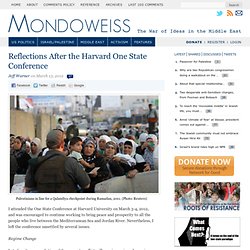
(Photo: Reuters) I attended the One State Conference at Harvard University on March 3-4, 2012, and was encouraged to continue working to bring peace and prosperity to all the people who live between the Mediterranean Sea and Jordan River. Nevertheless, I left the conference unsettled by several issues. Regime Change. The Future of Palestine: Righteous Jews vs. the New Afrikaners. John J.
Mearsheimer This is the transcript of the Hisham B. Sharabi Memorial Lecture delivered by John J. Singular Legal Regime Necessitates One-State Solution.