
The 2013 Iranian Presidential Elections: Cause for Optimism? In the 2009 Iranian presidential elections, votes were counted within a mere 6 hours after polling closed; the results were of course highly contentious, as Mahmud Ahmadinejad was re-elected under widespread suspicions of vote-rigging.
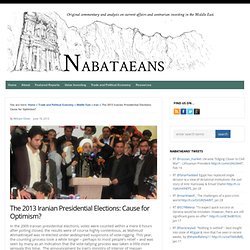
This year, the counting process took a while longer – perhaps to most people’s relief – and was seen by many as an indication that the vote-tallying process was taken a little more seriously this time. The announcement by Iran’s ministry of interior of Hassan Rouhani’s victory has been welcomed in most quarters as a progressive step for Iranian politics. Speaking recently at a Chatham House event on the implications of the 2013 presidential elections, Shahram Chubin described Rouhani as a pragmatic technocrat – a description which his fellow panellists Ali Ansari and Arshin Adib-Moghaddam were in agreement with.
Shiva Bahlagi adds some colour, observing that The results were unexpected in many quarters. Read more: Like this: Like Loading... Iran’s Man in the Middle by Haleh Esfandiari. The decisive election of Hassan Rouhani as Iran’s new president has been greeted around the world as a sign that Iranians are tired of hardline policies at home and abroad and are ready to embrace change.
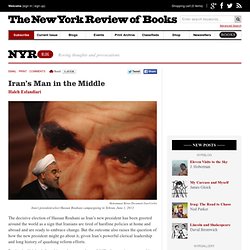
But the outcome also raises the question of how the new president might go about it, given Iran’s powerful clerical leadership and long history of quashing reform efforts. Rouhani will inherit from his predecessor a host of difficult, even insurmountable problems. In the past eight years, such limited freedoms as existed have been severely eroded. The economy is in shambles due to Western-imposed sanctions and outgoing president Mahmoud Ahmadinejad’s reckless spending and misguided policies. With few real friends, Iran is internationally isolated, and its relations with the US and the Europeans are under strain over Iran’s nuclear program, its support for Assad in Syria, and its inflammatory rhetoric on Israel. While he is considered a moderate, Rouhani comes to office as an insider. Iran After Ahmadinejad. Will the Presidential Elections “Cure the Pain” of the Iranian People?
Do not just look at the pictures of Iranians celebrating late into the night in Tehran’s streets.
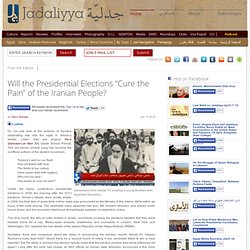
Listen, they are singing Yar-e Dabestani-ye Man [My Grade School Friend]. This old Iranian protest song has become the unofficial anthem of the student movement. Tyranny’s welt on our flesh Has not faded with time The fields of our culture Have grown wild with neglect... Who but you and I Has power to cure our pain? Unlike the highly contentious presidential elections in 2009, the morning after the 2013 elections, Tehran’s streets were mostly empty. This time round, the tally of votes trickled in slowly. Inevitably, there was conjecture about the delay in announcing the election results. As day turned to night in Tehran, the MOI announced that almost all the votes had been counted.
Soon after, Iran’s Minister of Information announced that Rouhani had won by a wide margin in an “epic election.” Within Iran’s factional politics, Rouhani traditionally had been counted among the conservatives. Iran President accuses Speaker of Parliament of Corruption, as Labor Minister is Impeached. With the Iranian presidential elections only 5 months away, Iranian politics is heating up.
Outgoing president Mahmoud Ahmadinejad on Sunday accused the family of the speaker of the Iranian parliament of corruption. In response, the speaker, Ali Larijani, accused the lame duck president of himself being corrupt, and of being linked to the terrorist group, the Mojahedin-e Khalq (MEK). Not since 1981, when President Abol Hassan Bani-Sadr was chased from office, has the presidency been the focus of regime infighting to this extent. Parliament met to vote on whether to impeach the minister of labor.
He was being accused of appointing former state prosecutor Saeed Mortezavi as head of the social security administration. Ahmadinejad thought the best defense would be a good offense. Iranian state TV gives a remarkably balanced account with video: Ahmadinejad and Larijani have a long-running feud, so this exchange was partially about out-sized political theater.