
Social media? Get serious! Understanding the functional building blocks of social media 10.1016/j.bushor.2011.01.005 : Business Horizons. Abstract Traditionally, consumers used the Internet to simply expend content: they read it, they watched it, and they used it to buy products and services.

Increasingly, however, consumers are utilizing platforms—such as content sharing sites, blogs, social networking, and wikis—to create, modify, share, and discuss Internet content. This represents the social media phenomenon, which can now significantly impact a firm's reputation, sales, and even survival. Yet, many executives eschew or ignore this form of media because they don’t understand what it is, the various forms it can take, and how to engage with it and learn.
Twitter Is Selling Your Old Tweets [REPORT] Google, Yahoo Both Fail At Moneyballing Oscar Predictions. Both Google and Yahoo used search data to create their own Oscar ballots.

Turns out, their predictions were terribly wrong. At best, Google may have correctly predicted Meryl Streep winning, depending on how you read things. But overall, neither of them really got the winners right. Google’s predictions are here; Yahoo’s here. Let’s see how they did! Best Picture Google: Extremely Loud & Incredibly Close (or The Artist, Midnight In Paris)Yahoo: War HorseWinner: The Artist What went wrong here? If the underdog trend holds this year, Extremely Loud & Incredibly Close could be our surprise winner. With Yahoo, its predictions relied on what was searched the most.
“‘War Horse’ seems to be the fan favorite, but this is a competitive category,” said Thelma Adams, contributing editor for Yahoo! Best Actor Google: George Clooney (or Gary Oldman)Yahoo: Brad PittWinner: Jean Dujardin As before with Google, it didn’t clearly come out with a single prediction. Best Actress. Neuroscience Makes Strong Case for Engagement, Personalization in Marketing. Recently, Facebook sponsored a study run by NeuroFocus -- found via Search Engine Land-- intended to quantitatively determine how people respond to websites and website ads.

The results had some interesting findings for marketers who are wondering how their site structure and ad campaigns affect how users react to their website. Let's just dive right in to those results and see what marketers can learn from their experiments. What the Study Looked At NeuroFocus used devices to measure the brainwaves of searchers when visiting websites, and looked to see if any patterns emerged. The test subjects were 50% men, 50% women, aged 21-54, and with a minimum annual household income of $30,000. The researchers were able to combine scores given for each of these responses into something called Overall Neurological Effectiveness, a composite measure of the efficiency of a test subject's cognitive processing. Interesting Findings From the Study 1.) 2.) 3.) 4.) 5.) 6.) 7.) Image credit: digitalbob8. 5 Essential Spreadsheets for Social Media Analytics.
Ann Smarty is a search marketer and full-time web entrepreneur.
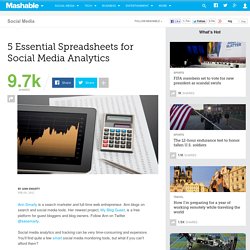
Ann blogs on search and social media tools. Her newest project, My Blog Guest, is a free platform for guest bloggers and blog owners. Follow Ann on Twitter @seosmarty. Social media analytics and tracking can be very time-consuming and expensive. You'll find quite a few smart social media monitoring tools, but what if you can't afford them? That's why many social media marketers and power users are in constant search of free, efficient alternatives. Most of the scripts that run the spreadsheets are "public," meaning you can access them from the Tools + Script Gallery menu (this also means they were reviewed and approved by Google Spreadsheets team). 1. GetTweets is a simple and fast Google Spreadsheet script that lets you quickly export Twitter search results into a spreadsheet. Increase the number of results returned — up to 1,500. Spreadsheet details: Public script? Mass Relevance « Engage Audiences Anywhere with Social Curation.
Advertisers, This Is What an NFL Fan Looks Like [INFOGRAPHIC] Just two NFL teams will remain after Sunday's league semifinals, setting up a final showdown for Super Bowl XLVI glory.
![Advertisers, This Is What an NFL Fan Looks Like [INFOGRAPHIC]](http://cdn.pearltrees.com/s/pic/th/advertisers-looks-infographic-21864472)
But the Super Bowl isn't just a huge event for the players, coaches and fans involved. It's also make-or-break time for the television advertisers who pay a premium for the right to reach an audience of more than 100 million rapt viewers. But exactly who will these advertisers target? And what will they spend to do it? The infographic below shows that sales professionals, fans of science-fiction movies and people interested in buying Sony and Vizio products are "very likely" to tune into the game. But reaching those football buffs won't come cheap — 30-second spots are expected to top out at around $3.5 million each for the 2012 Super Bowl. From 2001 to 2010, total ad spending on Super Bowls topped a reported $1.6 billion.
Check out the infographic below for more details on who makes up the Super Bowl audience and what advertisers spend to reach them. Google Code.