
Data Visualization. Synchronous or Asynchronous? How to Pick Your Training Delivery Method by Danielle Slatinsky. “A crucial step in the instructional design process is audience analysis.

We need to determine what type of training will be most beneficial to the audience, and we also need to consider practical matters such as Internet accessibility or instructor availability.” The creation of online training presents many challenges. 21 Companies Using Gamification to Get Better Business Results. Damn You Art School. Whether you’re an architect, a communication or fashion designer, an artist, an illustrator or a photographer, DYAS is for everything they never taught you in art school.

“And other cool stuff.” Launched just two and a half weeks ago, DYAS has already had a great response from the creative community, receiving a whopping 35,000 views in such a short period. Created by online portfolio platform, 4ormat, the initiative was set up as a way to give back to the creative community. “As fellow artists and designers we realised there was a lack of knowledge creatives face with respect to business enhancing resources, so we thought we'd do something about it,” 4ormat’s marketing manager, Sofija Obradovic says. Listening skills. Instructional Design.
An Overview of How to Design Instruction Using Critical Thinking Concepts. “T-shaped” instructional design process « Spark Your Interest! (Not so) Recently I commented on Twitter about my approach to professional development this year and Steve Flowers (@xpconcept) commented that it made sense in a broader application to instructional design.
Then, I saw a tweet from David Kelly (@LnDDave) who was at an #ASTD2012 conference session with Michael Allen. They were presenting their Successive Approximation Method (SAM) as a substitution for ADDIE (poor girl, everyone’s favorite whipping horse), which sounded a lot like a “T” in my mind. A short twitter exchange between Steve and myself led to this…a blog post idea. And now, hopefully a few weeks later a blog post! Logo Design Love. Use CSS To Add Stroke Around Text. With some of the new graphical features you see in CSS3 it can start to add more and more effects to your HTML elements the same way you used to have to use photoshop to do.
Things like box shadow and color gradients are now so easy to do in CSS that you don't even need photoshop anymore. Here is another CSS property that you might not realise existed but it's another effect you would normally do in Photoshop and that's adding a stroke around text, just by using the CSS property text-stroke. An Overview of How to Design Instruction Using Critical Thinking Concepts. Instructional Design. JOLT - Journal of Online Learning and Teaching. Suzanne Young University of Wyoming Laramie, WY 82071 USA syoung@uwyo.edu Mary Alice Bruce University of Wyoming Laramie, WY 82071 USA mabruce@uwyo.edu Introduction With more than 25% of the total number of students in higher education receiving instruction online and ever increasing online student numbers projected (Allen & Seaman, 2010), educators continue to identify factors that may enhance meaningful online learning.
To facilitate positive outcomes, instructors must move beyond content oriented online delivery and create a supportive learning environment that is sensitive to student needs (Herbert, 2007; Mandernach, 2009). JOLT - Journal of Online Learning and Teaching. Zvi Goldman Post University Waterbury, CT 06723 USA zgoldman@post.edu Introduction and Challenge Student engagement with instructor and peers in online education, specifically over multiple discussion group sessions, is a critical factor that contributes to student learning, satisfaction, course success, and retention (Bedi 2008; Bocchi, Eastman, & Swift, 2004; Mandernach, Dailey-Hebert, & Donnelli-Sallee, 2007).
Creative Commons. PD Summer: Understanding How the Brain Thinks (Part 1 of 4) Understanding How the Brain Works For 21st century success, now more than ever, students will need a skill set far beyond the current mandated standards that are evaluated on standardized tests.
The qualifications for success in today's ever-changing world will demand the ability to think critically, communicate clearly, use continually changing technology, be culturally aware and adaptive, and possess the judgment and open-mindedness to make complex decisions based on accurate analysis of information.
The most rewarding jobs of this century will be those that cannot be done by computers. For students to be best prepared for the opportunities and challenges awaiting them, they need to develop their highest thinking skills -- the brain's executive functions. These higher-order neural networks are undergoing their most rapid development during the school years, and teachers are in the best position to promote the activation of these circuits. The High Costs of Maintaining the Factory Model.
CourseSites's Channel El3-65-bkwds-design.pdf (application/pdf Object) 157 of the Most Useful Websites on the Internet. By admin Tuesday, June 4, 2013 Social media has become one of the popular platforms for any company to advertise their products and services.
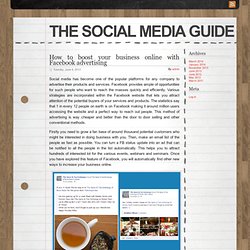
Facebook provides ample of opportunities for such people who want to reach the masses quickly and efficiently. Various strategies are incorporated within the Facebook website that lets you attract attention of the potential buyers of your services and products. The statistics say that 1 in every 12 people on earth is on Facebook making it around million users accessing the website and a perfect way to reach out people.
Firstly you need to grow a fan base of around thousand potential customers who might be interested in doing business with you. There are plenty of reasons why a normal Facebook ad fails. There are few basic ways by which the ads can get working for you.