
Edward Plunkett, 18th Baron of Dunsany. Edward John Moreton Drax Plunkett, 18th Baron of Dunsany (24 July 1878 – 25 October 1957) was an Irish writer and dramatist, notable for his work, mostly in fantasy, published under the name Lord Dunsany.
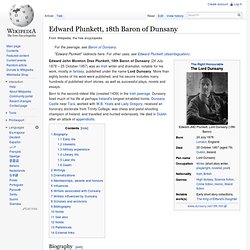
More than eighty books of his work were published, and his oeuvre includes many hundreds of published short stories, as well as successful plays, novels and essays. Born to the second-oldest title (created 1439) in the Irish peerage, Dunsany lived much of his life at perhaps Ireland's longest-inhabited home, Dunsany Castle near Tara, worked with W.B. Yeats and Lady Gregory, received an honorary doctorate from Trinity College, was chess and pistol-shooting champion of Ireland, and travelled and hunted extensively.
He died in Dublin after an attack of appendicitis. Biography[edit] His mother was a cousin of Sir Richard Burton, and he inherited from her considerable height, being 6' 4". Early life[edit] Lady Dunsany, Beatrice Child Villiers Interests[edit] Military experience[edit] Death[edit] Peter S. Beagle. Bio[edit] Beagle was born in Manhattan on April 20, 1939, the son of Rebecca Soyer and Simon Beagle.[4] Three of his uncles were noted painters, Moses, Raphael, and Isaac Soyer.
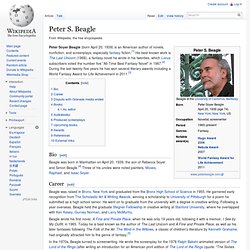
Career[edit] Beagle was raised in Bronx, New York and graduated from the Bronx High School of Science in 1955. He garnered early recognition from The Scholastic Art & Writing Awards, winning a scholarship to University of Pittsburgh for a poem he submitted as a high school senior. He went on to graduate from the university with a degree in creative writing. Beagle wrote his first novel, A Fine and Private Place, when he was only 19 years old, following it with a memoir, I See by My Outfit, in 1965. Beagle's work as a screenwriter interrupted his early career direction as a novelist, magazine nonfiction author, and short-story writer.
The Last Unicorn. Plot[edit] The story begins with a team of human hunters passing through a forest in search of game.
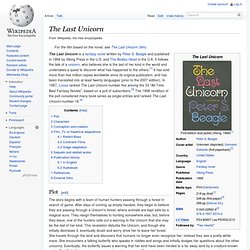
After days of coming up empty-handed, they begin to believe they are passing through a Unicorn's forest, where animals are kept safe by a magical aura. C. S. Lewis. Lewis and fellow novelist J.
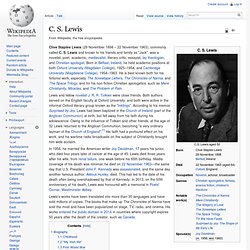
R. R. Tolkien were close friends. The Chronicles of Narnia. The Chronicles of Narnia is a series of seven high fantasy novels by author C.S.
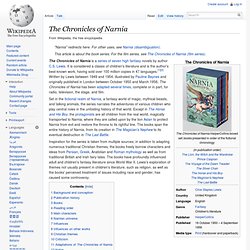
Lewis. It is considered a classic of children's literature and is the author's best-known work, having sold over 100 million copies in 47 languages.[1][2] Written by Lewis between 1949 and 1954, illustrated by Pauline Baynes and originally published in London between October 1950 and March 1956, The Chronicles of Narnia has been adapted several times, complete or in part, for radio, television, the stage, and film.
Inspiration for the series is taken from multiple sources; in addition to adapting numerous traditional Christian themes, the books freely borrow characters and ideas from Persian, Greek, Anatolian and Roman mythology as well as from traditional British and Irish fairy tales. The books have profoundly influenced adult and children's fantasy literature since World War II. Ursula K. Le Guin. Earthsea. Earthsea is a series by Ursula K.
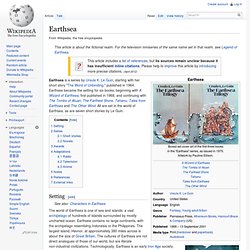
Le Guin, starting with her short story "The Word of Unbinding," published in 1964. Earthsea became the setting for six books, beginning with A Wizard of Earthsea, first published in 1968, and continuing with The Tombs of Atuan, The Farthest Shore, Tehanu, Tales from Earthsea and The Other Wind. All are set in the world of Earthsea, as are seven short stories by Le Guin. Setting[edit] A map of The Earthsea Realm originally drawn by Ursula K Le Guin and redrawn by Liam Davis. Eric Rücker Eddison. Eric Rücker Eddison, CB, CMG (24 November 1882 – 18 August 1945) was an English civil servant and author, writing under the name "E.R.
Eddison. " Biography[edit] Born in Adel, Leeds, Eddison's early education came from a series of private tutors, whom he shared with the young Arthur Ransome. Ransome recalls Eddison's daring and machiavellian methods of getting rid of unpopular teachers in his autobiography.[1] Afterwards Eddison was educated at Eton and Trinity College, Oxford and joined the Board of Trade in 1906, retiring in 1938 to work full-time on his fiction. He was also a member of the Viking Society for Northern Research.[2] During a distinguished career he was appointed a Companion of the Order of St. The Worm Ouroboros. The Worm Ouroboros is a heroic high fantasy novel by Eric Rücker Eddison, first published in 1922.
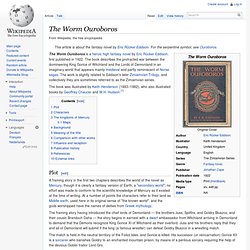
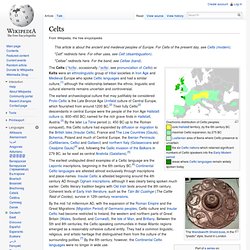
The book describes the protracted war between the domineering King Gorice of Witchland and the Lords of Demonland in an imaginary world that appears mainly medieval and partly reminiscent of Norse sagas. The work is slightly related to Eddison's later Zimiamvian Trilogy, and collectively they are sometimes referred to as the Zimiamvian series. Plot[edit] The framing story having introduced the chief lords of Demonland — the brothers Juss, Spitfire, and Goldry Bluszco, and their cousin Brandoch Daha — the story begins in earnest with a dwarf ambassador from Witchland arriving in Demonland to demand that the Demons recognize King Gorice XI of Witchland as their overlord. Juss and his brothers reply that they and all of Demonland will submit if the king (a famous wrestler) can defeat Goldry Bluszco in a wrestling match. The expedition's fleet is smashed and its army destroyed. Celts. Diachronic distribution of Celtic peoples: core Hallstatt territory, by the 6th century BC maximal Celtic expansion, by 275 BC Lusitanian area of Iberia where Celtic presence is uncertain The Celts (/ˈkɛlts/, occasionally /ˈsɛlts/, see pronunciation of Celtic) or Kelts were an ethnolinguistic group of tribal societies in Iron Age and Medieval Europe who spoke Celtic languages and had a similar culture,[1] although the relationship between the ethnic, linguistic and cultural elements remains uncertain and controversial.
The earliest undisputed direct examples of a Celtic language are the Lepontic inscriptions, beginning in the 6th century BC.[6] Continental Celtic languages are attested almost exclusively through inscriptions and place-names. Anglo-Saxon paganism. Anglo-Saxon paganism refers to the religious beliefs and practices followed by the Anglo-Saxons between the fifth and eighth centuries AD, during the initial period of Early Medieval England.
A variant of the Germanic paganism found across much of north-western Europe, it encompassed a heterogeneous variety of disparate beliefs and cultic practices.[1] Developing from the earlier Iron Age religion of continental northern Europe, it was introduced to Britain following the Anglo-Saxon migration in the mid fifth century, and remained the dominant religion in England until the Christianization of its kingdoms between the seventh and eighth centuries, with some aspects gradually blending into folklore. [citation needed] Beowulf. Beowulf (/ˈbeɪ.ɵwʊlf/; in Old English [ˈbeːo̯wʊlf] or [ˈbeːəwʊlf]) is the conventional title of an Old English epic poem consisting of 3182 alliterative long lines, set in Scandinavia, commonly cited as one of the most important works of Anglo-Saxon literature due to the fact that it is the oldest surviving epic poem of Old English and also the earliest vernacular English literature.[2] The full poem survives in the manuscript known as the Nowell Codex, located in the British Library.
Written in England, its composition by an anonymous Anglo-Saxon poet[a] is dated between the 8th[5] and the early 11th century.[6] In 1731, the manuscript was badly damaged by a fire that swept through Ashburnham House in London that had a collection of medieval manuscripts assembled by Sir Robert Bruce Cotton. Historical background[edit] Fairy. Irish mythology. Bunworth Banshee The mythology of pre-Christian Ireland did not entirely survive the conversion to Christianity.
However, much of it was preserved in medieval Irish literature, though it was shorn of its religious meanings. This literature represents the most extensive and best preserved of all the branches of Celtic mythology. Although many of the manuscripts have not survived and much more material was probably never committed to writing, there is enough remaining to enable the identification of distinct, if overlapping, cycles: the Mythological Cycle, the Ulster Cycle, the Fenian Cycle and the Historical Cycle.
There are also a number of extant mythological texts that do not fit into any of the cycles. English folklore. English folklore is the folk tradition which has developed in England over a number of centuries. Some stories can be traced back to their roots, while the origin of others is uncertain or disputed. Finnish mythology. Finnish mythology is the mythology that goes with Finnish paganism, of which a modern revival is practiced by a small percentage of the Finnish people.
It has many features shared with fellow Finnic Estonian mythology and its non-Finnic neighbours, the Balts and the Scandinavians. Some of their myths are also distantly related to the myths of other Finno-Ugric speakers like the Samis. Finnish mythology survived within an oral tradition of mythical poem-singing and folklore well into the 19th century. Although the gradual influence of surrounding cultures raised the significance of the sky-god in a monolatristic manner, the father god "Ukko" (Old Man) was originally just a nature spirit like all the others.
Mesopotamian religion. The god Marduk and his dragon Mušḫuššu Mesopotamian religion refers to the religious beliefs and practices followed by the Sumerian and East Semitic Akkadian, Assyrian, Babylonian and later migrant Arameans and Chaldeans, living in Mesopotamia (a region encompassing modern Iraq, Kuwait, southeast Turkey and northeast Syria) that dominated the region for a period of 4200 years from the fourth millennium BCE throughout Mesopotamia to approximately the 10th century CE in Assyria.[1] Mesopotamian polytheism was the only religion in ancient Mesopotamia for thousands of years before entering a period of gradual decline beginning between the 1st and 3rd centuries CE. Reconstruction[edit] As with most dead religions, many aspects of the common practices and intricacies of the doctrine have been lost and forgotten over time. History[edit] Overview map of ancient Mesopotamia. Welsh mythology. Arabian mythology. Hebridean mythology and folklore.
Norse mythology. Sumerian religion. Ancient Semitic religion. Sami religion. Animal spirits[edit] Aside from the Bear Cult, there are other animal spirits such as the Haldi who watched over nature. Scottish mythology. Greek mythology. Greek mythology is explicitly embodied in a large collection of narratives, and implicitly in Greek representational arts, such as vase-paintings and votive gifts. Continental Germanic mythology. Persian mythology. Persian mythology are traditional tales and stories of ancient origin, all involving extraordinary or supernatural beings. Druid. Witchcraft. Medea. Circe. Merlin. Aragorn. Bard. Minstrel. Crusades. Knights Templar. Paladin. Ogier the Dane. Assassins. Jack Vance. Dying Earth. Mazirian the Magician.
The Eyes of the Overworld. Philip José Farmer. Riverworld. World of Tiers. A. Merritt. John Bellairs. The Face in the Frost. Anne McCaffrey. C. L. Moore. Clark Ashton Smith. A. E. van Vogt. Coeurl. Lewis Carroll. Jabberwocky. Robert W. Chambers. Roger Zelazny. Jack of Shadows. The Chronicles of Amber. Fletcher Pratt. Gertrude Barrows Bennett. L. Sprague de Camp. Pusadian series. Tales from Gavagan's Bar. Novarian series. Harold Shea. Brian Lumley. H. Rider Haggard. Poul Anderson. Three Hearts and Three Lions.
Edgar Rice Burroughs. Barsoom. Improvisational theatre. Historical reenactment. Wuxia. Wargaming. Society for Creative Anachronism, Inc. Robert E. Howard. Conan the Barbarian. H. P. Lovecraft. J. R. R. Tolkien. The Lord of the Rings. Sources and influences on the development of Dungeons & Dragons. The Escapist : Maliszewski and “The Books That Founded D&D” Fairytale fantasy. High fantasy. Sword and sorcery. Low fantasy. Fritz Lieber. Welcome to Lankhmar Home of Fafhrd and the Gray Mouser. Fafhrd and the Gray Mouser. Michael Moorcock.
Multiverse. Elric of Melniboné. Law and Chaos. Eternal Champion.