
En école ou à la fac : le top 10 des nouvelles manières d'apprendre - Letudiant.fr. L’université de Grenoble réhabilite l’art du doute. Pour former l’esprit critique des étudiants, l’université Joseph-Fourier (UJF), à Grenoble, a dû pousser les murs.

Son cours de « Zététique & autodéfense intellectuelle »– le premier terme désignant l’art de douter – a déménagé dans l’amphithéâtre Weil au cours du premier semestre, le plus grand avec ses 900 places. Et il s’est ouvert à l’ensemble des étudiants de licence 1 et 2 des universités Grenoble-Alpes (Joseph-Fourier, Stendhal, Pierre-Mendès-France), ainsi que ceux de Sciences Po Grenoble. Au menu : décortiquer les thérapies bidon, les « pseudo-sciences » – y compris politiques –, le paranormal, les mécanismes de l’illusion, les manipulations en tout genre – des médiatiques aux sectaires –, la propagande… Ou du moins en donner des clés.
Certains étudiants ont choisi cette « unité d’enseignement transversal » dans leur cursus, d’autres assistent en auditeurs libres à ce cours-événement. Les ressources pédagogiques sont aussi mises à disposition librement en ligne. Ni cours, ni exam, ni stress… Le pari de l’université de Haute-Alsace. L’université va-t-elle faire une place à ceux qui ne veulent pas de l’université ?
C’est, en caricaturant un peu, le défi que l’université de Haute-Alsace (UHA) s’apprête à relever. Depuis le 2 février, l’établissement de Mulhouse accueille une dizaine d’étudiants dans un cursus iconoclaste. Appelée « UHA 4.0 », cette formation fondée exclusivement sur la pédagogie par projet vise à former des développeurs informatiques en trois ans avec la possibilité de décrocher une licence professionnelle. Mais l’originalité du cursus tient au fait qu’il n’y a ni cours, ni exam et donc ni stress. Vice-président délégué à l’innovation et professeur d’informatique, Pierre-Alain Muller, cheville ouvrière du projet, est parti de deux constats. MOOC on Mobiles for Development. Concluded and Certificates Distributed COL and the Indian Institute of Technology, Kanpur (IITK) ran a MOOC on mobiles for development during October 2 to November 25, 2013.
The course attracted 2,282 registrants from 116 countries. About 62 per cent of the registrants were active in the course space. A total of 333 participants were found eligible for receiving certificates of Competence (244 participants) or Participation (89). The top five countries in terms of registrants were India, Nepal, Mauritius, Grenada and South Africa. Les Mooc, la ruine de l’université ? Harvard and MIT make a compelling case for MOOCs. Harvard and MIT have released the draft of a working paper that makes a strong case for the potential benefits of massively open online courses, or MOOCs, despite low completion rates.

The paper is rich on data about their respective HarvardX and MITx courses (although they plan to release significantly more data and analysis soon) and focuses on what I think has always been a faulty focal point of many MOOC criticisms. In a free, online environment, completion rates are vastly overrated.
MOOC. UNOW - MOOC Conception. Bloom's Digital Taxonomy by Andrew Churches - Didawiki. La taxonomie DISCAS. La taxonomie de DISCAS est un effort pour regrouper, à partir de l'examen des divers programmes d'études, les diverses habiletés et attitudes sollicités chez l'élève dans l'ensemble du curriculum.
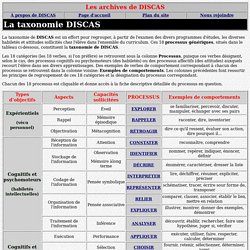
Ces 18 processus génériques, situés dans le tableau ci-dessous, constituent la taxonomie de DISCAS. Les 18 catégories (les 18 verbes, si l'on préfère) se retrouvent sous la colonne Processus, puisque ces verbes désignent, selon le cas, des processus cognitifs ou psychomoteurs (des habiletés) ou des processus affectifs (des attitudes) auxquels recourt l'élève dans ses divers apprentissages. Des exemples de verbes de comportement correspondant à chacun des processus se retrouvent dans la colonne voisine: Exemples de comportements. Les colonnes précédentes font ressortir les principes de regroupement de ces 18 catégories et la désignation du processus correspondant. Chacun des 18 processus est cliquable et donne accès à la fiche descriptive détaillée du processus en question. MobiMOOC - a MobiMOOC hello! Contents. New Test for Computers - Grading Essays at College Level. Higher ed leaders urge slow down of MOOC train. As scores of colleges rush to offer free online classes, the mania over massive open online courses may be slowing down.
Even top proponents of MOOCs are acknowledging critical questions remain unanswered, and are urging further study. Dan Greenstein, the head of postsecondary success at the Bill & Melinda Gates Foundation, now wonders aloud if MOOCs are a “viable thing or are just a passing fad.” Gates has agreed to spend $3 million for wide-reaching MOOC-related grants. But Greenstein said higher ed is suffering from “innovation exhaustion,” and MOOCs are part of the problem. “It seems to me, at least with respect to MOOCs, that we have skipped an important step,” he wrote in an Inside Higher Ed op-ed last week. Knowledge is the Water of the Mind: How to Structure Rights in “Immaterial Commons” There is a simple ethical foundation for open access to and free usage of basic resources such as air and water: the mere existence and the development of every human being depend on them.
But even fundamental ethical principles and human rights do not always prevail in real life. In history and even now, many knowledge and information resources are claimed as exclusive private property – that is, an owner has the right to exclude others from access to and usage of the property objects. But aren’t there some promising signs that history is not only, as Hegel has claimed, a development of freedom for the few to freedom for all, but also a development of the right of the few to control basic resources to the right of everyone to have such access and use? Access must be sustainable, of course; the resource cannot be allowed to be overused. Colleges Turn to Crowd-Sourcing Courses. Fuscia » partenariat Inria - Universités numériques.
Université Numérique Ingénierie et Technologie. Despite courtship Amherst decides to shy away from star MOOC provider. After months of wooing and under close scrutiny, edX was rejected this week by Amherst College amid faculty concerns about the online course provider's business plans and impact on student learning.
OpenupEd. Professor Leaves a MOOC in Mid-Course in Dispute Over Teaching - Wired Campus. Students regularly drop out of massive open online courses before they come to term.
For a professor to drop out is less common. But that is what happened on Saturday in “Microeconomics for Managers,” a MOOC offered by the University of California at Irvine through Coursera. Richard A. McKenzie, an emeritus professor of enterprise and society at the university’s business school, sent a note to his students announcing that he would no longer be teaching the course, which was about to enter its fifth week. “Because of disagreements over how to best conduct this course, I’ve agreed to disengage from it, with regret,” Mr. Mr. MOOC completion rates. École Polytechnique. MOOC ReSOP: C’est parti! A l’initiative de Pedago-TIC et d’École Numérique, ReSOP est un MOOC (Massive Open Online Course) - une formation gratuite ouverte à tous centrée sur l’apprenant et les échanges.
ReSOP – acronyme de Les Réseaux Sociaux comme Outils Pédagogiques – propose aux participants de réfléchir et participer pendant quatre semaines à l’intégration des réseaux sociaux dans les pratiques pédagogiques. MOOC - Projets ENT : Projets ENT. Features. Refondation de l'école - Mettre l’élève au cœur du système éducatif. Flip teaching. Flip teaching or a flipped classroom is a form of blended learning in which students learn new content online by watching video lectures, usually at home, and what used to be homework (assigned problems) is now done in class with teachers offering more personalized guidance and interaction with students, instead of lecturing. This is also known as backwards classroom, flipped classroom, reverse teaching, and the Thayer Method. "[1][2][3] Traditional vs flipped teaching[edit] Les MOOC changeront-ils les règles de jeu?
Dans toutes les discussion au sujet des systèmes de gestion de l'apprentissage (SGA), des ressources éducatives ouvertes (REO), des cours en ligne largement ouverts (massive open online courses, ou MOOC) et des avantages et défis de l’apprentissage en ligne, les enjeux les plus cruciaux sont peut-être ceux qui touchent la manière dont la technologie change notre façon d’enseigner et, plus important encore, la manière dont les étudiantes et étudiants apprennent. Faute d’avoir un meilleur terme pour le désigner, nous appelons cela la « pédagogie ». - Gestion de projet. The False Promise of the Education Revolution - College, Reinvented. By Scott Carlson and Goldie Blumenstyk Last year, leading lights in for-profit and nonprofit higher education convened in Washington for a conference on private-sector innovation in the industry.
The national conversation about dysfunction and disruption in higher education was just heating up, and panelists from start-ups, banking, government, and education waxed enthusiastic about the ways that a traditional college education could be torn down and rebuilt—and about how lots of money could be made along the way. The Trouble With Online College. CourseBuilderChecklist - course-builder - Checklist of all steps to create a course using Course Builder. - Course Builder.
Costs When you use Course Builder, you create your course as an App Engine application. Currently, each App Engine application can consume a certain level of computing resources for free, controlled by a set of limits. If you need resources above these free limits, you can switch to a paid app to set a daily resource budget. For more information, see Develop with App Engine. EADTU. On the territorial dimensions of MOOCs. To what degree have the territorial dimensions of Massive Open Online Courses (MOOCs) been made visible? Remarkably little, I would argue. Morgan Magnin (Centrale Nantes) : "Les MOOC permettent d'attirer les meilleurs étudiants étrangers" Internet : Tout Y est Pour Apprendre. Welcome to MRUniversity. Sessions. Sessions Registration 8:00-9:00 AM Check in and coffeeEdTech Showcase Welcome 9:00-9:15 AM. Heuristiquement. About. Khan Academy. Future Learn. Canvas Network. Canvas by Instructure. Designing a New Learning Environment. What constitutes learning in the 21st century?
Should reading, watching, memorizing facts, and then taking exams be the only way to learn? Or could technology (used effectively) make learning more interactive, collaborative, and constructive? MOOC Reviews & Ratings. Failure of a Prestigious Venture - CHECK.point-elearning.com. Failure of a Prestigious Venture Oxford, April 2006 – The AllLearn project, a consortium among Oxford, Stanford, and Yale Universities to research online learning, has come to a close. The eLearning joint venture has folded because it failed to attract enough students.
"We offered 110 online courses from Oxford, Stanford, and Yale Universities to over 10,000 participants from 70 countries during the past five years. Udacity Blog - Higher Education For Free. Higher Education News, Career Advice, Events and Jobs. Free Online Courses. Advance your College Education & Career. CourseTalk Launches A Yelp For Open Online Courses And What This Means For Higher Education. One of the most popular topics in education technology these days is the subject of MOOCs, otherwise known as “Massive Open Online Courses.” Thanks to the buzz around MOOC platforms like Coursera, Udacity and edX, there are few universities and colleges that aren’t currently struggling with whether or not they should hop on the bandwagon. Whether or not you’re long or short on MOOCs, it’s clear that, in the near term at least, they’re here to stay. However, as colleges, universities and more begin toying with open online courses and an increasing number of students and learners take to their virtual lecture halls, the signal-to-noise ratio has the potential to get pretty unfavorable.
It’s for this very reason that Jesse Spaulding decided to launch CourseTalk. 052boull.pdf (Objet application/pdf) Open University launches British Mooc platform to rival US providers. L’innovation éducative : une question économique. L'éducation paraît partout en crise. Les plus grandes écoles se posent des questions non seulement sur l'avenir de l'éducation, mais également sur comment apprendre à l'heure des nouvelles technologies.
Comme si leur intégration nécessitait de reposer en profondeur la question de l'apprentissage dans une société qui nous semble toujours plus complexe. Pourtant, les résultats de l'informatisation à l'école n'ont pas été forcément ceux attendus : comme le soulignait l'année dernière Matt Richtel dans sa série pour le New York Times. Là où il s'est installé, le numérique n'a pas eu d'effet majeur sur les résultats scolaires des élèves. 79-novembre-2012.pdf (Objet application/pdf) Comment choisir mon logiciel de mindmapping ? « Trouve ta voie ! Move Over Harvard And MIT, Stanford Has The Real “Revolution In Education” How Bill Gates' Favorite Teacher Wants to Disrupt Education. Dipity - Find, Create, and Embed Interactive Timelines.
Ça “tweete” chez les futurs directeurs. Global Perspectives on Learning and Development with Digital Video-Editing Media. Free Easy Way - Interface E-Learning. Course-builder - Course Builder. Pearltrees Visualizes How You Organize the Web. Speedernet elearning. La salle de classe planétaire. Top US universities put their reputations online. Coursera. EdX - Home. A 48 Loi du support 4.pdf. A 50 dimensions multiples d'une expèrience de formation à distance.pdf. Projet CLAIRE. CARTES MENTALES. Cartographie de controverses.