
Ngo rapes: too easy to blame the UN. There is no amount of training that can prepare you for the moment when you are in the field and a news report detailing the gang rape of nearly 200 women and four baby boys crosses your desk.

Failed state: Can DR Congo recover? 21 November 2011Last updated at 07:43 As the Democratic Republic of Congo prepares for just its second general elections in four decades on 28 November, Congolese affairs analyst Theodore Trefon considers whether this failed state, still recovering from a war which led to an estimated four million deaths, can ever be rebuilt.

People in the Democratic Republic of Congo expect very little from the state, government or civil servants. In fact, ordinary Congolese often repeat expressions like "the state is dying but not yet dead" or "the state is ever present but completely useless". It seems they also expect little from the upcoming elections and there can be little argument that DR Congo is indeed a failed state. Ordinary citizens are poor, hungry and under-informed. The government is unable to provide decent education or health services.
ADB_BD_WP_2008_142_EN_DRC%20-%20Results-Based%20CSP%202008-2012. For Next Steps in Congo, Listen to the Congolese. It’s difficult to make sense of the reactions of many Western governments and international actors to the disastrous elections in the Democratic Republic of the Congo (DRC) on November 28, 2011.

Initial responses from the United States and the European Union were muted, and Belgium later congratulated President Joseph Kabila on his reelection. As the extent of fraud and lost votes have became clearer, some governments have come out with stronger criticisms of the elections. US Secretary Clinton was “deeply disappointed,” while EU High Representative Catherine Ashton echoed Clinton’s assessment and said that the EU would “re-evaluate” its cooperation. The Congo: A Revolution Deferred. In the run-up to last November’s presidential elections in the Democratic Republic of the Congo, Cassandras were easy to find on the streets of Kinshasa.

“Ça va péter,” a parliamentarian told me, “It’s going to blow up.” It wasn’t hard to see why. Both the incumbent Joseph Kabila and his main opponent Etienne Tshisekedi toasted their victories before the polls even took place. It was clear neither was going to accept defeat. This rhetorical jousting translated into unrest on the streets. When the polls were marred by massive fraud—ballot stuffing, corrupted voter lists, “disappeared” votes—and Kabila was declared winner with 48 percent of the vote, many thought we would see large-scale unrest in Kinshasa.
And yet, it did not, or at least not in a way that would destabilize the regime. Scholars disagree on the exact ingredients that go into a strong social movement, but there is a very rough consensus on some key points that are worth repeating here. Values vs. Interests: The US and African Elections. The Democratic Republic of the Congo (DRC) held national elections beginning on 28 November 2011.
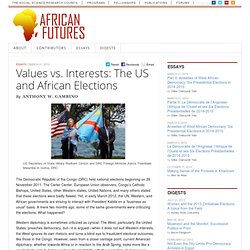
The Carter Center, European Union observers, Congo’s Catholic Bishops, United States, other Western states, United Nations, and many others stated that these elections were badly flawed. '15,000 rapes in war-torn DR Congo' - Africa. Why Humanitarian Interventions Succeed or Fail. Sites/reliefweb.int/files/resources/475F8D017EA4EC54C12572180047F70E-Tufts-Sep2006.pdf. Time to End the Congo Charade - By Jeffrey Herbst and Gregory Mills. After U.S.

Secretary of State Hillary Clinton's visit to the Democratic Republic of the Congo (DRC) this week, there is no better time to revisit a question that we posed in March on ForeignPolicy.com. There Is No Congo - By Jeffrey Herbst and Greg Mills. The international community needs to recognize a simple, albeit brutal fact: The Democratic Republic of the Congo does not exist.

All of the peacekeeping missions, special envoys, interagency processes, and diplomatic initiatives that are predicated on the Congo myth -- the notion that one sovereign power is present in this vast country -- are doomed to fail. It is time to stop pretending otherwise. Much of Congo's intractability stems from a vast territory that is sparsely populated but packed with natural resources. A mostly landlocked expanse at the heart of Africa, Congo comprises 67 million people from more than 200 ethnic groups. The country is bordered by nine others -- among them some of the continent's weakest states. A local Kiswahili saying holds, Congo is a big country -- you will eat it until you tire away! Mass Rapes in Congo Reveals U.N. Weakness. The Next Empire - Magazine. All across Africa, new tracks are being laid, highways built,ports deepened, commercial contracts signed—all on an unprecedented scale, and led by China, whose appetite for commodities seems insatiable.

Do China’s grand designs promise the transformation,at last, of a star-crossed continent? Or merely its exploitation? The author travels deep into the heart of Africa, searching for answers. Photography by the author A porter helped me with my bags as I made my way, sweating, into the train station in Dar es Salaam. Uncovering Local Perspectives on Humanitarian Assistance and Its Outcomes - Bakewell - 2002 - Disasters. Www.icrc.org/eng/assets/files/other/irrc_860_dijkzeul.pdf.