
Cryotherapy. Cryotherapy is the local or general use of low temperatures in medical therapy.

Cryotherapy is used to treat a variety of benign and malignant lesions.[1] The term "cryotherapy" comes from the Greek cryo (κρύο) meaning cold, and therapy (θεραπεία) meaning cure. Cryotherapy has been used as early as the seventeenth century. Its goal is to decrease cellular metabolism, increase cellular survival, decrease inflammation, decrease pain and spasm, promote vasoconstriction, and when using extreme temperatures, to destroy cells by crystallizing the cytosol. The most prominent use of the term refers to the surgical treatment, specifically known as cryosurgery. Other therapies that use the term are cryogenic chamber therapy and ice pack therapy. Hyperbaric gaseous cryotherapy[edit] In 1993, the company Cryonic Medical[2] developed the hyperbaric gaseous cryotherapy also called NeuroCryoStimulation or NCS that can immediately relieve pain by acting on four physiological effects :
Functional medicine. Functional medicine is a form of Western alternative medicine.[1] It is a popular modality for use by health care providers whose practice is largely within conventional medicine. [2] Functional medicine focuses on interactions between the environment and the gastrointestinal, endocrine, and immune systems of patients.

Practitioners attempt to develop individual treatment plans for each patient.[2] Functional medicine typically seeks to provide chronic care management based on the assumption that "diet, nutrition, and exposure to environmental toxins play central roles in a predisposition to illness and "provoke symptoms, and modulate the activity of biochemical mediators through a complex and diverse set of mechanisms. Functional medicine was developed and originated by Dr. Systems biology approach[edit] FMTown.com. Health freedom movement. The health freedom movement is a loose coalition of alternative medicine organizations, consumers, activists, practitioners, and producers of products who campaign for greater availability and decreased regulation of alternative remedies.

The movement is critical of the pharmaceutical industry and medical regulators, and uses the term "health freedom" as a catch phrase to convey its message. Although "health freedom" campaigners say they want a level playing field in health, skeptical voices note that they are actually engaging in special pleading and asking for lower standards of evidence and scrutiny, as they were criticized for doing in the lobbying run-up to the enactment of the United States' "Patient Protection and Affordable Care Act".[1] The skeptical website Quackwatch says of the health freedom movement: "Quacks use the concept of "health freedom" to divert attention away from themselves and toward victims of disease with whom we are naturally sympathetic.
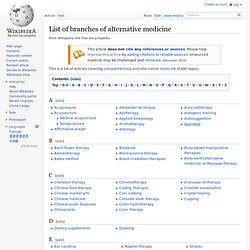
"[2] Legislation[edit] List of branches of alternative medicine. From Wikipedia, the free encyclopedia This is a list of articles covering complementary and alternative medicine (CAM) topics.
A[edit] B[edit] Traditional medicine. Traditional healer stand in an open market in Accra, Ghana Traditional medicine (also known as indigenous or folk medicine) comprises knowledge systems that developed over generations within various societies before the era of modern medicine. [citation needed] The World Health Organization (WHO) defines traditional medicine as:
Sigalon's Health/Alternative Soup. Alternative medicine. Alternative medicines may contain unsafe or toxic ingredients.
The science community is critical of alternative medicine for making unproven claims. Alternative medicine is any practice that is put forward as having the healing effects of medicine, but is not based on evidence gathered using the scientific method.[1] It consists of a wide range of health care practices, products and therapies.[2] Examples include new and traditional medicine practices such as homeopathy, naturopathy, chiropractic, energy medicine, various forms of acupuncture, Traditional Chinese medicine, Ayurvedic medicine, and Christian faith healing.
The treatments are those that are not part of the conventional, science-based healthcare system.[3][4][5][6] Complementary medicine is alternative medicine used together with conventional medical treatment in a belief, not proven by using scientific methods, that it "complements" the treatment. History of alternative medicine. "Disease Can Not Exist", October 1899 advertisement in the People's Home Journal for Weltmerism, a form of "magnetic healing" The term alternative medicine refers to systems of medical thought and practice which function as alternatives to or subsist outside of conventional, mainstream medicine.

Alternative medicine cannot exist absent an established, authoritative and stable medical orthodoxy to which it can function as an alternative. Such orthodoxy was only established in the West during the nineteenth century through processes of regulation, association, institution building and systematised medical education. Alternative medicine[edit] The concept of alternative medicine is problematic as it cannot exist autonomously as an object of study in its own right but must always be defined in relation to a non-static and transient medical orthodoxy. Before the "fringe"[edit] "Marriage à la Mode, Plate 3, (The Scene with the Quack)" by William Hogarth, 1745.