
Guitar Scale Generator. Image caption (100 characters): URL to image: Embed as HTML: Embed as BB code for message boards: Welcome to the GMC Scale Generator! With this tool it is possible to illustrate scales, give them titles and save them as images for inclusion in lessons or Forum posts. . - Use the dropdowns to find the boxes for a particular scale, or create your own just by clicking on the fretboard to add and remove notes. . - The fretboard shows the first 12 frets. . - Blue notes are "Root Notes" - a root note is the first and last note in a scale and gives us part of the name of the scale, for instance in the C Major scale, the root note is "C" - You will also notice that we only display sharps (#) and not flats (b).
As ever, if you have any questions or problems with the tool, or want to learn how to use it better, head straight over to the GMC forums! 4 Scales You Should Know. Tuesday, August 19, 2008, 1:39 139,384 views When it comes to guitar soloing, there are four scales that can be applied more often than any others.
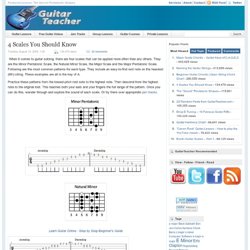
They are the Minor Pentatonic Scale, the Natural Minor Scale, the Major Scale and the Major Pentatonic Scale. Following are the most common patterns for each type. They include an easy-to-find root note on the heaviest (6th) string. These examples are all in the key of A. Practice these patterns from the lowest-pitch root note to the highest note. About the Author Storm has written 127 stories on this site. Related Content. Musically Gorgeous One Octave Arpeggio Pattern. Targeting a Mode - Turning Scales into Solos - Part 6. If there are two main points that you have, hopefully, gotten thus far in each of our “Turning Scales into Solos” series of lessons, it’s that, first and foremost, a solo should be determined by the song, by its mood, feel and chord progression.

The second idea is that a single scale is rarely the only solution to finding a way to solo over a chord progression. Getting these two thoughts into your head is essential if you want to be able to solo over any song. If the point hasn’t been driven home yet then, again hopefully, this latest installment will help you drive the point home. On the surface, this should seem easy enough. We’re going to use a simple progression of two chords and figure out what will be the best way to solo over it. Okay, our chord progression will be in four-four timing and will consist of one measure (four beats) of Dm and then one measure of G. Again, it sounds pretty simple, right? First, we might want to think about what key this progression is in. Download MP3. Improvisation Tools: Pentatonic by Gunharth Randolf. Improvisation Tools: Pentatonic 1) The "Rock Hall of Fame" Patterns With these two patterns you can nearly play all top 100 Blues and R&R licks.
(The numbers represent the fingers of your left hand.) A Minor Pentatonic For now just remember where the roots are, and especially, on what string the lowest possible root is, e.g. the root of the first pattern is on the E string and is played with the first finger. C Major Scale Pos 2 - 'Jazz' Vs 'Rock' Hi there, this week I am demonstrating C major scale, 2 fingerings for the scale which come in handy when playing certain styles of music as the title implies.

There are 5 positions of major scales but there are also 2 fingerings in each position that are very popular with guitarists and so I will show you both. The 'jazz' version has easy accessibility to the notes which is what you want when playing this pure improvisation music style. The 'rock' version enables the guitarist to play the scale rapidly which is common in many rock, hard rock and metal guitar solos. Observe the fingerings for each scale. Start and end on the red notes. And this is the "rock" fingering. Start by playing the scales ALL DOWNSTROKES. I have included an exercise for each scale to give you something to do after you have it memorized. Sweep Picking. Intervallic Techniques. Riffs.