
G-Node/nerd. TinkerGraphGraphConfiguration (Rexster 2.2.0 API) Titan. Titan is a scalable graph database optimized for storing and querying graphs containing hundreds of billions of vertices and edges distributed across a multi-machine cluster.
Titan is a transactional database that can support thousands of concurrent users executing complex graph traversals in real time. In addition, Titan provides the following features: Download Titan or clone from GitHub. Read the Titan documentation and join the mailing list. <dependency><groupId>com.thinkaurelius.titan</groupId><artifactId>titan-core</artifactId><version>1.0.0</version></dependency><! NoSQL Database Technical Overview. The Oracle NoSQL Database is a distributed key-value database.
It is designed to provide highly reliable, scalable and available data storage across a configurable set of systems that function as storage nodes. Data is stored as key-value pairs, which are written to particular storage node(s), based on the hashed value of the primary key. Storage nodes are replicated to ensure high availability, rapid failover in the event of a node failure and optimal load balancing of queries. Customer applications are written using an easy-to-use Java/C API to read and write data. Oracle NoSQL Driver links with the customer application, providing access to the data via appropriate storage node for the requested key.
News! Need help getting started. Product Overview White Papers / Presentations. NoSQL Pain? Learn How to Read/write Scale Without a Complete Re-write. Lately I've been reading more cases were different people have started to realize the limitations of the NoSQL promise to database scalability.

Note the references below: Take MongoDB for example. It's damn fast, but it doesn't really know how to save data reliably to disk. I've had it set up in a replica pair to mitigate that risk. Guess what - both servers in the pair failed and corrupted their data files at the same day. It appears that for many, the switch to NoSQL can be rather painful. NoSQL, NewSQL and Beyond. The 451 Group has published last week the conclusions of a report detailing the growing set of options in the information management space.

In the process they also clarified what they meant by "NewSQL". “NewSQL” is our shorthand for the various new scalable/high performance SQL database vendors. [...NewSQL vendors] have in common the development of new relational database products and services designed to bring the benefits of the relational model to distributed architectures, or to improve the performance of relational databases to the extent that horizontal scalability is no longer a necessity.We would include (in no particular order) Clustrix, GenieDB, ScalArc, Schooner, VoltDB, RethinkDB, ScaleDB, Akiban, CodeFutures, ScaleBase, Translattice, and NimbusDB, as well as Drizzle, MySQL Cluster with NDB, and MySQL with HandlerSocket.
The latter group includes Tokutek and JustOne DB. For Matthew Aslett, senior analyst at the 451 group, there are currently three trends in the industry: Visual Guide to NoSQL Systems - Nathan Hurst's Blog. There are so many NoSQL systems these days that it's hard to get a quick overview of the major trade-offs involved when evaluating relational and non-relational systems in non-single-server environments.
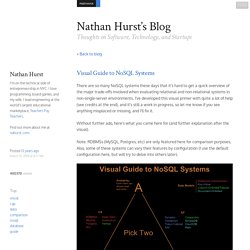
I've developed this visual primer with quite a lot of help (see credits at the end), and it's still a work in progress, so let me know if you see anything misplaced or missing, and I'll fix it. Without further ado, here's what you came here for (and further explanation after the visual). Note: RDBMSs (MySQL, Postgres, etc) are only featured here for comparison purposes.
Also, some of these systems can vary their features by configuration (I use the default configuration here, but will try to delve into others later). GraphDatabaseTinkerpop - orient - Graph Database and Tinkerpop - NoSQL document database light, portable and fast. Supports ACID Tx, Indexes, asynch queries, SQL layer, clustering, etc. Memoirs of a Graph Addict: Despair to Redemption.
Relational Graphs: What are they? Graph Databases, NOSQL and Neo4j. Introduction Of the many different datamodels, the relational model has been dominating since the 80s, with implementations like Oracle, MySQL and MSSQL - also known as Relational Database Management System (RDBMS).
NoSQL GraphDB. I received some constructive criticism regarding my previous blog in NoSQL patterns that I covered only the key/value store but have left out Graph DB.
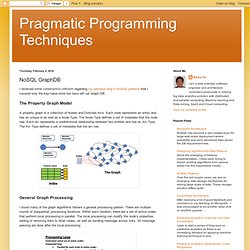
The Property Graph Model A property graph is a collection of Nodes and Directed Arcs. Each node represents an entity and has an unique id as well as a Node Type. The Node Type defines a set of metadata that the node has. Each arc represents a unidirectional relationship between two entities and has an Arc Type. General Graph Processing I found many of the graph algorithms follows a general processing pattern. This model is similar to the Google Pregel model. Notice that this model maps well into parallel computing environment where the processing of the set of active node can be spread across multiple processors (or multiple machines in a cluster) Notice that all messages from all in-coming links are arrived before the link changes within local processing. NoSQL Databases - NoSQL Databases. NOSQL Databases. Steve dekorte - projects - open source - vertexdb. TinkerPop. Performance in action.
Orient Technologies - Open source solutions built around the Orient DB. Neo4j open source nosql graph database » AllegroGraph RDFStore Web 3.0's Database. Twitter/flockdb - GitHub.