
Fun Science Games for Kids - Free Interactive Activities Online. What are the four properties of air. Science6airflight1. Properties of Air. Photo Credit: Clipart.com Purpose To demonstrate that air takes up space, and puts pressure, or pushes, on everything around it.
Context The world we live in is covered with air, called the atmosphere. Although we can't see it, the air in our atmosphere is made up of a mixture of colorless gases. In this activity students will be conducting investigations that will help them develop and refine their ideas about air. This lesson addresses some of the physical properties of air on the substance level in order to help students’ build toward future understanding of how air particles behave on a molecular level. Motivation Begin the activity by asking students to answer the following question in their science journals: What is air? Then ask the class to list things that they can think of, or see in the room, that are full of air. Do the following demonstration to illustrate that air takes up space and exerts a force. Procedure: Ask students to look at their answer to the question "What is air? " Tell Me - Why do helium balloons float? Search. Aerodynamics Experiments to Share With Your Kids.
This article teaches kids about aeronautics and gives a handful of totally fun activities to experiment with for their homeschool science learning (including helicopters, parachutes, and other flying machines).
It's also good for boy scouts working on a badge, or for any kids that love science experiments. These experiments are part of a homeschool science program that I teach, and I promise your kids will love it. Every flying thing, whether it's an airplane, spacecraft, soccer ball, or flying kid, experiences four aerodynamic primary forces: lift, weight, thrust and drag. An airplane uses a propeller or jet engine to generate thrust. The wings to create lift. The smooth, pencil-thin shape minimizes drag. Take the balsa wood airplane and try to fly just the body (no wings or fins). Helicopters Cut out a paper rectangle 5 by 2 inches. Butterfly Cups Tape two Dixie paper cups together, bottom-to-bottom.
Hot Air Balloons Shake out a garbage bag to its maximum capacity. Beginner's Guide to Aerodynamics. At this Web site you can study aerodynamics at your own pace and to your own level of interest.
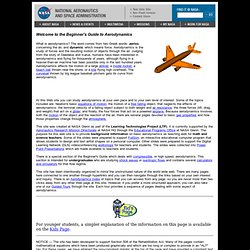
Some of the topics included are: Newton's basic equations of motion; the motion of a free falling object, that neglects the effects of aerodynamics; the terminal velocity of a falling object subject to both weight and air resistance; the three forces (lift, drag, and weight) that act on a glider; and finally, the four forces that act on a powered airplane. Because aerodynamics involves both the motion of the object and the reaction of the air, there are several pages devoted to basic gas properties and how those properties change through the atmosphere.
This site was created at NASA Glenn as part of the Learning Technologies Project (LTP). It is currently supported by the Aeronautics Research Mission Directorate at NASA HQ through the Educational Programs Office at NASA Glenn. There is a special section of the Beginner's Guide which deals with compressible, or high speed, aerodynamics. Aerodynamics.