
DIY PCB Etching at HubCityLabs. DIY PCB Etching at HubCityLabs Last night we had our Electronics Workshop #6, where we learned to etch our own PCBs.

And while DIY etched PCBs may not approach the quality of boards made at outfits like SeeedStudio, it’s great for making early prototypes as you don’t have to wait weeks. It takes less than 1 hour from printing the layout to having a fully etched board. Safety Tips Before we get started, do yourself a favour and read these safety tips: When dealing with caustic chemicals, please wear appropriate protection (Protective Eyewear, Rubber Gloves)Handle chemicals in a well ventilated areaUse Caution Board Layout Tips While it’s totally possible to etch 8 mil traces with small pads, the best results can be achieved with the following tips: Wherever possible, follow a 50mil-50mil rule.
Etching Solution Recipe For our etching solution, we decided to forgo using Ferric Chloride, and instead use a solution of Hydrochloric Acid (Muriatic Acid), and Hydrogen Peroxide: Etching Process DanyO. Cave photos by Peter Gedei over 25-year odyssey. By Nick Enoch Published: 14:59 GMT, 9 January 2013 | Updated: 15:12 GMT, 9 January 2013 While many of us would think twice before exploring the dark, dangerous caverns of the Earth's crust, for one fearless man, it is the perfect environment - and his greatest love.
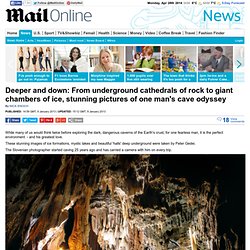
These stunning images of ice formations, mystic lakes and beautiful 'halls' deep underground were taken by Peter Gedei. The Slovenian photographer started caving 25 years ago and has carried a camera with him on every trip. Kostanjevika jama cave in Slovenia is one of the stunning scenes photographed by Peter Gedei Mr Gedei lives and works in Ljubljana and has been a member of Speleo Club Zeleznicar since 1987. The Slovenian photographer started caving 25 years ago and has carried a camera with him on every trip. Making a descent in Habeekovo brezno cave (left), and inside Kacna jama (right) one of the most famous Slovenian caves. Tackling the Ice Cave in Visevnik, Slovenia in 2010 Cavers explore Grotta Noe, near Trieste, Italy. Underworld wonder! The stunning network of chambers and caves beneath Papua New Guinea mountains. By Anna Edwards Published: 04:28 GMT, 15 November 2012 | Updated: 09:18 GMT, 15 November 2012 It's an adventure that demands explorers spend their time in the cold, wet and dark.
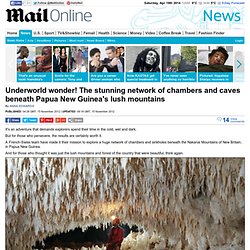
But for those who persevere, the results are certainly worth it. A French-Swiss team have made it their mission to explore a huge network of chambers and sinkholes beneath the Nakanai Mountains of New Britain, in Papua New Guinea. And for those who thought it was just the lush mountains and forest of the country that were beautiful, think again. A caver stands in a chamber of stalagmites in New Britain, Papua New Guinea Deeper underground: A man stands in a white chamber observing the stalagmites in the yawning cave A team of cavers step through the water in a cave as they explore the networks beneath the forest Is anybody there?
Don't look down: A caver abseils above a pool of water in a cave, watched by French photographer Philip Bence, who described it as an 'incredible and unforgettable adventure' Cave. A cave or cavern is a hollow place in the ground,[1][2] especially natural underground space large enough for a human to enter.

Caves form naturally by the weathering of rock and often extend deep underground. The word "cave" can also refer to much smaller openings such as sea caves, rock shelters, and grottos. Speleology is the science of exploration and study of all aspects of caves and the environment that surrounds the caves. Exploring a cave for recreation or science may be called caving, potholing, or spelunking. Types and formation[edit] The formation and development of caves is known as speleogenesis. It is estimated that the maximum depth of the cave can not be more than 3,000 metres (9,800 ft) due to the pressure of overlying rocks.[3] For karst caves the maximum depth is determined on the basis of the lower limit of karst forming processes, coinciding with the base of the soluble carbonate rocks.[4] Most caves are formed in limestone by dissolution.[5] Solutional cave[edit]