
Planetary habitability. Understanding planetary habitability is partly an extrapolation of the Earth's conditions, as this is the only planet currently known to support life.
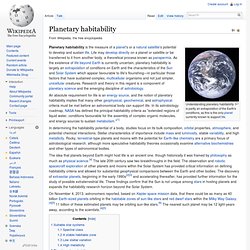
Planetary habitability is the measure of a planet's or a natural satellite's potential to develop and sustain life. Life may develop directly on a planet or satellite or be transferred to it from another body, a theoretical process known as panspermia. As the existence of life beyond Earth is currently uncertain, planetary habitability is largely an extrapolation of conditions on Earth and the characteristics of the Sun and Solar System which appear favourable to life's flourishing—in particular those factors that have sustained complex, multicellular organisms and not just simpler, unicellular creatures. Research and theory in this regard is a component of planetary science and the emerging discipline of astrobiology.
Suitable star systems[edit] Spectral class[edit] They live at least a few billion years, allowing life a chance to evolve. Terraforming. An artist's conception shows a terraformed Mars in four stages of development.
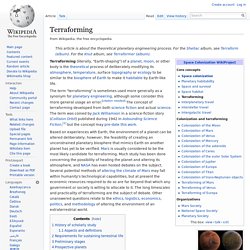
Terraforming (literally, "Earth-shaping") of a planet, moon, or other body is the theoretical process of deliberately modifying its atmosphere, temperature, surface topography or ecology to be similar to the biosphere of Earth to make it habitable by Earth-like life. The term "terraforming" is sometimes used more generally as a synonym for planetary engineering, although some consider this more general usage an error. [citation needed] The concept of terraforming developed from both science fiction and actual science.
The term was coined by Jack Williamson in a science-fiction story (Collision Orbit) published during 1942 in Astounding Science Fiction,[1] but the concept may pre-date this work. History of scholarly study[edit] In March 1979, NASA engineer and author James Oberg organized the First Terraforming Colloquium, a special session at the Lunar and Planetary Science Conference in Houston. Mars[edit] Mars Science Laboratory. Home - Mars One. Terraforming of Mars. Artist's conception of the process of terraforming Mars.

The terraforming of Mars is the hypothetical process by which Martian climate, surface, and known properties would be deliberately changed with the goal of making large areas of the environment more hospitable to human habitation, thus making human colonization much safer and more sustainable. The concept relies on the assumption that the environment of a planet can be altered through artificial means.
In addition, the feasibility of creating a planetary biosphere on Mars is undetermined. There are several proposed methods, some of which present prohibitive economic and natural resource costs, and others that may be currently technologically achievable.[1] Motivation and ethics[edit] Future population growth and demand for resources may necessitate human colonization of objects other than Earth, such as Mars, the Moon, and nearby planets. The Mars Homestead Project - Arrive, Survive, & Thrive!™
Astrobiology. Astrobiology is the study of the origin, evolution, distribution, and future of life in the universe: extraterrestrial life and life on Earth.

This interdisciplinary field encompasses the search for habitable environments in our Solar System and habitable planets outside our Solar System, the search for evidence of prebiotic chemistry, laboratory and field research into the origins and early evolution of life on Earth, and studies of the potential for life to adapt to challenges on Earth and in outer space.[2] Astrobiology addresses the question of whether life exists beyond Earth, and how humans can detect it if it does.[3] (The term exobiology is similar but more specific — it covers the search for life beyond Earth, and the effects of extraterrestrial environments on living things.)[4] Overview[edit] It is not known whether life elsewhere in the universe would utilize cell structures like those found on Earth.
The Origin and Evolution of Life in the Universe. Predicting what extra-terrestrials will be like: and preparing for the worst. 1.
Introduction ‘Astrobiology is the study of things that do not exist.’ This well-known statement can be dismissed as flippant cynicism, but one might suggest that in its vernacular way it is struggling to grasp what on earth (so to speak) we might expect to find. The Kardashev Scale – Type I, II, III, IV & V Civilization. Mass Effect citadel.
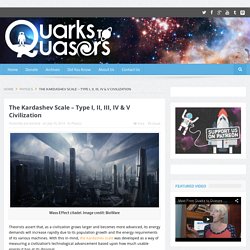
Image credit: BioWare Theorists assert that, as a civilization grows larger and becomes more advanced, its energy demands will increase rapidly due to its population growth and the energy requirements of its various machines. With this in mind, the Kardashev scale was developed as a way of measuring a civilization’s technological advancement based upon how much usable energy it has at its disposal. Credit: Chris Cold.
The Origin and Evolution of Life in the Universe. Astrobiology Web. COSPAR Home Page. Stellar engine. Stellar engines are a class of hypothetical megastructures which use a star's radiation to create usable energy.
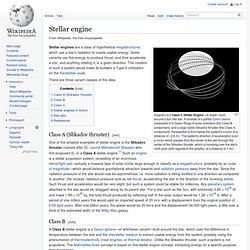
Some variants use this energy to produce thrust, and thus accelerate a star, and anything orbiting it, in a given direction. The creation of such a system would make its builders a Type-II civilization on the Kardashev scale. There are three variant classes of this idea. Class A (Shkadov thruster)[edit] Class B[edit] Astrobiology: The Living Universe - Main Page. Astrobiology: The Living Universe is the web's premiere educational resource for astrobiology, featuring in-depth information and interviews on exobiology, planetary biology, the origins of life and human spaceflight.

Our site doesn't end with that however - every single page within this website is also available in an enhanced PDF printable format and we have a network of forums and interactive applets as well as a number of Flash animations. Find out more about the Living Universe >> 30/1/01: We're finally back, and we're working flat-out to update every single page within this website, and not just that but also to ensure that no page is more than one month out of date. 16 of the updated articles are now online, and soon you'll be able to know that you're reading the most comprehensive and up-to-date source of information on Astrobiology on the entire Internet.
Expect further news soon... Kardashev scale. The Kardashev scale is a method of measuring a civilization's level of technological advancement, based on the amount of energy a civilization is able to utilize.
The scale has three designated categories called Type I, II, and III. A Type I civilization uses all available resources on its home planet, Type II harnesses all the energy of its star, and Type III of its galaxy. The scale is only hypothetical, but it puts energy consumption in a cosmic perspective. Type 1. Multiverse. Brian Greene: Is our universe the only universe?
Drake equation. The Drake equation is a probabilistic argument used to estimate the number of active, communicative extraterrestrial civilizations in the Milky Way galaxy.
The equation was written in 1961 by Frank Drake not for purposes of quantifying the number of civilizations,[1] but intended as a way to stimulate scientific dialogue at the world's first SETI meeting, in Green Bank, West Virginia. The equation summarizes the main concepts which scientists must contemplate when considering the question of other radio-communicative life.[1] The Drake equation has proved controversial since several of its factors are currently unknown, and estimates of their values span a very wide range.
This has led critics to label the equation a guesstimate, or even meaningless. History[edit] In September 1959, physicists Giuseppe Cocconi and Philip Morrison published an article in the journal Nature with the provocative title "Searching for Interstellar Communications. We could spot alien civilizations from the light of their cities. Idées du nombre d'Exoplanètes découvertes. The Possibility of Alien Life Is Now (Almost) Impossible to Deny. Big Picture Science. Planetary Habitability Laboratory @ UPR Arecibo. L'Encyclopédie des Planètes Extrasolaires. Kepler's Exoplanets Visualized. Super-Earths? Hot-Jupiters? Habitable zones, sun-like stars, Earth-like planets?
Astronomers Have Found the First Earth-Sized, Habitable Zone Planet. Cosmoquest. The Planetary Society. Les exoplanètes. NSRC 2012. Exopolanets.jpg (Image JPEG, 1920x1280 pixels) - Redimensionnée (63%) Exoplanet Atlas full of errors – VisualJournalism. When you do graphics for print in Wired – and then post on your blog about the process – stressing how much attention you pay to the details, then you’re asking for it.
Sorry, David McCandless … (Click the graphic for full-size at Wired and read the blogpost at information is beautiful here) Your Exoplanet Atlas is full of errors. According to your own description, you have three designers and three researchers working on the project for nine months doing 26 drafts, and yet it takes only a very simple check-up to realize, that this Atlas is not to be trusted. My advice – Get a proofreader with infographic knowledge and hopefully you’ll put out an error-free graphic next time. I’m sure you’ll agree, that information not only has to be beautiful – it also has to be correct: 1. 2. 3. Space Colonization. Space colonization (also called space settlement, or extraterrestrial colonization) is permanent human habitation that is not on Earth. Many arguments have been made for space colonization. Welcome to the NASA Exoplanet Archive. Les exoplanètes de Kepler réunies. Cette simulation regroupe les quelque 2 229 candidats exoplanètes découvertes par le satellite américain Kepler autour d'une étoile de la taille du Soleil (cette liste exclut les faux positifs avérés et les planètes en orbite autour de deux étoiles).
Ces planètes ont été mises à l'échelle par rapport au rayon de leur étoile hôte (le rayon orbital et la taille d'une planète dont l'étoile est n fois plus petite que le Soleil sont agrandis d'un facteur n). Leur couleur correspond à leur température estimée, qui varie de -110 à 4500 °C (du bleu vers le rouge). Les orbites des planètes internes du Système solaire – Mercure, Vénus, la Terre et Mars – sont visibles à mesure que le champ s'élargit. Presque toutes les candidates se situent à l'intérieur de l'orbite de Mercure ! What our civilization needs is a billion-year plan. Artist’s concept of a Kardashev Type 2 civilization (credit: Chris Cold) Lt Col Garretson — one of the USAF’s most farsighted and original thinkers — has been at the forefront of USAF strategy on the long-term future in projects such as Blue Horizons (on KurzweilAI — see video), Energy Horizons, Space Solar Power, the AF Futures Game, the USAF Strategic Environmental Assessment, and the USAF RPA Flight Plan.
Now in this exclusive to KurzweilAI, he pushes the boundary of long-term thinking about humanity’s survival out to the edge … and beyond. — Ed. Odyssespace: l'astronomie sous toutes ses formes. Largest-Ever Simulation of the Universe Revealed. Back in 1970, Jim Peebles at Princeton University carried out a ground-breaking experiment. He used the new-fangled technology of computing to simulate the behaviour of a cluster of galaxies under the force of gravity. This simulation was tiny by modern standards: it involved just 300 ‘particles’. Embryo space colonization. Self-replicating spacecraft. The idea of self-replicating spacecraft has been applied — in theory — to several distinct "tasks". Living Universe Foundation. Space News From SpaceDaily.Com. The Future. Headlines. Extraterrestrial Life. The official U.S. government position on extraterrestrial life and the three major efforts to search for it. Noogenesis. Ancient astronauts. Ancient astronauts or ancient aliens[1] is a pseudo-scientific hypothesis that posits intelligent extraterrestrial beings have visited Earth and made contact with humans in antiquity and prehistory.[2] Proponents suggest that this contact influenced the development of human cultures, technologies, and religions.
A common claim is that deities from most, if not all, religions are actually extraterrestrial in nature, and that such visitors' advanced technologies were wrongly understood by primitive men as evidence of divine status.[3][4] Proposers subscribing to the resultant paleocontact hypothesis proposal have popularized, particularly in the latter half of the 20th century, include Erich von Däniken, Giorgio A. BuildTheEnterprise. 100 Year Starship™ Stanford torus. Actualités. Dyson Spheres: The Ultimate Energy Shell Game. STANTRUS.jpg (Image JPEG, 1600x1190 pixels) - Redimensionnée (67%)