
Rethinking e-Learning by Clark N. Quinn : Learning Solutions Mag. “The opportunity we now have is to use technology to move from an event-based learning model that we know to be ineffective, to a more distributed and contextualized environment that elegantly spans the continuum from formal learning to performance support.
And this is not science fiction – we have the tools we need now. Even if we didn’t, we should be preparing our thinking for this capability.” LMS is no longer the centre of the universe. OK, so here’s the deal – if learning is work and work is learning, why is organizational learning controlled by a learning management systems (LMS) that isn’t connected to the work being done in the enterprise?
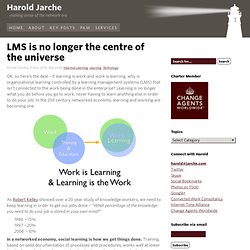
Learning is no longer what you do before you go to work, never having to learn anything else in order to do your job. In the 21st century networked economy, learning and working are becoming one. As Robert Kelley showed over a 20 year study of knowledge workers, we need to keep learning in order to get our jobs done – “What percentage of the knowledge you need to do your job is stored in your own mind?”
In a networked economy, social learning is how we get things done. Training, based on solid documentation of processes and procedures, works well at lower levels of complexity and we can develop best practices. What is the future of the LMS? - Social Media In Learning - Inte. Teaching the Facebook Generation. Our goal as college professors is to open studentsâ minds to new experiences so they can grow intellectually while they mature through the traditional four-year process.

But we are also challenged to give students the immediate skills they will need once they graduate so that they can begin their professional careers and move away from the fry-o-later to the cubicle and beyond. Over the past decade, there has been a sea change in the marketplace demands for graduates.