
Liberals often blame mass incarceration on the war on drugs. That’s not quite right. It’s a fact that may surprise many liberals: Mass incarceration is a result of way more than the war on drugs.
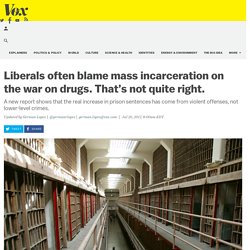
Over the past few years, long prison sentences for low-level drug offenses have gotten a lot of attention in the media and the public for contributing to higher incarceration rates. But a new report by the Urban Institute suggests it's not these low-level sentences that really helped cause higher imprisonment rates in the US, but rather sentences for violent crimes like murder.
The Myth of Deterrence. Michael Moore Goes to Norway & Visits a Prison of the Future. Breaking the Addiction to Incarceration: Weekly Highlights. Today, the U.S. has the highest incarceration rate of any country in the world.

With over 2.3 million men and women living behind bars, our imprisonment rate is the highest it’s ever been in U.S. history. And yet, our criminal justice system has failed on every count: public safety, fairness and cost-effectiveness. Across the country, the criminal justice reform conversation is heating up. Each week, we feature our some of the most exciting and relevant news in overincarceration discourse that we’ve spotted from the previous week. Check back weekly for our top picks. Mass Incarceration and Criminal Justice in America. A prison is a trap for catching time.
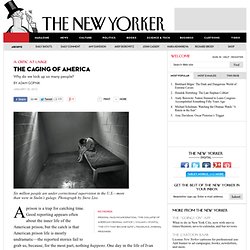
Good reporting appears often about the inner life of the American prison, but the catch is that American prison life is mostly undramatic—the reported stories fail to grab us, because, for the most part, nothing happens. One day in the life of Ivan Denisovich is all you need to know about Ivan Denisovich, because the idea that anyone could live for a minute in such circumstances seems impossible; one day in the life of an American prison means much less, because the force of it is that one day typically stretches out for decades. It isn’t the horror of the time at hand but the unimaginable sameness of the time ahead that makes prisons unendurable for their inmates. The inmates on death row in Texas are called men in “timeless time,” because they alone aren’t serving time: they aren’t waiting out five years or a decade or a lifetime.
America_s_One_Million_Nonviolent_Prisoners.pdf (application/pdf Object) US Has the Most Prisoners in the World. WASHINGTON - Tough sentencing laws, record numbers of drug offenders and high crime rates have contributed to the United States having the largest prison population and the highest rate of incarceration in the world, according to criminal justice experts. A U.S. Justice Department report released on November 30 showed that a record 7 million people -- or one in every 32 American adults -- were behind bars, on probation or on parole at the end of last year.
Of the total, 2.2 million were in prison or jail. According to the International Centre for Prison Studies at King's College in London, more people are behind bars in the United States than in any other country. China ranks second with 1.5 million prisoners, followed by Russia with 870,000. The U.S. incarceration rate of 737 per 100,000 people in the highest, followed by 611 in Russia and 547 for St.
Prisoners per capita statistics - Countries compared. Citation "All countries compared for Crime > Prisoners > Per capita", International Centre for Prison Studies - World Prison Brief.
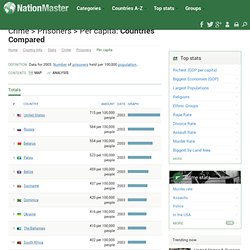
Aggregates compiled by NationMaster. Retrieved from "All countries compared for Crime > Prisoners > Per capita, International Centre for Prison Studies - World Prison Brief. Aggregates compiled by NationMaster. " 2003 'All countries compared for Crime > Prisoners > Per capita, International Centre for Prison Studies - World Prison Brief. "All countries compared for Crime > Prisoners > Per capita", International Centre for Prison Studies - World Prison Brief. America Has Become Incarceration Nation. December 21, 2006 | Like this article?

Join our email list: Stay up to date with the latest headlines via email. [Infographic] Combating Mass Incarceration - The Facts. June 17, 2011 The war on drugs has helped make the U.S. the world's largest incarcerator.
![[Infographic] Combating Mass Incarceration - The Facts](http://cdn.pearltrees.com/s/pic/th/infographic-incarceration-25972060)
America’s criminal justice system should keep communities safe, treat people fairly, and use fiscal resources wisely. But more Americans are deprived of their liberty than ever before - unfairly and unnecessarily, with no benefit to public safety. The prison industry in the United States: big business or a new form of slavery? Human rights organizations, as well as political and social ones, are condemning what they are calling a new form of inhumane exploitation in the United States, where they say a prison population of up to 2 million – mostly Black and Hispanic – are working for various industries for a pittance.
For the tycoons who have invested in the prison industry, it has been like finding a pot of gold. They don’t have to worry about strikes or paying unemployment insurance, vacations or comp time. All of their workers are full-time, and never arrive late or are absent because of family problems; moreover, if they don’t like the pay of 25 cents an hour and refuse to work, they are locked up in isolation cells. Plantations, Prisons and Profits. That paragraph opens a devastating eight-part series published this month by The Times-Picayune of New Orleans about how the state’s largely private prison system profits from high incarceration rates and tough sentencing, and how many with the power to curtail the system actually have a financial incentive to perpetuate it.
The picture that emerges is one of convicts as chattel and a legal system essentially based on human commodification. First, some facts from the series: • One in 86 Louisiana adults is in the prison system, which is nearly double the national average. • More than 50 percent of Louisiana’s inmates are in local prisons, which is more than any other state. The next highest state is Kentucky at 33 percent. Louisiana Incarcerated - NOLA.com. Alabama Agriculture Department Advances Plan to Replace Immigrant Workers With Prisoners. The Economics of Incarceration. Nile BowieActivist Post For anyone paying attention, there is no shortage of issues that fundamentally challenge the underpinning moral infrastructure of American society and the values it claims to uphold.
Private Prison Corporation Offers Cash In Exchange For State Prisons. As state governments wrestle with massive budget shortfalls, a Wall Street giant is offering a solution: cash in exchange for state property.

Prisons, to be exact. Corrections Corporation of America, the nation's largest operator of for-profit prisons, has sent letters recently to 48 states offering to buy up their prisons as a remedy for "challenging corrections budgets. " In exchange, the company is asking for a 20-year management contract, plus an assurance that the prison would remain at least 90 percent full, according to a copy of the letter obtained by The Huffington Post. The move reflects a significant shift in strategy for the private prison industry, which until now has expanded by building prisons of its own or managing state-controlled prisons. It also represents an unprecedented bid for more control of state prison systems.
Corrections Corporation has been a swiftly growing business, with revenues expanding more than fivefold since the mid-1990s. Banking on Bondage: Private Prisons and Mass Incarceration, Profit and Loss. November 2, 2011 Executive Summary The imprisonment of human beings at record levels is both a moral failure and an economic one — especially at a time when more and more Americans are struggling to make ends meet and when state governments confront enormous fiscal crises. This report finds, however, that mass incarceration provides a gigantic windfall for one special interest group — the private prison industry — even as current incarceration levels harm the country as a whole. Private Prisons. Private Prisons, Politics & Profits By Edwin Bender Early the morning of Aug. 12, 1999, Tennessee Gov. Don Sundquist took the podium at the 26th annual meeting of the American Legislative Exchange Councilto welcome attendees to Nashville.
It was an intimate affair of some 2,700 in total, including a large number of lawmakers, state and national, gathered to discuss governing and public policy. Private Prisons Conflict With The Values of a Democracy « Nisqually Jail Impact. The Issues of locking up inmates for profit examined in the academic study Prisons, Privatization, and Public Values. The critical decision to transfer jail management from public to private hands has been done very quietly in Thurston County. It is a big decision with the following issues. Opponents of private prisons argue that their incentive to cut costs to maximize profits presents a threat to the safety of prisoners, prison staff, and the public at large.
They argue that private prisons tend to have fewer guards with less experience, which results in an increased rate of violent incidents behind bars. One study found violent incidents to be as much as 50% more frequent in private prisons (Greene, 2001). The Return Of Debtor's Prisons: Thousands Of Americans Jailed For Not Paying Their Bills. By Marie Diamond on December 13, 2011 at 5:20 pm. 2 US Judges Plead guilty to selling children to private prisons! The High Bugetary Cost of Incarceration. Raise the Crime Rate. Is it true that living in America has become riskier?