
The 13 Most Important Numbers in the Universe - James D. Steins Cosmic Numbers. In the 17th century, scientists understood three phases of matter—solids, liquids and gases (the discovery of plasma, the fourth phase of matter, lay centuries in the future).
Back then, solids and liquids were much harder to work with than gases because changes in solids and liquids were difficult to measure with the equipment of the time. So many experimentalists played around with gases to try to deduce fundamental physical laws. Robert Boyle was perhaps the first great experimentalist, and was responsible for what we now consider to be the essence of experimentation: vary one or more parameter, and see how other parameters change in response. It may seem obvious in retrospect, but hindsight, as the physicist Leo Szilard once remarked, is notably more accurate than foresight. Lo ultimo en fisica cuantica 1de6.avi.
Teoría de cuerdas. La teoría de cuerdas es un modelo fundamental de física teórica que básicamente asume que las partículas materiales aparentemente puntuales son en realidad "estados vibracionales" de un objeto extendido más básico llamado "cuerda" o "filamento".
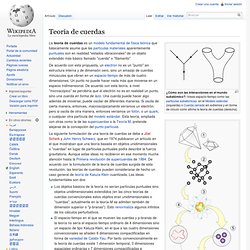
De acuerdo con esta propuesta, un electrón no es un "punto" sin estructura interna y de dimensión cero, sino un amasijo de cuerdas minúsculas que vibran en un espacio-tiempo de más de cuatro dimensiones. Un punto no puede hacer nada más que moverse en un espacio tridimensional. De acuerdo con esta teoría, a nivel "microscópico" se percibiría que el electrón no es en realidad un punto, sino una cuerda en forma de lazo.