Fukushima
< Financial crisis
Get flash to fully experience Pearltrees
Thursday, Sep. 29, 2011 Radioactive soil and vegetation that must be removed in Fukushima and four adjacent prefectures could reach up to 28.79 million cu. meters, equal to filling the Tokyo Dome 23 times, according to a recent Environment Ministry estimate. But finding a disposal or temporary storage site will be a tall order. The estimate covers soil and dead leaves mainly from areas with radiation levels of more than 5 millisieverts per year in the prefectures of Fukushima, Miyagi, Yamagata, Tochigi and Ibaraki, whose data were used to mete out the rough figures. In Fukushima, home of the nuclear plant leaking all the radiation, about 17.5 percent of the prefecture is contaminated to that level.
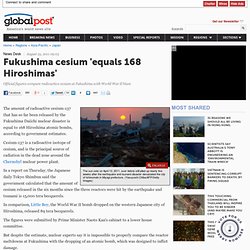
The amount of radioactive cesium-137 that has so far been released by the Fukushima Daiichi nuclear disaster is equal to 168 Hiroshima atomic bombs, according to government estimates. Cesium-137 is a radioactive isotope of cesium, and is the principal source of radiation in the dead zone around the Chernobyl nuclear power plant. In a report on Thursday, the Japanese daily Tokyo Shimbun said the government calculated that the amount of cesium released in the six months since the three reactors were hit by the earthquake and tsunami is 15,000 tera becquerels. But despite the estimate, nuclear experts say it is impossible to properly compare the reactor meltdowns at Fukushima with the dropping of an atomic bomb, which was designed to inflict damage.