
Character. Compare. Past and Present. Erik Erikson. Although Erikson lacked even a bachelor's degree, he served as a professor at prominent institutions such as Harvard and Yale.
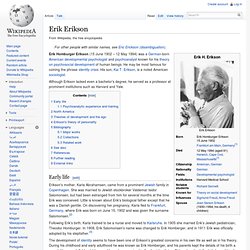
Early life[edit] Erikson's mother, Karla Abrahamsen, came from a prominent Jewish family in Copenhagen. She was married to Jewish stockbroker Valdemar Isidor Salomonsen, but had been estranged from him for several months at the time Erik was conceived. Little is known about Erik's biological father except that he was a Danish gentile. On discovering her pregnancy, Karla fled to Frankfurt, Germany, where Erik was born on June 15, 1902 and was given the surname Salomonsen.[2] Following Erik's birth, Karla trained to be a nurse and moved to Karlsruhe. At Das Humanistisch Gymnasium his main interests were art, history and languages, but he lacked interest in school and graduated without academic distinction.[5] After graduation, instead of attending medical school, as his stepfather had desired, he attended art school in Munich, but soon dropped out.
Bibliography[edit] Meet the cast - Punk Rock. Contrasting shootings. Why? Diary. Identity crisis. Identity crisis, according to psychologist Erik Erikson, is the failure to achieve ego identity during adolescence.[1][2] Erikson coined the term.
The stage of psychosocial development in which identity crisis may occur is called the Identity Cohesion versus Role Confusion stage. During this stage (adolescence), we are faced with physical growth, sexual maturation, and integrating our ideas of ourselves and about what others think of us.[3] We therefore form our self-image and endure the task of resolving the crisis of our basic ego identity.
Successful resolution of the crisis depends on one’s progress through previous developmental stages, centering on issues such as trust, autonomy, and initiative.[4] Concept[edit] Those who emerge from the adolescent stage of personality development with a strong sense of identity are well equipped to face adulthood with confidence and certainty. Erikson's own interest in identity began in childhood.
See also[edit] References[edit] Bibliography[edit] The characters in punk rock are so miss matched, so why stay together? Punk Rock. Simon Stephens. Simon Stephens (born Manchester, 6 February 1971) is an award-winning English playwright.
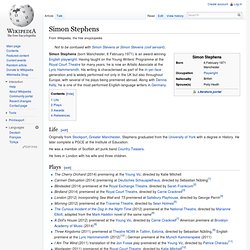
Having taught on the Young Writers' Programme at the Royal Court Theatre for many years, he is now an Artistic Associate at the Lyric Hammersmith. His writing is characterised as part of the in-yer-face generation and is widely performed not only in the UK but also throughout Europe, with several of his plays being premiered abroad. Along with Dennis Kelly, he is one of the most performed English-language writers in Germany. Life[edit] Originally from Stockport, Greater Manchester, Stephens graduated from the University of York with a degree in History. He was a member of Scottish art punk band Country Teasers. Punk Rock at Birmingham Repertory Theatre. William Carlisle.

The world at his feet. Its weight on his shoulders. Peterviney.files.wordpress.com/2010/09/351_eventimage2.jpg. Static.guim.co.uk/sys-images/Arts/Arts_/Pictures/2009/9/10/1252591254710/Punk-Rock-at-the-Lyric-Ha-001.jpg. Www.citylife.co.uk/img/17532/35582_tom_sturridge_henry_lloydhughes_and_sophie_wu_in_punk_rock.jpg.
Www.birmingham-rep.co.uk/files/images/applicationfiles/395.674c0/676x400.fitandcrop.jpg. 3.bp.blogspot.com/_x2EomzF9eM0/TJhwRA0wjVI/AAAAAAAAAew/9vEGzjQN9VE/s1600/punk%2Brock.jpg. Punk Rock (play) In the library of a grammar school, seven sixth-formers are preparing for their mock-A Levels and nearing the end of their school lives.

There are various sub-plots detailing the various love lines or triangles that emerge through the play. Some critics have criticised Stephens for unoriginality, however. For example, Leo Benedictus, writing for the guardian in 2009, said "The critics spot various possible influences such as The History Boys, Another Country, Lord of the Flies, Elephant, If…, Skins, and The Catcher in the Rye. "[10] Punk Rock inspired Identity Crisis, a drama and philosophy project, exploring the play's themes with young people in London and Manchester.[13] Punk Rock is frequently used in Drama education in sixth form in England, as well as a few other places around the world. Punk rock. Punk rock (or simply punk) is a rock music genre that developed between 1974 and 1976 in the United States, United Kingdom, and Australia.
Rooted in garage rock and other forms of what is now known as protopunk music, punk rock bands eschewed perceived excesses of mainstream 1970s rock. Punk bands typically use short or fast-paced songs, with hard-edged melodies and singing styles, stripped-down instrumentation, and often political, anti-establishment lyrics. Punk embraces a DIY ethic; many bands self-produced recordings and distributed them through informal channels.
Characteristics.